Does the word that just popped into your head show up here? Find out:

Showing posts with label compost. Show all posts

30 December, 2012

Green Tree?


Every year before Christmas, newsrooms in cruise mode revive the great Real Tree vs Plastic Tree debate. Every year as Hannukah kicks off, my college room-mate attempts to understand why so many goy insist on killing a fir tree every year. After all, Jesus only killed a fig tree (Matthew 21:18-22), and didn't do it again every year.

In terms of appeal, fake trees win only among the extremely fastidious and the lazy, for whom cleaning up a few needles is too much of an imposition, so the articles in recent years have often focused on the environmental aspect of the debate. Initially, the ersatz Tannenaum contingent had the upper hand, asserting that cutting a tree down every year damaged forests, whereas plastic trees last forever. 


But nearly all live (then dead) trees now come from farms like this one, just outside of Olympia. People like me come and cut trees, and the farmer plants more. A recent study shows that if the tree farmers don't kill the groundcover plants between trees, such farms are good for carbon sequestration--not as good as a forest, but still significantly better than fields of annual crops or pasture lands (and bonus: no cattle farts), which is what most Christmas tree farms were previously.

In my case--recognizing that this will not be true in all parts of the country--there's the added benefit that the round trip to get the tree consumed less than a gallon of gas. Plus, I'm supporting the local economy, helping a farmer make ends meet, and helping forestall the loss of farmland to development. Because this is an ongoing operation, new trees replacing old every year, it's a relatively stable habitat for birds, deer, and other critters that like something between grassland and forest. No, it's not pristine, but it has some ecological value, and it beats the hell out of a lot of the alternatives.

Meanwhile, fake trees are made of petrochemicals and metal ripped from the earth, processed in factories that consume more oil and create toxic waste, packaged in cardboard boxes (killing trees! the horror) and more plastic, and shipped from China the trucked to your locality. The carbon footprint is large, and the sequestration value zero. If these trees lasted forever, the footprint might be amortized, but fake trees make their way into landfills, not from generation to generation. 

[A Digression: The same goes for ornaments on the tree. If you are stingy and nostalgic like I was this year, then you have ornaments that have somehow stayed out of landfills for decades. A bunch are made from Christmas cards and chicken pot pie tins recycled when I was in second grade, waylaid from the waste stream for twoscore years.] 

All this should be famliar to those of you who reard or read reports on the Real vs Fake theme before Christmas, but what about after? Fake ones go back in a box or into the garbage, so making them less environmentally harmful is a matter of holding on for as long as possible before trashing them.

For real trees, the environmental impact can vary a lot depending on what you do after the holidays. At one end of the spectrum, you  could burn it. Torching a dry fir can be a great show, but it exhales the carbon it breathed in from the atmosphere for years right back into the air in a few minutes. You could douse the flame before it consumes the wood and bury the charcoal, in which case the carbon could stick around for tens of thousands of years. 

Many counties and municipalities have programs to mulch Christmas trees. Olympia even comes around to pick them up. The chipped trees become mulch in parks and in some cases may be sold or given to citizens; this extends the useful life of the tree, provides a local source of mulch with a lower cost and fuel use, and ends up in the soil. Sequestration time varies depending on conditions and from needle to branch to bole, but again something is better than nothing, and the breakdown feeds soil microbes, fungi, arthropods, and so on--it is carbon recycling, not emission. 

I'm stingy with biomass, and would no sooner give the city my tree than I would my compost. At some point in January, I take the tree outside, stand and all. This being the maritime Northwest, it can stay there looking green and alive until April or May, and in years past I have placed to to seem like part of the landscaping. Some years, as Spring comes round, I cut off the boughs and lay them among the blueberries as a nice acidic mulch; I may come back the next year and toss the skeletal branches aside. The trunk gets tossed in back for the native blackberries to clamber over, and eventually to return to the soil. Other years, I remove the stand and toss the whole tree in back. Birds hide in it, berries climb through, and the soil beneath gets better year by year. 

I rationalize habitually, but in this case I really do think that my choice of tree and my treatment of it after the holidays is as good a way to go environmentally as most of the alternatives. A live tree, planted out after Christmas, would be better, but I don't own any ground to plant in, and I don't know many people who have the space to do that year after year. No tree at all could be better, maybe, but it sounds like no fun. Besides, I want my local tree farm to stay in business.

09 December, 2011

Taking Out the Garbage


A few weeks ago, the city dropped off the new trash can. Last year, some rats chewed a hole in the bottom of one, set up house, and were eventually relocated to the landfill. Maybe we called about it, or maybe it was just garbage can replacement week, but in any case, now there's this snazzy new receptacle that says I have a Waste Wise Home. I am wise about so few things that this makes me puff up with pride. 

But alas, I am a data junkie and a skeptic, so I have trouble accepting accolades without knowing I've earned them. A quick look on garbage day confirmed that for a block in either direction, there are only two or three of these little trash cans, so maybe I am generating less trash than a typical neighbor. (Rolling the tiny trash can back down to the house, my burgeoning sense of pride made up the difference in volume.)

I don't have reliable figures for how much garbage my neighbors produce, and I don't feel like going down the road with a scale to find out for sure, but the EPA reports that nationally, 4.3 pounds per person per day is the average. We Americans apparently make more trash than actual products. We may be the value-subtracted champions of the world. 
But compared to 30 years ago, we at least recycle more, an average of 34%, say EPA figures. This means that the average person only produces 2.9 pounds of outright garbage every day. More or less what we threw out 30 years ago, as it turns out, so we seem to have increased junk production to keep pace with the recycling fad.

I don't know how big or small a pile 2.9 pounds of garbage is, and estimates in the weight/volume conversion game vary. New Mexico cites a hefty 225 pounds per cubic yard, King County (where Seattle lives) lists 177 pounds per yard, and Honolulu a mere 100 pounds (ah...I remember the lighter garbage of the tropics). My Waste Wise can holds 20 gallons, which is about a tenth of the 202 gallons contained in a cubic yard, so a full load equals somewhere between 10 and 22.5 pounds.

Sounds hefty, but four people live in this house, and garbage pick-up happens bi-weekly, which means the weight of the full can must be divided by 56 to yield pounds/person/day. Run those numbers, and you get somewhere between 0.18 and 0.4 pounds/person/day. This is about 10% of the alleged average output. I have a little bit of a smug grin right now. 

How is it that my family can be an order of magnitude lower than average? A big factor is that we compost almost all of our food waste. Other than occasional fowl bones, it all goes out to the back corner the microbes and possum buffet. 
Another factor is what we remove from the garbage portion of our waste stream. Our recycling bin is about twice the volume of the trash can, and although I have no figures, the percentage that is recycled--by weight or volume--has to be well over 50%. The table below (also from EPA) shows paper, glass, metal, and plastics amounting to 54.5% of total output. Except for a small portion of plastic that is not recyclable, almost all of the weight in these categories gets recycled around here. 

Of the remaining categories, there are a few that never make it into a trash or recycling container. Olympia offers food and yard waste recycling, but I covet my biomass, and either compost it or feed it to the wild-ish area in back under the alders. Wood? I cannot remember there being an occasion for wood to be thrown out; trimmings and windfall stay in the yard (the occasional larger alder ends up as embers under salmon), old furniture ends up being sold or donated, and leftover lumber from projects either gets stashed for future smaller projects, or turned into kindling. Leather, rubber and textiles? Pretty unusual for them to reach the discard pile. 

What's left is mostly plastic. The un-recyclable lids of containers, plastic-coated paper, and packaging. Some of what any modern American brings into their house inevitably ends up as garbage. Lots of packaging has no secondary use. There are things that will never qualify as hand-me-downs. The best way to deal with these is just to avoid bringing them into the house in the first place. Minimal packaging is a criterion when I shop. By growing some of my own food, I eliminate a bit more, and one of the benefits of canning is that those jars can last forever (take it from an archaeologist), and each time I use one that's one less can inthe recycling bin. I really should start making beer again, so I can pull the same trick with bottles...yeah, that's it, making beer is good for the environment. 

So, that's the lowdown on garbage production at this residence. Well below average, but it does not take much effort. At some point in the future, landfills will be mined for the minerals and petroleum-based products they contain, but until then, it would benefit us all to aim low. 

How low? Think personal. By filling the garbage can 26 times, I am producing somewhere between 66 and 146 pounds of trash every year. The EPA's figures indicate most people are pumping out just over a half ton; Americans are getting fatter, but even that is way more than most people weigh. If everyone aimed to produce no more than their weight, we'd see an 80% or more reduction in trash going to landfills, which would benefit is all (except maybe those future garbage miners).

22 July, 2011

Garden 9: Simulated Anadromy

I spend a lot of time walking around in the woods and can confirm that yes, bears do poop there. Often enough, right in the middle of a trail. What do they care? They're moving on, and won't step in it.


But they don't poop so much in the burbs, or city lots. Nor do eagles and ospreys. Gulls save their payloads for cars or pile it on the pilings and docks. And cormorants, well, I've always been told that they are relentless autocoprophagists, but really I believe that they just don't mind shitting where they eat, right back in the water.


And that is how, gardeners of Olympia, we've been robbed of the bounty of the sea ever since settlers wrested the place from the gathering of bears who had held sway for so long. Without all these critters feasting on the fish runs (not to mention the sad depletion of the runs themselves), then dropping steaming piles of recycled ocean-dweller upon the land, we no longer get that special fertilizer. The salmon spends years in the Pacific gobbling oceanic energy, and dutifully brings it back to the land, fetching nutrients from that vast soup, concentrating them, and allowing a fair amount to make landfall. Nitrogen? Sure. Also some iron from the blood, calcium from the bones, and so on. Best of all, that plethora of trace elements so readily soaked up in the ocean, but spastically and stingily distributed on land. 


This cycle, bringing the riches of the sea back to the rivers, swimming deep into the landmass, was already recognized by the people who lived here since time immemorial. Recently, science has caught up, studying isotopes locked in old growth trees, recognizing the cycling by anadromous fish of nutrients into the terrestrial system, salmon making that one last leap, miraculously becoming part of the land. There is a growing awareness that the ecosystems of the northwest would be weak spindly things without the fish bringing surge after surge of fertility from the ocean. Reacting to these studies, descendants of the people who maintained an agreement with the salmon people for millenia commented,  "No shit."


One day, people will have extirpated themselves from most habitats, dams will crumble, and whatever salmon remain will be free to spawn and rebuild their finny tribes. Until then, I'm stuck buying jugs of fish emulsion, simulating the gift of anadromy. Smells horrific (worse than just a dead fish, I think, and way worse than bear poop), but my garden thanks me for a drink or two of this goo, liquefied diarrheatic Alaskan fish. I've tried to convince the family that I could feast on coho from time to time, then do my bear impression out in the garden where it would do some good, but they're unconvinced that the result would be less offensive than the ersatz gull-crap in a jug.

I've never been a fan of fertilizing, and yeah, I know that much wiser and more experienced gardeners have better approaches, but I'm too cheap and lazy to haul my ass over to Black Lake Organic and get the lovely blend of ground stone and stuff, or to make a total fertilizer a la Steve Solomon. Gangs of opposum and rats pillage my compost, so I don't really produce enough to make a difference. 


So it's ground up fish for my garden. Cannery waste..fins, guts, and bones made into fertilizer. I like that what would have been waste (or another Hormel product) is serving some useful purpose instead. I like the poetry of anadromy.

25 June, 2011

Garden: Part 2, Hardened Surfaces

Pretty Irrelevant Photo
 
I've spent more than my fair share of time removing gravel, sidewalk, and rocks to let soil kiss sky and revive again, but it's also my experience that a gardener needs some barren, hard places. Fully sun-baked if you can get it (and we are just now in that part of the year where that's possible, Pugeteers): harsh, a thirsty patch that won't drink any water, a callous upon the land.

Why? So you can kill weeds, first of all. In drought-strangled Virginia, I could toss a weed any old where and the sun would delight in beating the life out of it. Here, it might just as easily take root and manage to slip by and set seed. And even if the one laying on the driveway does have seeds, they're on concrete. A few may wash down to a crack or blow away to fertile ground, but mostly this is the end of the weed road.  Speaking of which, every time the car pulls in or out of the drive, the weeds get pulverized: first step on the soil road.

Because yeah, the hard-top better be helping me make soil, or I'd rip that shit out. I confess to being a dirt farmer, soil is my primary produce, everything else is after. My garden aspires to the urban homestead ilk, and I'd just as soon turn my weeds back into soil than put them in a bin for the city. Same with compost--am I just gonna give away my biomass? Huh-uh.
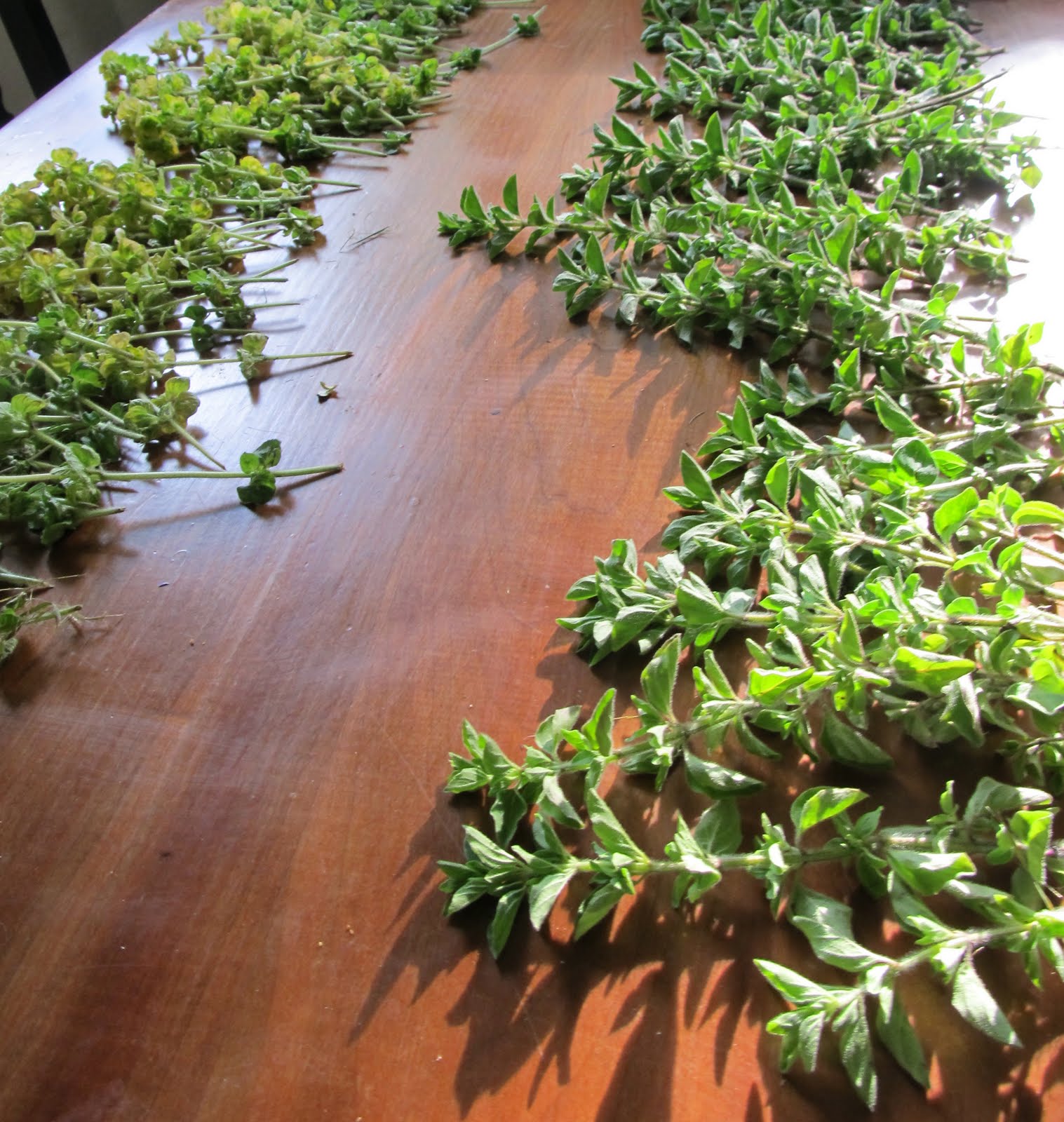
The Utilitarian Herb Dryer
The driveway may not be as pretty as the first photo, but it's a better herb dryer. Put 'em on the asphalt, and it goes even faster. This is where refinished furniture, paintings, screens wet from being cleaned (yeah, like I do that) and whatever else needs drying goes on a sunny day. 

And when it's not a sunny day, having a hard surface is still nice. To walk on without being in the mud. To let the rain wash the dirt off something. To send some sediment and water to that soil patch downslope. Level hardscapes rarely ever exist. You may think it is, but water will prove you wrong. Anyway, completely level slabs are for chumps. You want gravity and water to help you clean it off, and not just willy nilly. 

There's also something about a barren patch in the midst of a garden that provides balance. The hardness feeds soil's softness not just with organics and sediment, maybe, but metaphysically, or maybe that's just the sleep deprivation talking. The hard speeds the spin of the soil-weed-soil cycle, at any rate. Weeds thrown upon the altar sate the more ravenous of the soil gods.

So yeah. Gardens should have hard surfaces. For those and other reasons. I have no brilliant or pithy summation. What did you expect from someone who delves into a garden series with a post about barrenness and concrete, death and dessication? Stay tuned, it gets easier...

12 June, 2011

Ratified Treaty?

Last year, as the season of seeds filled out, I wrote of rats. I haven't been seeing so many lately, but Olympians unafraid to broach subjects rodential confirm that our fair burg continues to have an issue. My last conversation with the pest control guy (yeah, "control," because they don't even pretend to be able to exterminate the population on even a local basis) revealed that the population is booming. The big Norwegian rats have only advanced a little way uphill from the downtown and waterfront, but black rats (a.k.a. roof rats and maybe some other names, Rattus rattus suggesting that scientists saw this kind first, or worship them as the archetype) are everywhere, moving beyond our neighborhoods and into the woods. Roof rats are smaller than their viking cousins, and maybe less berserk, so I was a little relieved to know that what inhabited my neighborhood, although I'd have been happier with kangaroo rats, which are not really rats, but a desert creature, or maybe just a denizen of old Warner Brothers cartoons.


Initially, I signed a non-aggression pact. As long as they refrained from giving me and my family the black death, I'd leave them be. Other than compost (comprised primarily of fresh-ish veggie scraps that they don't really like anyway), I was not obligated to provide aid of any sort. They would aerate the soil, do some clean-up (my yard would be a thicket of hazel otherwise), and stay in their territory, which is to say the Outside. 


But one of their number, whether rat bastard or dirty rat I cannot say, started cheating, and before long they were chewing holes under the bathroom, living in the attic, and finally deciding that they should come through the wallboard and into our home. 

Enough.


I killed a couple, and hired rat guy to get some more. We hardened the defensive perimeter. Rats are smart enough not to want to work too hard, or to risk their lives, and they kept out. Michael Pollan wrote about the Omnivore's Dilemma, but the Opportunity of rats and every other omnivore is that when denied one thing (the bacon on my kitchen counter), they make do with something else (the calendula seeds in my garden). I tried to avoid setting out a buffet by keeping the dog's food inside (even though Mr. Crow would not share much with rats anyway) and canceling plans for the backyard granary. 


The truce seems to have held, and I see fewer rats than I used to. Maybe they are in a downward trend for a while. Populations of rapid breeders tend to have booms and busts, and even though the winter was not that bad, we're still a few months away from the abundance of late summer and fall, when seeds and nuts will be everywhere. More likely, the rodents are underground. 

Literally. Lots of tunnel activity evident lately. I only hope that they are just trying to avoid being seen, afraid of being picked off by humans and hawks. My fear is that they're using the truce to breed an army (rat mammas can pump out ten in a litter, several times a year for about three years), or breach the perimeter surreptitiously in advance of a massive assault, or bring in explosives under the house foundation. 


For the time being, though, hope trumps fear, and I continue to make offerings of compost (and they continue to drag it into their tunnels, transforming it into soil), and have not killed any this year. Once the house was clear, I un-hired the rat guy and stopped setting traps. We'll see if that works, or if this is just another scam like Hitler's non-aggression pact with Russia. (Ew, bad comparison. I don't wanna be Stalin.)


No doubt there will be more to this story. The sickly hairless tale of rats and humans will continue to co-evolve. We're stuck with each other.

28 April, 2011

Decomposite Sketch

Remember wanted posters with sketches of criminals, composites drawn from multiple observations filtered by memory? The Unabomber in a hooded sweatshirt and aviator sunglasses, his face telling you that he was a young middle-age white guy, if not much more. One day soon (or a few years ago, if you live in a major western city), there will be cameras everywhere, and no work for the person who sat and listened to witnesses describe hair, jawlines, noses, and scars. The idea of a composite will live on, as computers merge the traffic camera shot of a pedestrian with the Quickie Mart shot of his face and the cell-photo of the crime in progress.

Composites allow their makers and users to triangulate, to approach from various angles, to interpolate and make a sensible whole. A composited composition like the movie Ran can even let the audience appreciate, maybe negotiate. Most of the time, though, composites are presented as a single true thing, more easily approached than the incomplete components, more readily read than the manifold individual accounts.

Archaeologists deal in decomposite sketches. Something once whole, broken and mostly decayed, informed maybe by a faded historic account or tenuous analogy to something alive. Culture fragmented then mended, extrapolated from the durable leavings of people long gone. Black greasy dirt telling tales of people who cooked and ate, walked about barefoot, their waste and dander of their life becoming soil. Hiding in that matrix, clues: tiny frags of volcanic rock brought from elsewhere and used to oblivion (almost), chemical traces where once were plants and meat, motes of charcoal preserving cellular structure from which ancient forests may be regrown in the mind's eye.


From the soil, artifacts, and ecofacts, we draw our decomposite sketches. With any luck, we may be able to conjure forth a good story of a people long since gone or changed. In a good site, the decay is not so complete that all the nutrients feeding this process have been leached away. In a good site, decomposition has left us archaeological compost, from which sprout theories and culture histories.

Likewise with gardening, I am a decompositer. Plants that are whole and even thriving, but which offer no food, aroma, materials, or beauty--they get whacked. Chopped up and composted to feed something better. Same for prunings and dead annuals and the windfall of leaves, flowers, catkins and cones that drop to my soil--all the disarticulated organics sacrificed to the earth deity.


Why the relentless chopping, burning, carnage? Because more than anything else, I grow soil. What grew before must be decomposed to make what grows next come forth, whole and expanding.
 

14 November, 2010

Dormancy

A decade of tropical living, gardening and bush-whacking through jungle scrub and desert, eroded my memory of dormancy. Arrowroot and olena clung to an ancestral habit of sprouting in spring and retreating in winter, but for the most parts seasons were worn down and subtle: high temps dropped 10 degrees, mangoes had new shoots or flowers or fruit. But the ground never froze and the trees declined to drop all their leaves and retreat for months.

The Puget Sound lowlands have a bit of a blunted seasonality as well, out vast basin of water keeps the summer from getting too hot or the winter too cold, but there's no escaping trhe latitude, a little past the halfway point from equator to pole. Even the warmest winter lacks the light to keep leaves happy, and as you may have heard, the clouds here jealously filter out as much winter sun as possible.

So the trees that invest in something more than miserly needles are forced each autumn to surrender their wealth, dropping leaves to replenish the soil, and letting the sap settle back down to rest before the spring engorgement. Some plants compltely retreat into the ground, ceding the airspace. Some big critters hibernate, while hordes of insects and their arthopodic kin fall back even further into pupae and eggs, all the winter hiding places of the summer swarms.

Humans bury themselves in layers of textiles, avoid the cold rainy outdoors, and maybe withdraw into depressive solitude. (I'm guessing that over the years, I'll post more entries in winter than summer. One day many people may read this blog, but the making of it is a thing I accomplish alone, buried deep in the loam.)

Winter and dormancy always get saddled with the death metaphors, with the pall of loss and sad decay. Their contributions to fecundity lack the photogeneity of spring. Who wants to turn away from the flower in bloom to look at grey decay, at ill-lit muck?

But the frozen exoskeleton and waterlogged leaves fuel the spring growth. The respite from insects and warm weather give the plants a chance to recover and regroup. The cold and wet winnow the unhealthy. And hidden below ground, roots and hyphae may not be so dormant, the infrastructure for the superstructure often advances before and after any action is evident up top.

And not so much here, but in the desert regions there are species that go dormant for more than a season, beyond a year. Baked in mud, buffeted by winds, biding their time and witholding action until the right rain hits and then bursting forth with astonishing vigor from some unimpressive husk.

Seeds may not be dormant as biologists defined it, but an inert capsule that holds in it the germ of an entire organism seems like a special case of the same phenomenon. The joy of gathering seed each fall, knowing that the seed from one plant can birth a whole bed of progeny is one of the things that keeps me gardening and happy. I've seen seeds buried for decades or longer sprout when given the chance, and there are species whose seeds are engineered to outlast the elements in wait of the wet year or the fire that triggers growth.

My garden is about done for this season, and there are plenty of perennials, bulbs and bushes gone dormant. I'll find some excuses over the winter to go out and work--removing a stump or planning new beds, maybe--but in general I'm goign into garden dormancy as well. Other pursuits spring to life: writing and carving, reading and dreaming. At least some of these will prove to be roots that strengthen next years growth.

28 September, 2010

Rattus Redux, or Eratication

So of course having written about them in a most accommodating way, calling a truce wherein they get to range everywhere except the house, I found rats trying to move in the day after the Rattus Amongus post. Saw one in the garage. OK, two.

It was silly of me to be so conciliatory, to write as if they would return the favor. Rats don't read, they watch Fox "news," and are no more prone to a 2-state solution than any other zealot pushing the settlement boundaries, expanding their lebensraum.

What to do?

Maybe history has a lesson. In the 80's, working on an old farm my uncle had bought (it was his bizarre wish to vacate the Front Range and retire to the Colorado-Kansas border country), my cousins and I went to war with rats, who had taken the place over. At first it was glorious: we shot them with 22s and a 20-gage shotgun, ripped their nests apart and burned them out, invited coyotes to hang out. One cousin threw a wrecking bar at one fat male darting around the compound, and creased its spine neatly from about 15 yards away. Another night, sick of hearing them run through the duct running the length of our trailer, I blasted one through the grate with an IID (improvised incendiary device, or a can of WD40 and a lighter). Another cousin made a rat stencil, and we would spraypaint kill markers on the side of the shed, like WWII pilots stenciling enemy planes on their own warbirds. I think we logged about 3 dozen confirmed kills.

Of course it probably didn't last. My uncle died, meaning a period of abandonment once again, during which time the rats moved back, bred like crazy, and ate all the leftovers. In retrospect, I'm pretty sure that the oldest cousin had encouraged the rat-war at least in part to keep me and his brother from killing each other. Sort-of like how Canadian provocateurs manage to keep both Red and Blue US states focused on wars in far-flung reaches, lest we explode near their poorly defended underbelly. Or worse yet, start thinking of conquest in the neighborhood.

And what if we had continued, instead of heading off to school in the fall? The eratication might have swerved from functional to completely recreational. We might have started shooting the cute bunnies (oh wait, that did happen a couple of times). Maybe elaborated, doing more than just tossing the bodies out to coyote land, taking time only to notice that the males always died with wee rat boners. (Oh wait, we did start chopping off tails and nailing them to the shed.) Another month or so, and we would have been sitting in near darkness, our compound surrounded by rat-heads on pikes, muttering "The horror...the horror."

Now that I have kids, I'm not sure I wanna go that route.

But also, I don't want rats in the house either. So, I guess I'll put out some traps. An air gun is tempting (assuming the neighbors wouldn't call the cops), especially since these critters have some pretty well-established runs and can be counted on to frequent certain spots: the juniper hedge, the compost, and other portals to their underworld. Also, it's a whole lot harder for them to adapt to a lead pellet in the head than to avoid a trap. (Question: Would I stick to the ethic that if you kill it, you should eat it? Answer: Not as long as I have a job.)

They might also be easier to exclude were I ever to dismount my high horse and do things like buy a compost tumbler instead of laying out a buffet, or maybe even surrender some of my biomass to the greenwaste collection program instead of putting piles of branches and other rodent cover out back. Maybe I should break down and get a high-strung killer terrier.

I love the mellow dog I already have too much to risk the poison route, besides which the prospect of breeding super-rats holds so little allure. The old snap-traps are not foolproof, but if they catch a few, so much the better, and at least we won't be infested with the stupidest of the lot.

Coordinated action would work best. Pick a week and have everyone in the neighborhood clean up, set out traps, and cut down those damn juniper hedges. But that makes too much sense. First of all, not too many people are shameless enough to admit that rats have the run of the place. And have you ever tried to convince grandmas that their bird feeders are really just rodent smorgasbords? They'd have to be forced. Only firm-handed socialism will save us from the rats, and even Olympia ain't ready for that.

18 September, 2010

Rattus Amongus

Olympia has rats, or some kind of giant gerbil. My family concocts, consumes, and disposes of various euphemisms for these creatures. And no doubt they drag the remains back to their lairs.

And attempted lairs, like in the bottom of our trash can, where they chewed a channel through the bottom and started setting up house. The weird thing is that they brought a Cheeto bag from somewhere else. Which just goes to show: them critters have networks of runs from lair to food to water to the secret escape tunnel to...everywhere. I live in great habitat--enriched with the offal flow of a dense human population--and the most I can reasonably expect without major interspecies warfare is to keep them out of the house. When we moved in I literally had to mortar in places under the house to keep them from coming in via the fireplace.

Granted, our rodents are as adorable as they get: big soulful eyes, healthy clean fur, that perky hop-run they do across the moonlit yard, not too big,...they're not so bad. The girls shudder at the suggestion of just killing them. Poison could kill our dog and rats eventually figure out how to avoid every trap anyway, which over the course of a few of their generations puts you right back where you started, except with fitter rats. So as an archaeologist, I'd have to classify any period of rat-free existence I could achieve as "ephemeral."


Anyway, the rat population is what it is because of humans. They are commensal species with us, and when you have a 2-week trash pickup cycle and a large percentage of composters in a fecund climate with yards providing cover and food, they flourish. We create habitat, they fill it. Whenever I've excavated in sites where small bones can survive, some species or another of genus Rattus has been found. Polynesians ended up transporting them everywhere they sailed, to the extent that one of the ways used to recontstruct their ancient migrations is through comaprison of rat DNA on all the far-flungislands of the Pacific. Really.

What remains unknown is how a rat could survive in tight quarters, with a crew of humans you would think would be intent on guarding their food stores and all the planting materials destined to start life on a new island. Archaeologists in Polynesia argue about this all the time. One camp says rats are just good stowaways. The other side scoffs, and says they were alloowed to survive, maybe even intentionally brought along, because they are edible. Imagine that you are setting out to colonize an island with unknown food resources, but you pretty much know there are not going to be any land animals worth eating. Would you maybe bring along something that subsists on scraps and seeds, multiplies rapidly, and tastes good roasted on a stick? From a survival perspective, it makes a lot of sense. After a while, when you've got your pig operation rolling, you pretend you never ate rat.

But if you're not in the mood for roasted rat (or tarts, or sorbet, or any of those other Monty Python dishes), how exactly does this coevolution benefit humans? I mean, they poop in our food caches, chew holes in everything, harbor diseases,... Well first of all, don't be so damn simple-minded and literal. Species that live and evolve together don't typically have altruistic thoughts about each other--they just have to co-occupy the same space without making the other extinct. The Plague, in the cold light of evolution, only made the European human population stronger. Thanks for the favor, rat.

To find the benefit on a more immediate scale, set back your clock a century or so, before trash collection and widespread urbanization. You tossed rubbish over the fence or into a pit, where rats were maong the creatures and microbes that broke it all down. Rats are incessant gnawers and poopers (dropping 200 turds a day, I've read), so they must be a significant factor in soil formation around human settlements. Through several varied attempts at composting here, I dealt with rodent incursions; they would sneak in and haul off whatever they liked best. They even ate or drove away worms I'd bought for composting, the rat bastards. Eventually, I just opted for a bin on the ground, nothing to prevent their tunneling in. Now I throw in the scraps, and they disappear down the bottom, eventually to become dirt somewhere.

All those tunnels aerate said soil, and provide habitat for all sorts of other critters. And of course when the starving times come calling on the large bipeds, the rats start looking like food again...

So if I were somehow able to eliminate rats from the neighborhood, more stuff would either pile up here or end up in landfills. The soil wouldn't be as good, and seeds would not be so widely distributed within it. I'd have less protein in the end times.

And plus, I cannot help but wonder if, facing extinction, the rats would up the level of their activity from annoyance to truly fighting back. What if the rats, sensing real trouble, started to systematically attack our food supply? Or gnaw through our infrastructure, contaminate us and maximize their disease vector behaviors? Yeah, where would we be then?

It remainds me of that Charles Darwin quote, attributed by some to Stephen J. Gould, but in fact made up by me, "Once the rats figure out how to do agriculture, we are toast."