Does the word that just popped into your head show up here? Find out:

Showing posts with label weather. Show all posts

23 September, 2014

The Rain is Back, and So am I


All of a sudden, I see it's been months since I posted here (if that makes any sense). Today, we've finally returned to prototypical Northwest weather: rain, the horizon blurred by a liquid sky, drizzle-drop-drench. I was just talking to my kids, and they agree, it's a relief.

So we must be fully acclimatized to this place. Last week, even though it was a full 20 degrees cooler than "sweltering" in the land of my birth, I was sweating, unable to keep count of how many sunny days we'd had in a row. The girls agree: too many days of bright blue skies in a row becomes oppressive. We welcome the wet blanket now.

Summer rarely reaches the white-sky, humid hellishness of a mid-Atlantic summer here, and it's true that we all soak it up, enjoy it, and retreat from the indoors. It's no accident that Northwesterners spend so much time hiking and camping and such. (OK, not me, but other people, whose jobs keep them inside most days.) This summer more than most, I took a hiatus from blogging and other trivialindoor pursuits. Instead: gardening, fieldwork, and gazing into the yard that became my own, and moving.

So, a new season, a new (old) house. Through great willpower, I've managed to put off doing yardwork at the new place, but that's about to change. For one thing, the communal/community garden is starting to wind down. For another, who the hell wants to dig up the yard when it is hot(ish) and the ground is hard? For yet another, there were side gigs and wildfire-chasing to do while the sun was out.

Now, as the drizzle softens the glacial outwash that is my yard, it's time to dig in. Now, as the Equinoctal threshhold has been crossed, there will be time to write. (As opposed to just clicking in photos at Anthrowback, my minor-effort summertime diversion.) Now, as Winter wrings the glare of Summer sun into a pool of mild Autumnal reflection, it's time to seek shelter under roofs and with kin.

02 April, 2014

Twilight. All Beauty, No Vampires

Step out of the Darkness

This past February, while everyone from embattled Alaskan codgers to entitled Southern heiresses was bemoaning our only four-week month, I worked on the Pacific Coast of Washington, the notoriously winter-drenched Olympic Coast.It was warm and sunny.

Spectrum in the Spectre-less Forks

I stayed in Forks, most famous during my kids' lifetimes as the setting of the Twilight series of movies and their prequel books, a protracted tale of teenage angst and love, featuring vampires and werewolves in the Northwest, written by a Mormon from elsewhere. The town clings to the notoriety, fading movie images all around, not-quite-copyright-infringing attempts to cash in ready for the tourists unable to see the beautiful, actual, twilight.


Clear skies and stunning sunsets are not the order of February's precious few days in the Hoh Valley. I'll admit that, and I may never have as beautiful a few days on the coast as happened inexplicably this Winter. But instead of dismissing that beautiful twilight as an aberration, writing off Winter as gloom, my memory is lit by that golden softness.

26 January, 2012

Brittle-flex


The photo above is of ice on an apple branch. First, the branch caught snow and ice that stacked up on top, and froze there. And here, the next day, some of that ice has slipped and slung itself don below the branch. 


But ice is hard. When I whack it, or some giant branch comes crashing down, ice breaks like the glass it mimics. Crystal brittle fragility. Or, if it gets thick enough, hard and unyielding, unchanging if nobody turns up the heat.


Or speeds up the clock. Unimaginative reckoning of time traps our perception, makes us think things are solid when they are fluid, immutable when they are changing before our eyes. I've always had a weakness for the revelatory power of time-laps photography: a seed spreads her dicot to reveal a luscious tendril that becomes a plant. But with a little patience, the same can be seen without the fancy equipment. Glaciers flow, the hard little ice on an apple twig sags like a rope.


Or, the thousands of frozen shards cracked from a falling branch cascade like water, like in this shot (yeah, I know, it doesn't really show up). Hard pointillist frags conspire to produce a fuzzy flow. Then the virtual shutter of my camera freezes it into a cloud that will never move on. Of course, not even that is true: the file will degrade, pixels will disappear and move every time it is copied or re-saved. And by the way, your screen shifts everything a little to the right.

Stolidity becomes fluidity. Slow is not unchanging. Pieces become wholes and break up again. This post may be edited.


23 January, 2012

Weather Feral


Lights out, everybody home.

After months of lulling us into a false sense of security (or, for the neurotic, misplaced worry over lack of precipitation), the weather unloaded on Olympia this past week. It began with rumors of snow, and the masses watched TV or teemed to websites with little snowflake icons. Weather geeks spent more time looking at radar and satellite views, and tuned into Cliff Mass at every opportunity, because his fans like to hear him talk almost as much as he does. Me? I'm one of those outliers who just reads the Forecast Discussion from the Seattle National Weather Service office.

They called for 1-3" on Monday, and again on Tuesday, and Olympia came in at the top of that range, although it was melting from the bottom the whole time, and we didn't end up with a full 6 inches Tuesday night. As the next system came round, the NWS discussion began with a quote from Airplane, "I sure picked the wrong week to quit drinking." Various models kept predicting different amounts of snow, and differed on when it would turn to rain.

In the wee Wednesday hours, more focused on keeping the fire going than sleeping, I peeked outside and began to lose interest in the predictions and models. At first, it was a desire to replace speculation with data. The snowflakes were flat and shiny, frozen hard, and the dripping from the roofline had stopped, so clearly, it was getting colder. As day dawned, snow continued, piling up rapidly.

The last time I paid any attention, meteorologists were saying that the Olympia area might top out at 6 inches…right about the time we hit 6 inches. By mid-day, there was little sign of warming, or even of the predicted cease-snow. I'm not one of those people who scoffs at forecasters for sport (a dull, uninventive sport, indeed), but I do think that sometimes they need to ignore the model and take a walk outside.

Snowflakes got smaller, and eventually turned to pellets of ice. The warming trend never kicked in enough to give us rain, save a brief partial outbreak 24 hours late. Precipitation came in one frozen form or another for a while, and atop the snow grew a crust of ice. I decided not to shovel the driveway, reasoning that it would only result in an icy surface.

Besides, why drive? Olympia is not known for being able to handle major winter storms, and I had firewood and food. My winter fertilization had escalated beyond ignoring the weather pros to withdrawing from car culture.

And the process would continue. I got more attuned to small cues in the weather over the course of the storm. Wind direction and intensity read in the trees and chimney output, the ominous swarming of gulls seeking refuge from the bay, the sound and feel of the snow as I stalked through it.

At the same time, withdrawal from civilization became more pronounced. After an all-too-brief respite, I could hear traffic building on I-5 again, but I had no desire to join in. As consumption junkies and ailment addicts succumbed to "cabin fever" (which does actually exist, but takes weeks to incubate and only ends with a lovely spring or ugly cannibalism), people shoveled drives and ventured out to join the madding crowds buying potato chips and crappy beer as if survival depended on it.

Instead, my time went to winterizing the homestead, by which I mean playing in the snow with the kids, sculpting a giant bust of a baboon, and building a mini-luge track over the driveway. Because I'd become more attuned to the weather as it is--not how a computer say it may become--I knew exactly when to make the ape and sled run so that they'd become coated in ice.

At some point, the power went out. So I went out, and listened as firs cracked and alders popped. Ever 10 minutes or so, there was a big branch falling, the initial break followed by the glassy cascade of ice freed from twigs and falling to earth; this symphony may elude my aging ears next time around, so I gloried in its irregular crescendoes. I helped the apples shed some ice, and learned that blueberry twigs just break if you try to help them do the same.

Eventually, I headed in, shed a few wet layers, and tended fire. I barely run our electric heat if I can help it, but at this point the fire became more than a hobby. It kept the house warm, and for a couple of days it is how we cooked. I McGyvered a little grill, making some pie-like things and sausages, warmed a pot of soup and foil packet of potatoes, stewed a mess o beans, and even made espresso (NOTE: the plastic handle of those little Italian espresso makers will look OK, but then melt to your hand, the sneaky bastards.)

The house shrank into the den, four hominids by the window or the fire, depending on whether they valued light or heat more at the moment. Furniture and the TV disappeared under wet vestments, and the floor became a layer of bark fallen from firewood. Daylight ruled, stretched only a bit by candleflame. Trips beyond the dripline to get more wood, to forage for fun, but otherwise, a family sticking close to the hearth, not so different than the thousands of generations before our kind got electrified and uppity.

Feral is not all fun. Splitting and hauling wood, knocking ice off the food trees. I guess making a baboon sculpture and sled run is not exactly necessary, but it takes effort. My kids said, "Dad, you're steaming," and it is true that I did create my own tiny weather system. The day after the ice-fall, the Olympia climate replicated this on a larger scale, fog and wood-smoke enveloped everything.

Yet, the I-5 noise grew. People drove by. Eventually, a snowplow made it even to our side street. Civilization once again reared its ugly head (for those who could afford it), and there were rumors of free frozen food from the grocery store stricken with powerlessness, inciting a rush. Also, those stricken with cabin faux-fever rushing onto the roads.

Eventually, this included members of my own family, and somehow I ended up pressed to shovel the driveway (taking out the luge run, which was disintegrating but still heavy as hell), working up enough heat to reduce small thunderheads of steam over my balding pate. Then, because of the  car-driving acumen supposedly bestowed on me by my manly parts, I drove the family out into the slushy grid of asphalt that separates us from snow-baboons and other allegedly inferior apes.

And it was not pretty. Guys with overly active dangly bits driving like madmen. Everyone converging on the stores with electricity to buy…whatever. Cabin feverishness gone amok. I found myself in a grocery store (turns out that my foil stash was unequal to the task of fireplace cookery--so I guess there was some purpose), and was infuriated to learn that with a quarter million people lacking power, Safeway chose to use its precious current to play Phil Collins "music." Inforgivable.

I was glad to get back home, and play feral again. More fire. More observing the weather (quickening wind from the south with some thin spots in the cloud cover, a good sign for thawing, and mercifully short of the damaging high winds that the weather geek rumor web was predicting), which somehow stuck within a degree or three of freezing for days and nights on end, yet provided an interesting array of precipitations, fogs, and overcasts.

The adventure is over now, except for the telling. Work was abuzz this morning. While the novelty will fade, the legion is yet to be born. A few years of typically minor snowfall, and January 2012 will loom larger. That gnarly tree? 2012. The abundance of firewood? 2012. The half-assedness of future winter weather? Bow down before 2012, when the wild demigods of winter skewered the weak with mighty icicles, when the trees cracked under the unflinching ruthlessness of La Nina. Yes, in time this half-hairy ape will spin these few days into mythology, and the un-sullied minds of children and superstitious souls of the old will nod in agreement and supplication before the spirits of weather unfettered.

Happily feral

18 January, 2012

A Foot o Frozen Stuff


After a couple of days of a couple or three inches, it cut loose today. I was tending fire to keep us warm, sleeping on the couch and rousing every once in a while to mate new wood with old glowth embers. On the 2 o'clock round, I saw snow falling. At four and a third hours, the back porch light revealed big sparkling flakes mounting quickly. Dawn seemed to come late, so dense was the snow, inching up past boot height. 


By then, the school district had admitted the inevitable. My job had pre-empted the snowfall, telling us to work from home, but I'd already decided to take the day off. Write technical reports or play? No choice at all.


And play I did, but not nearly so much as a certain first grade girl who: ate her weight in snow, buttressed a snow-fort, staked claims to untrodden quarters of the yard, explored the pick-up bed full of flakes, and made snow angels (though not in the same quantity as face-prints, mind you, and not quite to the same effect as the motion-deprived snow-crucifixes she also embedded in the deepening white stuff). Among other things. At one point, she menacingly wielded a plastic lettuce knife at her sister; I'd foolishly given it to them to sculpt snow with, feebly unable to predict her using a giant green plastic knife as a, uh, giant knife. 


Baboon, or Australopithecene? I care not, so long as he guards my abode with ferocity belying his lazy grin.
Me? I'm more of a hands-on worker of snow. It took me about an hour of surprisingly aerobic work to make this. Nestled in the winter-shadow of the south hedge, it's some sort of great ape. Cracker has this song, "Guarded by Monkeys," which rocks lyrical and guitarical mad genuisness, but monkeys are only good in troupes, being fairly insubstantial, even frail, one-on-one. So I opted with a single big-ass ape (ass not pictured). For scale, the pupils of it's eyes are bottle caps. Rumors have already made it back to me that a case of Winterhook is buried in this creature's medulla oblongata, but it ain't so. This will have to do for home defense as well as a stand-in until I can realize my life-ling dream of hanging out in snowy hot springs with Japanese monkeys.

Eventually, the snow petered out, leaving a foot or son on the ground. Miserly little ice pellets finished off the day, but too few to bring down the power grid (I hope). Just in case, the fire is still burning. 

Yes, I'm gonna say it: Grillin and Chillin.

25 September, 2011

It Must Be Fall

We are in the post-Equinoctal world, Autumnal Edition. I would know this even without a calendar, because of these events:
  • Rains returning to the NW
  • Between clouds, the sun angles in low, below hat brims and car visors
  • People searching for "heatilator" are landing at this blog again
 

Garden 11: The Hoop House

September, and tomatoes are finally ripening.

I tend to go with the flow (Disclosure: rarely in the main stream, sometimes along a flux as inscrutable as neutrinos through granite), and opt for simply ept over the fancy engineering available to today's gardener.
But the flow's so slow with the maritime Northwest Spring, especially this year. The sun may climb quickly from it's root-bound Winter Nadir to the sunshine daydream of a Salish Summer, but the clouds wet and dark rob the light and waylay the warmth. So to get some early(ish) greens and tomatoes and beans going, I decided to goose the flow a little this year. 

June 2011: The plastic comes off.
This photo shows only the hoops, but imagine it covered in clear(ish) plastic, trapping air to tap photons that make it through the clouds; these shivering ragged survivors do manage to warm things up a bit. Not enough to affect soil temps, though, which I measured frequently and never saw get past the low 40s Fahrenheit before I yanked the plastic and let the real summer in. 

Anyway, the shot from the roof there illustrates my approach, which stems from frugality and some would say lassitude, though I prefer to think it is clever(ish).
  • Dig a 12 by 4 foot bed sloped slightly down south.
  • Lay out a 25 foot soaker hose up and back.
  • Get some skinny pvc, stick one end in the ground in a corner the bed.
  • Go down the long side, planting another every 2 feet.
  • With the help of a boathook or friend, bend these over and stick the other end in the ground.
  • Get a roll of heavy clear plastic sheeting, and lay it over the hoops and secure the long edges.
The only thing you cut is the plastic sheet, and there's no exotic material required. Easy. Cheap.


Spring's greenhouse reborn as Summer's tomato cage.
Plastic retraction time comes when the tomatoes start pushing against it, which as luck had it this year was when we started to get real stretches of clear sky, sun showering down on chlorophyll for hours on end. At which point I took a couple of old tomato cages I'd made a while back out of leftover fencing, and laid them over the hoops. Just guide shoots up where you want them and they'll flop on top, maybe even sling a few of the branches below. Watch for fruits growing into wires, but otherwise you're pretty much done til harvest. 

South of the tomatoes, I had lettuce and spinach, some of which had an extended growing season as the growing tomatoes kept the sun from hitting tender leaves all day. To the north was a single row of string beans, climbing twine to a line strung from eave to eave on the end of the house, but that's another story.


From the post-Equinoctal perspective, the hoop house seems like a worthwhile investment. Digging the bed was by far the most labor intensive part of it, and that gets easier over time. Everything is off-the-shelf and inexpensive, and one person can make it in under an hour. The tomatoes alone pay for it the first year. I'm glad I finally did it.

21 September, 2011

Fanless

Fanless. A state of being without: a) a mechanical device for moving air, or b)  sufficiently multitudinous devotees to invey Stardom(TM)

Either one sucks. For example, "a)" sucks when you realize the hotel room you just checked into qualifies, and you ate Taco Bell on the road. Or "b)" sucks when you want stardom. 

The latter of which affects me not. This blog logs its lowest numbers, lately.  And happily I write whatever the hell I want. Like this:

That a certain national hotelier systematically lacks bathroom fans, however, bothers me. It should bother them, as it is bound to adversely affect repeat bidness among: trysters, eaters of beans, very sensitive loners, and other demographics.


05 September, 2011

More Irony, and some Ire at Morons

Hellscape Texas (NOAA photo)

I used to have to sate my Rick Perry irony hunger by looking at the title of his book, Fed Up. It can be read in the "Up with Feds" sense, contraindicating the semi-literate rants between the covers, subliminably urging his almost-semi-literate fans (admit it, most people who buy it do so for ornamentation, not to crack it open) to support Federalism.


No? You're right. That's a ridiculous stretch.  He wants to fuck them snide lyin' sons-a-bitches (=scientists) up, and ain't gonna let no bureaucrats and technocrats tell him what to do. The guy genuinely hates government.

Or does he?


Today's events suggest that he may not believe that all gummint is bad, that in fact swaggerin' and prayin' may be usefully augmented by science-based action, funded by...taxes.


Because today, Perry could've been strutting in front of a crowd of South Carolinian Tea Partiers and the national press, railing against the liberal elite and big government. Instead, he flew back (shepherded for all the way by those helpful FAA guys Republicans would like to get rid of...again) to coordinate government response to wildfires. Making sure that state resources are applied against the thousands of fires consuming beloved Texas ground. Will he refuse federal fire crews, disaster relief? 


No. He'll avail himself of the evil he points to in the public square. 

Some would say that's hypocritical, but there's some irony in there too. And it gets better: the emergency he's dealing with is a consequence of global warming, which he denies even exists. Texas is experiencing it's worst drought ever, with record high temperatures. Don't take my word for it, I'm just quoting a report from the Office of the Texas State Climatologist


Nope, you cannot make up irony like that. A government scientist (whose data will be crucial in securing federal assistance and funding), a public employee, proving his idiot boss wrong. I hope for his sake that he's got a union.

16 July, 2011

Garden 8: Summer Rain

Summer sun took it's time peeking through on the far south Sound, but Olympia has not had decent rain for a while. Clouds taunted us garderners with their rainlessness (robbing lumens to boot), or else absconded while the sun turned its full attention on evapo-transpirating moisture from our sandy soil. 

I resorted to soaker hoses and occasionally setting a sprinkler to spradiate over a few feet in dire need. I don't use a lot of water, though, for a bunch of reasons: plants on life support depress me, I'm devoted to a Creator named Evolution (who will not abide cheating for long), water costs money, and water from a pipe has too many additives and subtractives to match the vigor of the H2O that falls from the sky.


Now we are in the midst of a steady rain. Not the light mist that dampens the surface and leaves roots begging  for more. Not a sudden downpour that erodes and runs off. Just hours and hours of rain falling on flowers, washing foliage, quenching roots down to their deepest. And the plants will respond; even the light dose earlier this week had them stretching higher, flexing and filling out, darkening green, multiplying blooms, growing fruit, and just generally splashing brighter and bolder brush-strokes across the canvas of gardens. After this drink, if we don't backslide into too many days of mold-inducing cool wet weather, the plants will drink in sun and go off.


So while other Olympians may be cursing the souply ground at Lakefair or the damper on other weekend activities, I'm thankful for this liquid gift. Sitting here, hearing drips hitting deck like some tireless woodpecker, I see not the greyed weekend, but the saturated weekend. Some sunny day in August, I'll revisit this rain in the form of tomato flesh, squash, beans, greens, and all the other transmogrified precipitation climbing back skyward from my patch of ground.


25 June, 2011

Garden: Part 2, Hardened Surfaces

Pretty Irrelevant Photo
 
I've spent more than my fair share of time removing gravel, sidewalk, and rocks to let soil kiss sky and revive again, but it's also my experience that a gardener needs some barren, hard places. Fully sun-baked if you can get it (and we are just now in that part of the year where that's possible, Pugeteers): harsh, a thirsty patch that won't drink any water, a callous upon the land.

Why? So you can kill weeds, first of all. In drought-strangled Virginia, I could toss a weed any old where and the sun would delight in beating the life out of it. Here, it might just as easily take root and manage to slip by and set seed. And even if the one laying on the driveway does have seeds, they're on concrete. A few may wash down to a crack or blow away to fertile ground, but mostly this is the end of the weed road.  Speaking of which, every time the car pulls in or out of the drive, the weeds get pulverized: first step on the soil road.

Because yeah, the hard-top better be helping me make soil, or I'd rip that shit out. I confess to being a dirt farmer, soil is my primary produce, everything else is after. My garden aspires to the urban homestead ilk, and I'd just as soon turn my weeds back into soil than put them in a bin for the city. Same with compost--am I just gonna give away my biomass? Huh-uh.
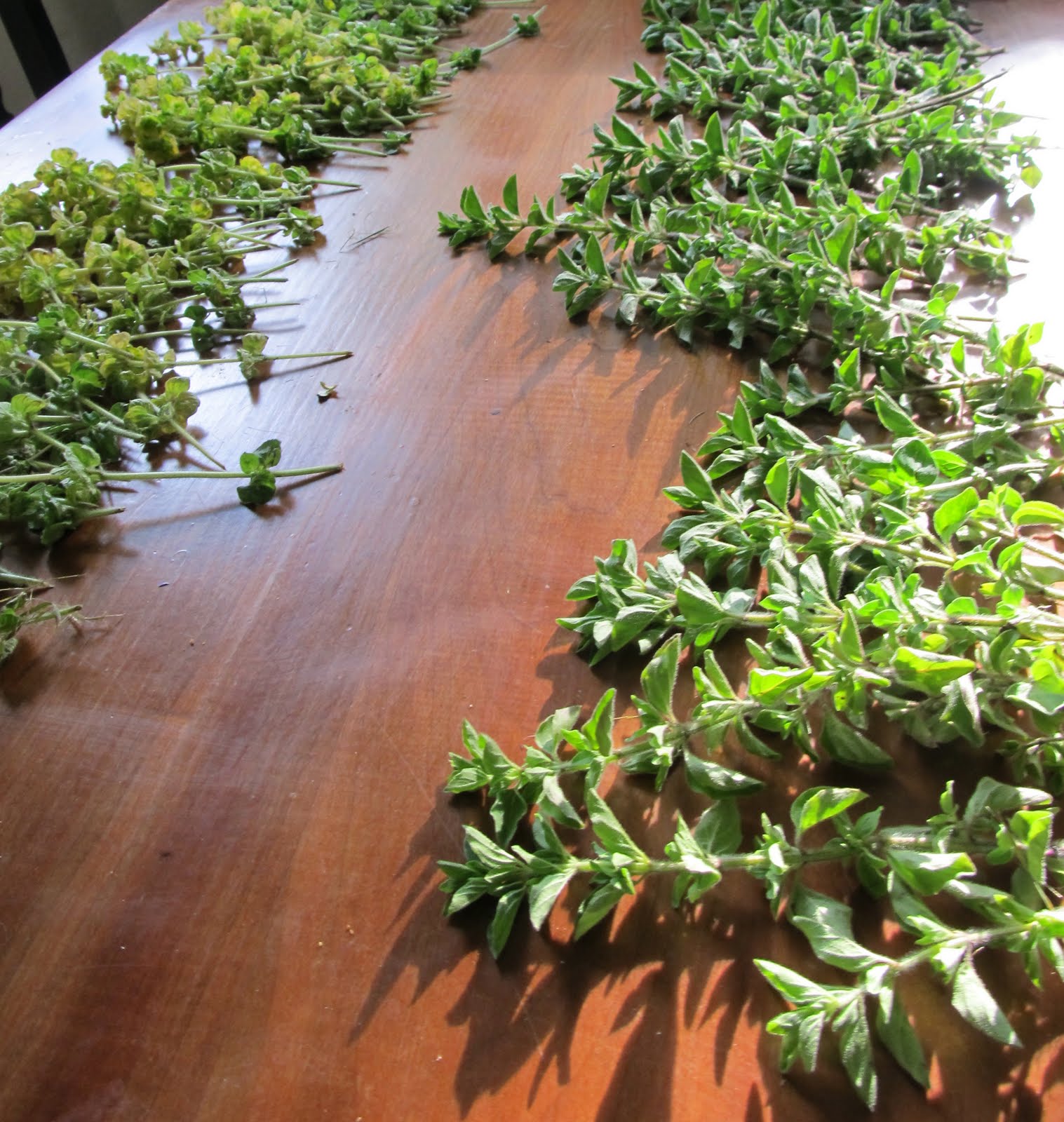
The Utilitarian Herb Dryer
The driveway may not be as pretty as the first photo, but it's a better herb dryer. Put 'em on the asphalt, and it goes even faster. This is where refinished furniture, paintings, screens wet from being cleaned (yeah, like I do that) and whatever else needs drying goes on a sunny day. 

And when it's not a sunny day, having a hard surface is still nice. To walk on without being in the mud. To let the rain wash the dirt off something. To send some sediment and water to that soil patch downslope. Level hardscapes rarely ever exist. You may think it is, but water will prove you wrong. Anyway, completely level slabs are for chumps. You want gravity and water to help you clean it off, and not just willy nilly. 

There's also something about a barren patch in the midst of a garden that provides balance. The hardness feeds soil's softness not just with organics and sediment, maybe, but metaphysically, or maybe that's just the sleep deprivation talking. The hard speeds the spin of the soil-weed-soil cycle, at any rate. Weeds thrown upon the altar sate the more ravenous of the soil gods.

So yeah. Gardens should have hard surfaces. For those and other reasons. I have no brilliant or pithy summation. What did you expect from someone who delves into a garden series with a post about barrenness and concrete, death and dessication? Stay tuned, it gets easier...

03 June, 2011

It's the Environment, Stupid

If history via film documentary is to be believed, ragin' Cajun James Carville's mantra lifted Clinton to victory in 1992, back when votes were counted in presidential elections. "It's the Economy, Stupid." Clinton hammered the GOP on their mismanagement of the economy, reminded voters of how poorly they'd fared after being trickled on, and swept into office.

In 2008, I suggested that things had changed a bit, and that now It's the War, Stupid. I was wrong, people don't actually care that much as long as the dead are foreigners or the poor and working class who fill our military's ranks. Not just that, but I was hilariously wrong in suggesting that the Mayday action by longshoremen--shutting down ports as a war protest--represented an awakening of the Boston Tea Party spirit, completely unaware that a couple of years later the Tea Party would have been hijacked by bitter, rusted wing-nuts.


2012 election coverage is heating up, with Great White Hope Mit Romney (a German phrase meaning "with gypsies") declaring his candidacy today, but I find it hard to get excited. I'll vote for the lesser of evils, sure, but to call me an Obama supporter when he has embraced Republican policy on the economy and wars would be an exaggeration.


The problem is more fundamental than US politics will ever manage to address, unless I am being blind again to a radical change just around the corner. It's the Environment, Stupid.


As I write this, the morning news is focusing on the economy. The Dow slipped 2% yesterday, the conventional wisdom being that this is due to the weakness of our recovery from the Great Recession. 


Look deeper, though. Why so weak? One factor is the weather. Violent storms lay waste to places, places where there had been jobs. Floods drown other jobs and stall even more as supply chains become clogged on riverways shut down while the Army Corps flounders amid disasters it created. I just heard from family in Virginia that temps climbed well into the 90s during May, reminding us all that summer will bring the kind of heat that slows everyone down, evaporates water supplies, and spawns hurricanes and tornadoes. We may get lucky again, and dodge a year of major storms hitting the Atlantic and Gulf seaboards, but if they do, look forward to more economic stall-outs.

Deeper still, the Japan earthquake and tsunami disrupted a major economy, one of the aftershocks being stilled production lines at American plants. The spectre of nuclear accidents is bound to dampen investment in more such plants here (despite generous corporate welfare having the Obama boost), and Germany has already made the choice--characterized in US media as an economic drag--to abandon that path in favor of more difficult routes to energy production (and, in a move utterly foreign to us, energy conservation as well). Meanwhile, Icelandic vulcanism disrupts air travel even of the leader of the free world again and again. 

Meanwhile, glaciers melt and sea level rises into our neighborhoods. Considering the portion of the global population residing and working in coastal areas, this has implications too enormous for us to want to consider, and so by and large we do nothing, waiting until a disaster forces action, by which time the remedies will cost far more. There will be casualties, human and economic. At the same time, the ocean grows more acidic as it ameliorates our pollution of the atmosphere. So acid that fish stocks are affected (not to mention krill, sweet sweet krill), and shipping firms must spend more time and money maintaining hulls. Many eyes are on the arctic, where the melting may finally open the Northwest Passage that Europeans searched for forever, but that will not eliminate the adversities wrought by stormier acidic oceans and drowned waterfronts. 


Sea and air trade has spread bugs and pathogens worldwide, causing damage to timber, agriculture, and other means of extracting GDP from the earth. Climate change, too, is not likely to be a positive in natural resource economies. The northwest has dodged firestorms for years now, but as the beetle-killed forests expand, we can be sure that La Nina or whatever has spared us thus far will not hold out forever, and vast tracts of timber will go up in smoke before they can provide jobs. Droughts do not just have it in for the former Communist lands, and will visit us in their own sweet time. 

In the meantime, the political minions of our corporate overlords work ceaselessly to avert any legislative or regulatory attempt to stop them from dumping toxins into the biosphere, and to thwart the lawsuits now required to enforce rules already on the books. Every year, more drinking water supplies are found to be contaminated, and the brownfields expand, often irreversibly poisoned--more land and water subtracted from our base for sustained human survival and culture. And it ain't gonna get cleaned up at this rate: the same politicians who prevent sensible regulation cite economic hardship to prevent funds from being used for environmental clean-up, or for jump-starting clean energy industry.

Increasingly desperate, we double down on all bets, hoping that technology will rescue us, that science will go messianic on us and bear miracles. Sounds crazy, right? Not so much to the hucksters hawking genetically engineered snake oil and fracking the hell out of mother earth; they'll make their money, spend lavishly, and die seven months into pacemaker number two,...before the cosmic repo man comes. Weeds in the field? Just buy this herbicide immune soybean seed and spray the hell out of your field. Water no good? Try our bottled water, we swear it's safe, and stats show that you'll never be able to pin your cancer on us. Drought stricken, fish all gone, locusts swarming? No prob, try new Soylent Green, made with sweet sweet krill,...sorta.

15 May, 2011

Cooookin in the Rain, I'm Cooking in the Rain

Warning, Objects in the grill-dome reflection appear fatter than they are.

Yeah, the title is stolen from a musical, even though I despise musicals in general. I do make an exception for Clockwork Orange, though.

Cooking out holds an almost completely opposite place in my esteem, as long as I am the cooker-man, and the few times I haven't enjoyed it can be blamed on inexplicably bad meat or unavailability of good wood. 


But not rain.


Which is good, living in Olympia, where fair weather grilling is not possible often enough to sate my hunger for smoky goodness. If I held off every time clouds threatened rain, or drizzle dropped, or outright downpours dampened the day, I'd be a sad shell of a man. If the Oxygen to H2O ratio is high enough to let flames get a hold of the wood, then I'm good to go.


Yeah, wood. I am not a modern American griller, weekend warrior with a thousand dollar gas grill or a humbler briquet bucket. I do not have a "Kiss the Cook" apron or feel the need to dress up in silly summery outfits. I have no fancy gear, and my grill was foraged on Large Trash Pick-up Day (prior to which, I had a little hobo set-up consisting of a few cinderblocks). But I am pretty particular about what I'll cook on.


Gas is an idiotic expense: somewhere far away somebody fracks the earth, refines the stuff, compresses and ships it, and charges me enough to make it grate on my homesteader soul, but not enough to really pay for the environmental damage. Besides: no flavor. 

And briquettes? Long ago when I used them, the lighter-fluid infusion bothered me to begin with, and the occasional appearance of nails and other foreign objects reminded me that yes, I was cooking something I would eat on a lozenge of ground up who-knows-what. I imagined the maker, a "legitimate businessman" (sarcasm implied, whether you want to take that as the mafia euphemism or just an indictment of capitalist worship of cheap raw materials) dumping old lumber covered in lead paint, bits of railroad ties, and all manner of toxic crap into the hopper.


A couple of times, I bought actual charcoal, the slow-burned nuggets of wood, crow-shiny chunks with fire enough left in them to cook. But again, my cheapskate DIY self just cannot abide the expense, even if I had the cash to spare. 


So I scavenge wood. In Hawai`i, I had a secret spot on Puowaina where kiawe (mesquite, more or less, to you gringos and chicanos) was there for the taking, and supplemented it sometimes with mango from the tree I'd trimmed. In Virginia, it was hickory from the back yard thinning. Here, it's alder, again from the back yard. I am on year three of the wood from a single big alder I took down, and now I know why the Indians would use the half-rotten, age-softened wood to smoke fish. The smoke is abundant and flavorful without being too acrid or overpowering. Saying so may mean that I cannot return to the south, but: it's better than hickory.


So out I go to find some windfall twigs and maybe some cedar splints to get the fireball rolling, adding on progressively larger pieces until the real chunks are going. All the while: running out front to pull some garlic and get it clean and diced, back to check the fire, in to flavor the fish and burgers, back out to check the fire and fiddle with it's air supply, in again to grab another beer, back out to spread the coals how I want them. Then bring on the food, and set to grilling. Often as not, I'll be talking with my sister, already fed and 3000 miles away, as the process unfolds. Nice long conversation, and the coals are ready. This is how I measure time; watches are for chumps.


The black dome not only lets me pull this off in the rain, but is an important tool in any weather. Opening and closing the vents below the fire bowl and atop the lid to regulate the air stream, sliding it askew or removing it entirely to let the oxygen river rage. The dome lets me be miserly with the heat, especially important when cooking something big, toward the end of the cycle as the coals are ashing out to nothing, and the food coasts in to done-ness. Beneath the grate, holding it off bottom-dom, are a half-dozen carefully chosen volcanic rocks that have soaked up heat during the conflagration, and radiate it back now. Thanks dad for teaching me the physics, and mahalo Hawaiians for teaching me how to choose rocks that won't explode.


Over the past couple weeks, we've had sunny days that demanded cooking out. Both times, rain has appeared, but was kind enough to let me get the blaze going before cutting loose. Dome on, I watched as the drops hit the black and vaporized instantly with a sizzle I could feel (if not really hear anymore), the lid never appearing wet, as in the photo above (see the little steamer?). As the fire stopped sticking out its tongues, as coals glowed softer, rain made shrinking circles of wet; I suppose I could calibrate evaporation time with temperature, but an intuitive sense is enough. By the time the dome has cooled enough that droplets have time to collect and rivulet down the sides, the food is done. Imprecise and variable according to conditions, but again, that's how I regard time: I want it to speed up and slow down, stripped the standardization that puts it in charge.


Because years from now I may forget, here is the menu as of late:
Burgers from local, organic, pastured beef (first ground beef in years, and it's retty good)
Steaks of local grass fed beef tenderloin (some people claim the leaner meat is harder to cook, and corn-fed fatty stuff is better, but people are lazy and stupid)
Burgers of mushroom, beans, garlic, and probably something else (wich I'd written it down, because the taste, texture, color and mouthfeel are better than any veggie burger I've ever eaten)
Sturgeon on a foil boat laden with olive oil, garlic scallions, and sea salt
New potatoes from the farmers market, same prep as the sturgeon


11 April, 2011

Once and Future Islands


Early March found me in the Skagit lowlands, field after field of flat. Not much growing now, just puddles of rain and snowmelt. And maybe the water table coming up. Meanwhile, on NPR, the US Navy's chief meteorologist was being interviewed. The military is not exactly a bastion of liberalness (the policy for left of center personnel is Don't Ask, Don't Tell, with no end in sight), but when it gets down to brass tacks (or shell casings) they don't have a lot of patience for cockamamie right wing theories that fly in the face of science. A lot of math was developed with trajectories in mind; physics, chemistry, and materials science are at the heart of many a weapons system. Communications, surveillance, keeping copters and jets in the air,..the list of military needs that won't work on the basis of Creationism or Faith goes on and on.


This extends to long term planning, which is where the admiral came in. A scary proportion of Republican congressmen may deny the existence of global warming, but the US Navy sure as hell doesn't. They know that the sea is rising, and that the rate could suddenly increase if and when the Greenland ice reaches a tipping point and starts flowing into the sea at more than the accustomed glacial speed. They know that this will bring them headaches ranging from submerged and storm-battered bases to increased geopolitical stress and strife as populations migrate inland and fresh water tables are salinated. I'm sure the admiral would love to believe that it won't happen, but he knows better.


The low fields of western Skagit county have tasted the ocean before, and will again. The hills that poke up through the coastal sediments, long seen by farmers as intrusions into an otherwise nice field, will once more become islands. The dikes that have held back the Salish Sea will be gobbled by it, deltas will erase levees and fan out. 


All this in a blink of a celestial eye, a tic of geological time. The far-flung flats are no older than the last glaciation, anyway. The waters of the straits and sounds, seemingly so protected from the ocean and buffered by islands, rise and fall with wild abandon in just the short time that humans have been here. Not entirely because of water being frozen and then released, either. The land itself rises and falls as glacial weights pile on and flow away, as the oceanic plate plows beneath the continent, as faults give way. Some of the San Juan islands bob up rather gently on the rebound after glaciers leave, while others were thrust up suddenly from deep in the earth during subduction zone quakes that dwarf anything humans can recall. 


The Japanese quake and tsunami remind us that cities can be erased suddenly, landscapes altered in a day. (The geologists' office where I work displays a quote from Will Durant, "Civilization exists by geologic consent, revocable without notice.") The climate's change promises us a less obvious, but far more widespread, alteration of our earth. We humans, clinging to the coast, are in for some hard lessons, especially if we insist on denying what is demonstrably true because it does not comport with short term political goals or a particular religious outlook. Reality won't wait for the slow-witted, and even if they manage to make an ark, their drifting voyage will find whatever shores it may reach already occupied by people who operated not on faith, but on knowledge.

27 December, 2010

Sunbreak

So yeah, it rains up here. But that makes the sun brighter when it shows.


If you were to judge by the historical data or by the little cloud or raindrop icons on TV and internet weather predictions, you'd think it rains all the time. But that's misleading, the data are too coarse by farr. A passing squall, here and gone in under an hour, registers as a rainy day in history. And the icons? Clouds kick in at like 30% chance of precip--since this is not a sun-and-fun tourist destination, I guess nobody feels any pressure to highlight the sunlight.

Maybe dark dank forecasts aim to keep more people from moving here. Maybe it's northern European stoicism or fatalism weaving grey into the cultural tapestry. Maybe it's the need to excel, the American drive to superbole, to be the most of something, even if it's the most crappy weather.

I'm not that much of an optmist, but this seems unnecessecarily gloomy. Many days that will go down in history as rainy are blessed by sunbeams, brightened by sunbreaks. Even the fleeting glimpse of sky and light offers promise, a hint of the stint of long sunny days in summer. The sight of blue sky peeping through a hole in the clouds miles in the distance is enough for me to perk up, I cast a line into that azure puddle and set the hook of memory.  Rain lets up, and a lighter shade of grey lures me into the garden. Sometimes, even without the sun breaking through, the play of light and dark, of thick and thin clouds, of swirls and masses is enough. The allure of the veiled creates warmth. There are a million kinds of rain and cloud here, kaleidoscopic and fractally fascinating.

You'll hear the weather people on TV and radio talk of the chance of sunbreaks. I don't have the data, but I'd bet they do this more often toward the end of winter, when people are worn out. Some people seem perpetually worn out, though, and look at sunbreaks as "sucker holes," sunlit bait drawing the unwise outside just so that the clouds can rush back and dump on them. I, for one, enjoy a good sucker hole, accept it for what it is, and bear it no ill will. I cannot make the sun stay, but I can sure as hell enjoy it while it's here, and reel in a memory.

These recollections are important, for the fact is that there is plenty of in-between time in the winter. Even reminisces of sunbreaks help clear the gloom. Memories of the cloudless 16 hour days of summer offer their own kind of promise, surety that hanging in there for the long run will be rewarded. But knowing that a sunbreak may brighten even a late November day offers more immediate hope.

As I write this, rain drips from the eaves, and as the sun climbs, the dawn comes into sharper focus, the grey wash of sky splits up and strikes off as individual clouds. High ones hanging, and low ones scudding. Lighter patches show up and move on. There will be blue today.

07 December, 2010

Cypress Again (Finally)


This third Summer in the NW began to seem familiar, my body more used to the rythms, seasoned enough to feel comfortable just past halfway north to the pole. And as you may recall, I was pretty sure I knew ahead of time that August would find me on Cypress Island.

But government time does not comply with the seasons, and even though they recognize years and do some things annually, they prefer the biennium. So August slipped to Sept., then boat trouble delayed the whole operation to October, maybe Halloween, but still I drifted along in the belief that in the islands, Autumn falls softlier than where I live, and the trip could still play out under that season's rippling sideways sunbeams.

But the calendar fell subject to arcane formulae concerning the availbility of funding, rules rules and more rules, other project timelines, and quite a few other variables of less or more dubious officiality. Government time set the trip for late November, when it would finally be darker and rainier than usual. Specifically, early on the Monday after Turkey Day, which meant a Sunday drive on I-5 with a million other people.

Foreboding didn't really have time to set in, and my hermitty self grinned at the promise of island seclusion. The road was crowded, but not clogged. Everything went well dockside, then a run no more complicated than dodging crabpots in Secret Harbor. The predicted gale held off til late in the day, by which time we were tucked away low in the lee, watching low clouds skudd, but feeling only the greatest gusts. (The return was on a channel glassier and calmer than I'd ever seen it.)

The boat and backhoe pilot stayed over, more fun than hermitage, and remained a few days til the work was done. It's really nice to work with someone you don't know, and find out that they're interesting and can handle themselves in the field.

My part was spending time in trenches through the old ball field, filled in past years and destined to be re-opened to the ocean in future biennia. So I was looking for things in the fill to tell me when they were deposited, and found a pitcher's mound and superball (no earlier than 1970s, based on materials).

To get deeper we had to run a pump, which at times would empty the trench quicker than water at the far end could drain. Other times it just choked on clay or the rodent who'd drowned the first night. In the 40 minutes or so between pump and seepage victories, I walked the muck, troweled clean the walls, drew stratigraphic profiles. Oh, and shoveled saturated muck.


Like all good dirt, this stuff says something. I haven't figured it all out yet, but the sequence of sand, clay, sand, organic, clay, sand, fill tells a tale of a Salish Sea and people. Was that organic layer a natural thing, maybe when glaciers sucked the sea shallower? Or a Salish woman's silverweed marsh garden? Or logging droppings?

Questions to ponder later.

14 November, 2010

Dormancy

A decade of tropical living, gardening and bush-whacking through jungle scrub and desert, eroded my memory of dormancy. Arrowroot and olena clung to an ancestral habit of sprouting in spring and retreating in winter, but for the most parts seasons were worn down and subtle: high temps dropped 10 degrees, mangoes had new shoots or flowers or fruit. But the ground never froze and the trees declined to drop all their leaves and retreat for months.

The Puget Sound lowlands have a bit of a blunted seasonality as well, out vast basin of water keeps the summer from getting too hot or the winter too cold, but there's no escaping trhe latitude, a little past the halfway point from equator to pole. Even the warmest winter lacks the light to keep leaves happy, and as you may have heard, the clouds here jealously filter out as much winter sun as possible.

So the trees that invest in something more than miserly needles are forced each autumn to surrender their wealth, dropping leaves to replenish the soil, and letting the sap settle back down to rest before the spring engorgement. Some plants compltely retreat into the ground, ceding the airspace. Some big critters hibernate, while hordes of insects and their arthopodic kin fall back even further into pupae and eggs, all the winter hiding places of the summer swarms.

Humans bury themselves in layers of textiles, avoid the cold rainy outdoors, and maybe withdraw into depressive solitude. (I'm guessing that over the years, I'll post more entries in winter than summer. One day many people may read this blog, but the making of it is a thing I accomplish alone, buried deep in the loam.)

Winter and dormancy always get saddled with the death metaphors, with the pall of loss and sad decay. Their contributions to fecundity lack the photogeneity of spring. Who wants to turn away from the flower in bloom to look at grey decay, at ill-lit muck?

But the frozen exoskeleton and waterlogged leaves fuel the spring growth. The respite from insects and warm weather give the plants a chance to recover and regroup. The cold and wet winnow the unhealthy. And hidden below ground, roots and hyphae may not be so dormant, the infrastructure for the superstructure often advances before and after any action is evident up top.

And not so much here, but in the desert regions there are species that go dormant for more than a season, beyond a year. Baked in mud, buffeted by winds, biding their time and witholding action until the right rain hits and then bursting forth with astonishing vigor from some unimpressive husk.

Seeds may not be dormant as biologists defined it, but an inert capsule that holds in it the germ of an entire organism seems like a special case of the same phenomenon. The joy of gathering seed each fall, knowing that the seed from one plant can birth a whole bed of progeny is one of the things that keeps me gardening and happy. I've seen seeds buried for decades or longer sprout when given the chance, and there are species whose seeds are engineered to outlast the elements in wait of the wet year or the fire that triggers growth.

My garden is about done for this season, and there are plenty of perennials, bulbs and bushes gone dormant. I'll find some excuses over the winter to go out and work--removing a stump or planning new beds, maybe--but in general I'm goign into garden dormancy as well. Other pursuits spring to life: writing and carving, reading and dreaming. At least some of these will prove to be roots that strengthen next years growth.

Heatilator

Do you know what a heatilator is?


I found out when we got this house, and I saw the brickwork cattycorner in the den. Openings beside and above the fireplace form a passive convection heater. Warm, yet cool in a late 70s kind of groove. I dig it.

Of course, our fireplace is the laughing stock of the great Northwest. When we moved in there proved to be a rodent passage into the house through the hulk of hollow tile and mortar holding up the chimney. The damper long gone to install an insert that had been outserted at some point. Inside the masonry of the chimney is a big metal firebox, so the heatilator doesn't become the smokilator. And only a crappy trifold screen.

As is often true, the screen stands now over by the tv. It's a pain in the ass to keep moving it all the time. So when I have an eye on the situation, ready to pounce on the embers that pop out now and then, I don't bother. And don't worry, I put the screen up when I leave the room.

And meanwhile, the heatilator pumps out warm air enough to keep the house warm. The brickface and hearth exudes for hours. The den-fire draws us in to play games and draw, talk, nuzzle up to the internet, tend fire, dry herbs, dance, watch a show, knit, carve,...and become proficient at picking up embers bare-handed.

So, let's review. Doorless, bare-bones fireplace in a damperless chimney pumping CO2 and heat into the atmosphere. On the other hand, it's really easy to keep a fire going that keeps the house warm down into the 30s, and the heatilator is a pretty green thing with no requirement for a gas or electric grid.

The damperless chimney would be a problem, but there's a rain guard over the top opf the chimney that keeps the fire from being doused, and when we don't have a fire there's a piece of foamcore insulation with Hawaiian cloth over it to close out the cold air.

The cloth matches our tropical blue bricks, which were a sick gray-brown. I wanted to work the heatilator vents into a Mayan pyramid scene, but was vetoed.

Besides having arts and crafts style metal and glass screen doors custom made for the opening, I'd like to do an improvement that I could afford. That is, make a mantle. I'd use some of the top vents as mortises for some hefty tenoned brackets that would hold up a massive slab of wood. Blocking those vents would also increase velocity in the hot air being forced out of the remaining vents. Plus, a mantle would give me a place to hang chilis or whatever for drying, stockings for stuffing, and of course a shelf for miscellaneous stuff that will subvert whatever architectural charm may be achieved by the mantle. [If it is a horizontal surface, stuff piles up on it. Without that, archaeology would be less abundant. Also it's equally important corrolary: if it's not a horizontal surface, stuff may roll off of it and into some corner where only an archaeologist will find it.]

The heatilator has a horizontal surface in each vent-niche. I have no idea what has passed through them to the hidden corner of our house, that dead space surrounding the fireplace, but would bet on that to be a hotspot for archaeologists digging up this place. And that, my friends, is enough to come down on the pro-heatilator side, as if I hadn't already made that clear.

07 November, 2010

Fall Back

I should be writing this a few months from now, and feel compelled to apologize as a member of Procrastinators Local #1111  (pronounced  by membership,"ee-levvendy-levven.")

But sometime last night or this Sunday morning we set clocks back and get a free hour, courtesy of the cosmos' poor compliance with arbitrary human timekeeping schemes.

And fall back asleep.

Or maybe write a bit. Fall back into a comfy chair, heating pad on shoulders sore from yesterday's drive.

Yesterday's drive! Back then, when daylight was saved, and not squandered, I headed to the hills with a bunch of native weavers to learn something about beargrass. It's a native lily used by tribes for weaving. The long skinny leaves are ready-made strips that take dye well, the kind of raw material that will draw people up in the mountains, driving three-and-a-half hours winding through rain, fog, and hunters. And of course in the old days, that would have been days on a horse. And in the older days, days and days on foot. Everything you harvested, you hauled.

Not so today, with nice paved roads (courtesy of American socialism). So it is possible for an elder to go take part in gathering, teach the younger people how it is done, give them skills and knowledge that native people need. Teach them what they need to do to get by in times of hard, and values to remember in times of easy: give them culture to fall back on.

You thought I'd forgotten about the title, didn't you?

So anyway, those same roads also allow people to pull in with some underpaid labor and pull out at the end of the day with a fuckin truck-load of beargrass. Or salal or whatever else they are ripping from the ground and feeding to the global trade machine. Like all roads, these are also corridors for ob-noxious flora, fauna, microbes and what-all that spatter off tires and crawl out of campers. And it's fair to say (I mean, if you believe in science) that this 20th century web of roads and the fumiferous exudations of cars have contributed to the warming climate that especially threatens mountain plants like beargrass.

In the face of all that, what's a plant to do? Fall back til there ain't no more place to fall back into.

Well now I'm getting a little ham-handed with the 'fall back' thing. Or maybe mantra-ish. If you are still reading, you get a vote.

Native people fell and fought back with a tide of settlers and armies that demanded land and would not take peace for an answer. Almost nowhere in  this land does it look like it did when under native management. Depressing.

Of the remaining places hosting life-forms that tribes need to maintain their culture, a large portion are public lands. Of course commercial resource extraction occurs on and under them (with little public benefit, thanks to GOP objections), but at least there is greater than zero potential to avoid environmental disasters and manage public lands for conservation (thanks to ecologically-informed socialism).

And maybe a place recognize that native understanding of the land, of beargrass and all the other things that have been harvested sustainably for millenia, for as long as humans (or any othert big ape) has been present in the Americas, that maybe this highly evolved perspective has special value. That native gathering practices, beyond being a treaty right begrudgingly accomodated, are part of a larger culture that contains the knowledge needed to manage the land to keep providing in times hard and times easy. Not falling back on nostalgia, but looking seven generations ahead.

23 September, 2010

The Wayning Days of Summer


My dad loved the first breath of Fall. One night snaps cool, and Dad could smell it coming. After months of Virginia heat, his was the harbinge he and everyone else welcomed: the crisp breeze, a cold heavy dew-morning, the sudden blush of a leaf. The promise of Autumn to make up for August.

But in the meantime, adore the warm days all the more. Watch the sun fall down, burrow underground and turn into carrots and taters, dazzle off waters and birds, and weave itself into spiderwebs. Knowing that the heat daze is nearing its end makes it bearable, the mind and soul awaken to search for more evidence of the coming coolness.

Like the nights. On clear evenings, with no cloud blanket to hold hot air next to the earth, the warmth dissipates rapidly. Cold sky seems clearer, the universe bigger. Dad's phrase for the sky on such nights was "tangible clarity," and I love that description, reserving it for nice nights like that and precious little else.