Does the word that just popped into your head show up here? Find out:

Showing posts with label gardening. Show all posts

20 October, 2014

The Communality Garden

It's that kind of garden.
In college, one of my first anthro classes had a focus on community gardens in DC. I was pretty weak on the fieldwork project, not good at walking up to strangers and asking them questions, but the idea of a community garden seemed pretty cool. In Honolulu, I joined a community garden, eventually sponsored by the city but initially a guerilla garden wrought by a nonagenarian local Chinese woman who'd tended it through the years, walking up Punchbowl hill with a bag of scraps from her job at the UH cafeteria. The suburbs comprising the erstwhile GOP powerhouse Eric Cantor's district, where I next lived, were not fertile ground for anything smacking of community, food sovereignty, or any other potentially anti-corporate crap, so I gardened my own quarter acre more or lessa alone. Moving to Olympia may have been my best chance to join a 'normal' community garden.

But instead, I chose one that defies the usual model of assigning each member a small rectangle within which to grow a tiny individual garden. Sprouted by Sustainable South Sound, this garden is a plot to grow food in the neighborhood where it will be consumed. And instead of a grid of little gardens, it's two big gardens, dozens of beds that everyone works on together. We all chip in to buy seed and supplies, spend Saturday mornings weeding and planting, and harvest the results, which are distributed equally. Whatever division of labor that exists is self-sorting, and although some may work a bit more than others, nobody lazily skates by.

Which is what makes me wonder, "Are we being communists?" I mean, "From each according to her abilities, to each according to her share" is how we operate; isn't that a mere paraphrase away from Marxism? I've only ever gotten one garden member to cop to anything left of Socialism, but I have to wonder.

But then I also have to think, "So What?" We're not Stalinists, there's no distant committee committing us to 5-year plans, and the garden has no gulag. We're more like the autonomous collective (not really an anarcho-syndicalist commune, as some would have you believe) in Monty Python's Holy Grail. Everything we do has a mandate from the masses, there's even an Occupy-style blocking mechanism to assure consensus. Far from a Utopian pipe-dream--because I know that's what some of you suspect this amounts to--this system works.

Indoctrinating the unsuspecting youth with corn, oats, squash, and beans.

I'm not much of a joiner, and subjugating my opinions to group-will (especially when it comes to gardening) is not always easy. But the end results are worth it: plenty of good food, cameradrie, and the sort of smug satisfaction that only bountiful locavore collectivism can justify. In Honolulu, I rose to the Presidency of the community garden, and I loved that land the way I do any place where I have time to plant roots, but it was a collection of fiefdoms, and not a communal effort. A 'president' was required to make peace between the cat-feeders and gardeners, Tongans who cooked a dog and the Chinese woman grossed out by the thought, a bi-polar woman with a point about the mission of community gardens and the man growing sesame and chiles for sale, the guy who brought in barrels of toxic adhesive for "irrigation, or something" and everyone who didn't want cancer,...that kind of stuff. "Community" gardens can sprout plots that grow weeds, cat-piss, and strife.

Many Leaves, One Head

So, I am happy to be a part of this communalist garden, or whatever it is called. As we plan for the coming year, uncertain that this piece of land will be available beyond that, it's good to know that this experiment worked for so many years. If this garden cannot remain, it's not because of the people. we'll pop up elsewhere if and when this land becomes something else. Or maybe not. Whatever happens, I am glad that this garden happened, and can walk away knowing that the soil is better than it was when I arrived. For me, that's just fine.

03 August, 2013

Tendril is the Day

Thank you, Orange Survey Pinflag, for the backdrop.

Cucumber tendrils, wiry spirals reaching out for a hold, trying to seize the day. Tender is the night? Well, tendril is the day.


I love watching the tendrils explore thin air, riding the breeze and climbing the sunray until the coil touches something. Tender no more, the tip runs around the target a half dozen loops in no time. As it holds fast, it flexes, and gets stronger while the next tendril reaches higher. The vine won't climb without this.

But I didn't intend to get philosophical about it. I just like the orange and green, and tendrils look cool.

21 June, 2012

Grass


Some while ago, I took to upon myself to turn a sunny westerly slope into Eastern Washington. Sure, Olympia lacks basalt and the interior's ferocious sun, but drainage was good and due to some oversight there was no second-growth doug-fir blocking the sun. In came a few plugs of prairie and some shrubbe-steppe-seeds. Sages tridentata and ludovica with whatever rhizomes and bulb hitchhiked in the root-balls. Camas (nevermind the single common name, this includes multiple species).


But one thing I've learned, is that if you aim to reproduce a meadow, a wild-esque prairie, you need to have a major grass component. 


OK. I learned that from reading books. Which--in order to be produced in sufficient quantity to reach an occasional book-buyer like myself--must be produced in mass quantities, and therefore subject to dumb-down market demands or a dedicated/devoted publishing house. Sometimes, I would like to think, I find a rare treasure of ethnobotany or farm-team Esoterica agronomus through sheer determination, but these cases are random, and I'm not religious enough to attach any particular significance to such revelations. 


Whatever doubt I may have about "the literature," there's no particular reason doubt the importance of grass in meadows, and so I've only weeded out the cheatgrass and that rhizomatous, centapedoid crap is that creeps in from the relict (and, were I to ignore it, revengeful) lawn. I've even gathered seed from certain grasses that look cool. One day, I'll get around to ID-ing the species in the photos above, but for now it is enough to know that I got some pretty Plateau grasses growing in Olympia (without too much ecologuilt, since species from over there will succumb to dark-damp cold before they can get to be too much of a problem on this side of the mountain, in an area already heavily disturbed).


If you waded through those ramblings, my apologies. Really, I just posted because I'd spent time tweaking those photos, and didn't want the time to goto waste.

17 June, 2012

June Flowers

Orangey Daisy Thingy


Peony

Lupine close up, just before opening.
Lupines!


Phlox

Digitalis fingering the sky.

Valerian. These delicate blooms will transform from sweet to dog-poo smell in a week or so.

Ranunculus gone wild, with the neighbor's rhododendron cascading over the fence.

And finally, a 'weed' Potentilla


31 May, 2012

Healing Plants


Yes, the calendula has medicinal properties, but that's not what this post is about. It's more that all plants (except the gaudy and cursed bougainvillea and lantana) have healing properties. Cultivate them, or tolerate their random sprouting, and you are witnessing the birth of a miracle. Watch them go from seed to flower to fruit to another generation, and you see the miracle replicate; this is eternity. Enjoy their scent and sight, their touch and flavor, and you get better. With Spring hitting its stride here in the Northwest, we get to soak up the beauty of flowers, but every season has its medicine. For that, I am thankful.


25 September, 2011

Garden 11: The Hoop House

September, and tomatoes are finally ripening.

I tend to go with the flow (Disclosure: rarely in the main stream, sometimes along a flux as inscrutable as neutrinos through granite), and opt for simply ept over the fancy engineering available to today's gardener.
But the flow's so slow with the maritime Northwest Spring, especially this year. The sun may climb quickly from it's root-bound Winter Nadir to the sunshine daydream of a Salish Summer, but the clouds wet and dark rob the light and waylay the warmth. So to get some early(ish) greens and tomatoes and beans going, I decided to goose the flow a little this year. 

June 2011: The plastic comes off.
This photo shows only the hoops, but imagine it covered in clear(ish) plastic, trapping air to tap photons that make it through the clouds; these shivering ragged survivors do manage to warm things up a bit. Not enough to affect soil temps, though, which I measured frequently and never saw get past the low 40s Fahrenheit before I yanked the plastic and let the real summer in. 

Anyway, the shot from the roof there illustrates my approach, which stems from frugality and some would say lassitude, though I prefer to think it is clever(ish).
  • Dig a 12 by 4 foot bed sloped slightly down south.
  • Lay out a 25 foot soaker hose up and back.
  • Get some skinny pvc, stick one end in the ground in a corner the bed.
  • Go down the long side, planting another every 2 feet.
  • With the help of a boathook or friend, bend these over and stick the other end in the ground.
  • Get a roll of heavy clear plastic sheeting, and lay it over the hoops and secure the long edges.
The only thing you cut is the plastic sheet, and there's no exotic material required. Easy. Cheap.


Spring's greenhouse reborn as Summer's tomato cage.
Plastic retraction time comes when the tomatoes start pushing against it, which as luck had it this year was when we started to get real stretches of clear sky, sun showering down on chlorophyll for hours on end. At which point I took a couple of old tomato cages I'd made a while back out of leftover fencing, and laid them over the hoops. Just guide shoots up where you want them and they'll flop on top, maybe even sling a few of the branches below. Watch for fruits growing into wires, but otherwise you're pretty much done til harvest. 

South of the tomatoes, I had lettuce and spinach, some of which had an extended growing season as the growing tomatoes kept the sun from hitting tender leaves all day. To the north was a single row of string beans, climbing twine to a line strung from eave to eave on the end of the house, but that's another story.


From the post-Equinoctal perspective, the hoop house seems like a worthwhile investment. Digging the bed was by far the most labor intensive part of it, and that gets easier over time. Everything is off-the-shelf and inexpensive, and one person can make it in under an hour. The tomatoes alone pay for it the first year. I'm glad I finally did it.

07 September, 2011

Garden 10: Food for All, or It All Ain't Food

One of the Blueberry Guard

It only occurred to me as I vainly grasped for a clever post title that my rationalization for procrastinating myself out of any serious attempt at pest control in decades of gardening could pass as a Garden Philosophy. Maybe more, if I can pump up a fully righteous head of steam.


Meanwhile, back in the garden, a diversitude of creatures ambulate, root, hyphaeate and otherwise occupy what is in theory a controlled landscape. My monotheistic ancestors, farmers dependent on the God of Abraham (and the Holy Ghost of Agronomy), plucked bugs and pulled weeds til the cows came home, until one of those cows in it's brahmic wisdom brought forth unto these farmers a bounty of chemicals. Most tillers of soil lost out to the conglomerates who replaced stewardship with production, and had to leave the land to those who could wrench the greatest efficiencies out of topsoil tranmogrified from living organism to platform for nutrients, herbicides, and pesticides. The Holy Ghost ascended to the heavenly throne, and nations came to depend on the chemiracle to feed themselves, their armies, and their trade surpluses. (Then came genetic engineering, the chimeracle, but that's another episode...)


But those bugs and slugs flitting and crawling, the weeds stealing soil and crowding crops, the molds and fungi and microbial malevolents...they may be threatening the beans, the carrots, the squash, the tomatoes, egads--the hops! Maybe. But then again, some provide haven and ambush sites for pest-devouring preyers, diversity and distraction enough to derail disasters. The complexity of a soil only sorta weeded (not hoed and turned, much less the more harrowing experience of mechanifarming), strung through with a felt of roots, hyphae, tunnels and wee webs of creatures too multitudinous to comprehend, lacks a uniform veneer of predictability, but is a better long-term bet.


Chemfarmers gain a momentary advantage. The weevils and weeds die, the crop comes in (barring misapplication, bad weather, and the plethora of troubles that will always ace farmers). But not all the pestiferous fauna and flora die, and the survivors immediately set to breeding immunity into the population. The survivors represent a diversity-poor selection at first, theirs is a high-stakes gamble that overcoming a single chemical will result in success. But if they win, they win big, and a field becomes a field of weeds, with a single species dominating to an astonishing degree. 


Which is almost as lousy a place for the animals and fungi as was the industrial moncropland.


Meanwhile, back on the tendril of thought that started this post, my garden has no resident chemical residue. I've been known to directly expel and even violently attack a plant predator, but I don't poison anything. Which means that anything there can be food, even if not for me. If the ladybug can gobble the aphid with no worry, good. If herbivores have a plethoric buffet, so much the better for any one food plant to survive. If the fungi select out the weakest, then evolution points me in the right direction (or more precisely, away from a wrong one). I do not get miracle yields, but I get my share.

22 July, 2011

Garden 9: Simulated Anadromy

I spend a lot of time walking around in the woods and can confirm that yes, bears do poop there. Often enough, right in the middle of a trail. What do they care? They're moving on, and won't step in it.


But they don't poop so much in the burbs, or city lots. Nor do eagles and ospreys. Gulls save their payloads for cars or pile it on the pilings and docks. And cormorants, well, I've always been told that they are relentless autocoprophagists, but really I believe that they just don't mind shitting where they eat, right back in the water.


And that is how, gardeners of Olympia, we've been robbed of the bounty of the sea ever since settlers wrested the place from the gathering of bears who had held sway for so long. Without all these critters feasting on the fish runs (not to mention the sad depletion of the runs themselves), then dropping steaming piles of recycled ocean-dweller upon the land, we no longer get that special fertilizer. The salmon spends years in the Pacific gobbling oceanic energy, and dutifully brings it back to the land, fetching nutrients from that vast soup, concentrating them, and allowing a fair amount to make landfall. Nitrogen? Sure. Also some iron from the blood, calcium from the bones, and so on. Best of all, that plethora of trace elements so readily soaked up in the ocean, but spastically and stingily distributed on land. 


This cycle, bringing the riches of the sea back to the rivers, swimming deep into the landmass, was already recognized by the people who lived here since time immemorial. Recently, science has caught up, studying isotopes locked in old growth trees, recognizing the cycling by anadromous fish of nutrients into the terrestrial system, salmon making that one last leap, miraculously becoming part of the land. There is a growing awareness that the ecosystems of the northwest would be weak spindly things without the fish bringing surge after surge of fertility from the ocean. Reacting to these studies, descendants of the people who maintained an agreement with the salmon people for millenia commented,  "No shit."


One day, people will have extirpated themselves from most habitats, dams will crumble, and whatever salmon remain will be free to spawn and rebuild their finny tribes. Until then, I'm stuck buying jugs of fish emulsion, simulating the gift of anadromy. Smells horrific (worse than just a dead fish, I think, and way worse than bear poop), but my garden thanks me for a drink or two of this goo, liquefied diarrheatic Alaskan fish. I've tried to convince the family that I could feast on coho from time to time, then do my bear impression out in the garden where it would do some good, but they're unconvinced that the result would be less offensive than the ersatz gull-crap in a jug.

I've never been a fan of fertilizing, and yeah, I know that much wiser and more experienced gardeners have better approaches, but I'm too cheap and lazy to haul my ass over to Black Lake Organic and get the lovely blend of ground stone and stuff, or to make a total fertilizer a la Steve Solomon. Gangs of opposum and rats pillage my compost, so I don't really produce enough to make a difference. 


So it's ground up fish for my garden. Cannery waste..fins, guts, and bones made into fertilizer. I like that what would have been waste (or another Hormel product) is serving some useful purpose instead. I like the poetry of anadromy.

16 July, 2011

Garden 8: Summer Rain

Summer sun took it's time peeking through on the far south Sound, but Olympia has not had decent rain for a while. Clouds taunted us garderners with their rainlessness (robbing lumens to boot), or else absconded while the sun turned its full attention on evapo-transpirating moisture from our sandy soil. 

I resorted to soaker hoses and occasionally setting a sprinkler to spradiate over a few feet in dire need. I don't use a lot of water, though, for a bunch of reasons: plants on life support depress me, I'm devoted to a Creator named Evolution (who will not abide cheating for long), water costs money, and water from a pipe has too many additives and subtractives to match the vigor of the H2O that falls from the sky.


Now we are in the midst of a steady rain. Not the light mist that dampens the surface and leaves roots begging  for more. Not a sudden downpour that erodes and runs off. Just hours and hours of rain falling on flowers, washing foliage, quenching roots down to their deepest. And the plants will respond; even the light dose earlier this week had them stretching higher, flexing and filling out, darkening green, multiplying blooms, growing fruit, and just generally splashing brighter and bolder brush-strokes across the canvas of gardens. After this drink, if we don't backslide into too many days of mold-inducing cool wet weather, the plants will drink in sun and go off.


So while other Olympians may be cursing the souply ground at Lakefair or the damper on other weekend activities, I'm thankful for this liquid gift. Sitting here, hearing drips hitting deck like some tireless woodpecker, I see not the greyed weekend, but the saturated weekend. Some sunny day in August, I'll revisit this rain in the form of tomato flesh, squash, beans, greens, and all the other transmogrified precipitation climbing back skyward from my patch of ground.


04 July, 2011

Garden 7: Volunteers


They come every year, volunteers. If they didn't, I'd despair at the bare areas. Even when their aim is off and I transplant them to another spot, I depend on these plants that come back on their own, no tilling or planting, no slaving at saving seeds and protecting them from damp weather and damned predators.

The volunteers just pop up. Some I've come to expect. The calendulas, dill, and red shamrock pictured above all fall in that category, just like the little Hawaiian currant tomatoes that I plant exactly once at each new abode, thereafter peeking between and beneath each Spring's growth to spot the volunteers that will ramble and rove, dropping enough seeds by fall to ensure the next generation. 

Some gardeners look down on volunteers and weed them out. Even varieties they like, they want from new seed or starters, placed in their appointed position. These may be the same folks who pray to a god for some particular outcome, who think that deity and power concerns itself with placing all the pieces of creation just so, with dictating their moves forever after. Me, I'm happy to be a lackadaisical creator, casting some seed and letting evolution take its course. Maybe now and then playing the vengeful god, ripping out a greedy weed, cutting short the life of an underachiever, unnaturally selecting out the obnoxious and weak. 

But then again, I tolerate a fair number of what some people call weeds. It might be different if I gardened in a more pristine environment, but I live in a residential development, in what was once an orchard in what was once a clear-cut in what was once a successional forest in what was once a prairie in what was once a virgin forest. Maybe not all of those, but a disturbed landscape nonetheless, where a red shamrock or a tomato does no real harm. If the weed be yummy, fragrant, or otherwise delightful, it is a volunteer.

In enough abundance, a patch of volunteers might be thinned into something approximating a row, but their nature is never so boring as that. A geometry more fractal and chaotic than linear, expanding sometimes exponentially, their math has what my dad always loved about that field, wonder and elegance, something very different than the cut and dried thing it is thought to be by the unimaginative.

Each volunteer is a mystery and a miracle. I never know how many there will be, or where they will emerge. Some, I don't remember having planted last year, or maybe ever. They may be gifts or offerings from the birds and rodents who also enjoy the garden. They may have awoken from some long dormancy, echo of a garden decades old. Some trickster may have planted them to see whether I could recognize a gift. Others reappear year after year, sensing that they are wanted and loved.

Every volunteer is a step on the evolutionary journey. Drifted from the carefully selected product of the seedsman, perhaps, but closer to being perfectly adapted to this place. Diversified and crossed, selected by nature so local it knows my yard better than anywhere else. Roots feeding hyphae feeding soil, growing a horizon particular to this garden, which will spawn who knows what new variation. Volunteers save us from the hubris of over-selection, from the trap of uniformity sought by the big corporate seed builders. 

And besides, who can hate something that pops up on its own, offering gifts? Whoever cannot love an echo that returns and blooms is deaf to the joy of creation.

29 June, 2011

Garden 6: We Love Weeds

Weeds. I've waxed spewetic on the subject before, but cannot let it be. Weeds are in the eye of the beholder, and the stupider the eye, the more abundant they are. Or in some cases, the more educated the eye. I work with people who know native plants and their exotic foes so well, but myself, I fall back to the questions of the earthling: Is it edible? Therapeutic? Good smelling? Just plain purty?

If yes, it don't deserve eradication. UNless maybe you can answer 'yes' to: Is it a bully?

Pictured above is a foxglove, Digitalis. It as uses to those who know how to heal hearts with it. For me, not so knowledgeable in pharmaceuticals, it's just pretty, and that's healing enough. I likes me some purple and green. I imagine how the hair inside tickle honeybee belly and laugh myself. Tempting an tubular, oh the bells. 

So yeah, I may yank a few of these here and there: where they take up space more fruitfully filled by something else, where they'll grow only spindly and weak, but not in the odd corner, not in the driveway egde where a flower would liven things up.

I love me some weeds. Accidental (didn't see them coming), ornamental (but my, aren't they lovely), blessings (going with the flow has its rewards).

Garden 5: Urban Herbin'

Beeing busy, it's nice to have some things going on in the garden that don't require so much attention right now. Fruit trees and berry bushes, pruned and carrying on by sheer momentum as I dig, plant, thin and weed. Perennials pushing skyward as I fuss over their seed-dependent neighbors. And herbs.

27 June, 2011

Garden: 4. Going Up


Urban gardeners constantly crave space. On a lot less than 1/4 acre in area, with a house, driveway, alder shade (and roots) and a few other things gobbling up arable land, I am always seeking out  new ground, including the labor or ripping up a gravel RV driveway. But eventually, short of demolishing the house, there just is no more land. And then it's time to garden vertically.

26 June, 2011

Garden: 3. Tis the Peason


Not that I don't enjoy the planning, digging, and all the other jobs that lead to a garden actually producing, but when harvesting begins, happiness makes a quantum leap. Earlier in the year, my thickly planted garlic bed offered up scalliony goodness during thinning operations. Catch it before clove formation, and you can slice right through end to end, nothing wasted. 

June crept up on me before the snow peas started coming in, but now there is a flood. Every morning starts with a garden walk, pods crisp and dewy are my first meal of the day. And then part lunch, snacks, and dinner. Some become stir-fry, but most just go straight in my mouth, and my kids. The younger one, especially, sits in the circle garden of peas, munching. There's probably only about 16 row-feet, but the abundance knows no  bounds at this time of year. Yet, this is one crop we never get bored with, never get caught in the zucchini conundrum: what new recipe can we plan to hide the sameness of the ingredient? The green purity of peas, the prep-less package pops in your mouth. Done.

The direct joy of eating gets better with the subversive spice of eating without paying. A couple of bucks for seeds, yeah, but not 5 dollars a pound for the flaccid grocery store pods, or even more for the good stuff at the farmers market. (I love you, local farmers, and truth be told will still be buying most of what I eat from you.) Expanding the garden each year means that freedom is growing, or at least that I get to eat better stuff for less money. Both amount to a bit of divestiture from the globalized food machine.


Meanwhile, scapes escape the leaves on the garlic, offering up it's second meal. Diced, thrown in whole just to exude flavor,...however you want to go about it, they're a welcome taste of summer. And harvesting them can be a sensual dance. Slyly slip a forefinger inside the curve, a comforting thumb pressing on the back, and slide toward the tip until snap! the scape finds release. Cutting seems so brutal, besides which you can end up with tough stuff, nearly woody, no fun to chew. As with just about any picking, it's good to take what comes easily, if you're pulling hard your timing is off, or you're doing it wrong and hurting your plant. 


The other thing coming in now are strawberries. The first are a mystery variety from the neighbor's leftover shoots planted last summer. They carpet the ground under and around blueberry bushes. Birds peck at a few, but they are not as ambitious as a 6-year-old, who is eating nearly as many of these as the peas. This year seems much better than last for the berries, or maybe just the joy of harvest seasons beginning has me all blissed out. 


Lettuce prey has fallen to garden forays as well by now, and Olympia spinach, too. Cilantro still does not seem at home here, but is better than last year, reinforcing my garden superstition that seeds from far away--in this case the southeast--takes a few seasons to acclimate. Garden superstitions abound, even in my often science-bound mind, which suspects that they pertain to phenomena perhaps unexplained, but not necessarily inexplicable or supernatural. Seems like somethign I'll write about eventually.


But for now, it's time to glory in the abundance. To revere the reawakening of earth's generosity. To maybe, as Mr. Lowery says, sing songs of the fecundity of life and love.

25 June, 2011

Garden: Part 2, Hardened Surfaces

Pretty Irrelevant Photo
 
I've spent more than my fair share of time removing gravel, sidewalk, and rocks to let soil kiss sky and revive again, but it's also my experience that a gardener needs some barren, hard places. Fully sun-baked if you can get it (and we are just now in that part of the year where that's possible, Pugeteers): harsh, a thirsty patch that won't drink any water, a callous upon the land.

Why? So you can kill weeds, first of all. In drought-strangled Virginia, I could toss a weed any old where and the sun would delight in beating the life out of it. Here, it might just as easily take root and manage to slip by and set seed. And even if the one laying on the driveway does have seeds, they're on concrete. A few may wash down to a crack or blow away to fertile ground, but mostly this is the end of the weed road.  Speaking of which, every time the car pulls in or out of the drive, the weeds get pulverized: first step on the soil road.

Because yeah, the hard-top better be helping me make soil, or I'd rip that shit out. I confess to being a dirt farmer, soil is my primary produce, everything else is after. My garden aspires to the urban homestead ilk, and I'd just as soon turn my weeds back into soil than put them in a bin for the city. Same with compost--am I just gonna give away my biomass? Huh-uh.
The Utilitarian Herb Dryer
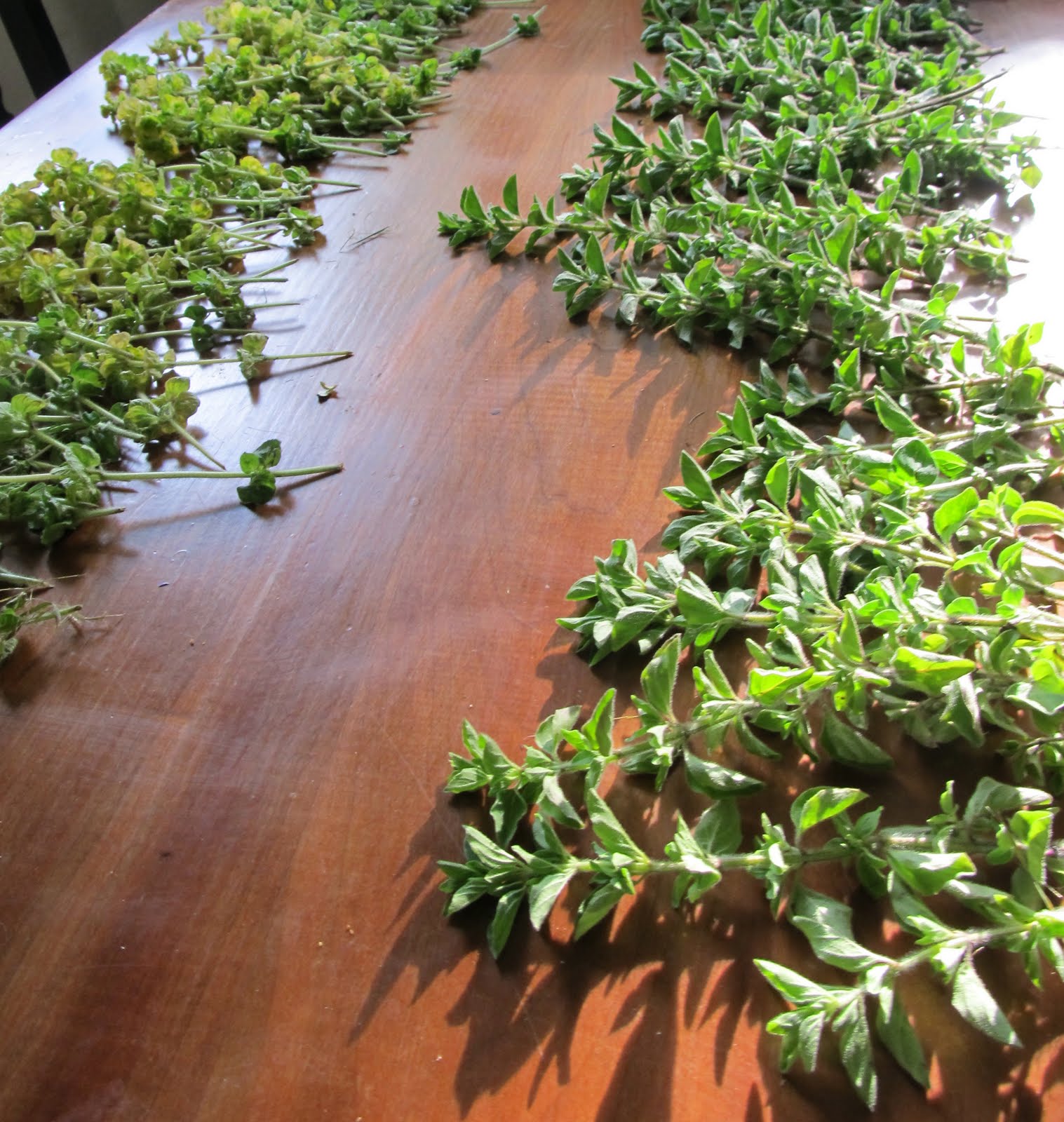
The driveway may not be as pretty as the first photo, but it's a better herb dryer. Put 'em on the asphalt, and it goes even faster. This is where refinished furniture, paintings, screens wet from being cleaned (yeah, like I do that) and whatever else needs drying goes on a sunny day. 

And when it's not a sunny day, having a hard surface is still nice. To walk on without being in the mud. To let the rain wash the dirt off something. To send some sediment and water to that soil patch downslope. Level hardscapes rarely ever exist. You may think it is, but water will prove you wrong. Anyway, completely level slabs are for chumps. You want gravity and water to help you clean it off, and not just willy nilly. 

There's also something about a barren patch in the midst of a garden that provides balance. The hardness feeds soil's softness not just with organics and sediment, maybe, but metaphysically, or maybe that's just the sleep deprivation talking. The hard speeds the spin of the soil-weed-soil cycle, at any rate. Weeds thrown upon the altar sate the more ravenous of the soil gods.

So yeah. Gardens should have hard surfaces. For those and other reasons. I have no brilliant or pithy summation. What did you expect from someone who delves into a garden series with a post about barrenness and concrete, death and dessication? Stay tuned, it gets easier...

21 June, 2011

Gardening Post 1

There have been other garden posts here before, but this is the first one lacking a decent title. And by decent, I mean smart-ass, obscure, and/or irrelevant. 


This is my fourth spring gardening in Olympia, and meteorologists say the region is a month or so behind schedule in terms of warming up. Even without the delay, the climate here allows for snow peas, strawberries, and lettuce on the summer solstice, which has blown my southern mind each and every year. Back in Old Virginny, where 90+ temps have become common even in May, the season for these has long since passed, and green is  turning brown.

 This shot is from the roof of my house, looking down into the front yard, which loses some grass every year. The road-side bed has wild strawberries, herbs, camas, a saskatoon, and the usual array of weeds, volunteers (as in, weeds I can use), things I cannot remember, and sprouts trying to fight their way through the strawberry blanket. This was the first bed I carved from the lawn.

At the far lower left is a glimpse of the driveway, along which I planted a row of blueberries in year two. The bright green patch has some strawberries that came to me from a neighbor wilted and unhappy late last summer. They're producing well right now, so much that there are some left for me after the kids have their fill. This be also has burgundy shamrocks that I may or may not have planted, spreading into a nice blanket and providing my youngest with an inexhaustible supply of tangy treats. There's also some mint edging, artichokes, bitterroot, oregon grape,...and of course stuff I cannot recall right now. 

The stone walkway comes from road cuts all over the state. It has taken years to accumulate. Stonecrop from an island up north is filling in the spaces, and is starting to bloom now. I had creeping thyme, but it gets as ugly and invasive as a neo-conservative after a while, and I ripped it out. 

The triangle beyond is mostly new, having been excavated last fall and winter to make room for a meadow full of stuff from east of the Cascades. Violets, lomatiums, sage, blue fescue and other grasses, hawkweed, camas,...and various things that either arrived as seed or stowed away in the roots of something else. Also here: a dwarf Fuji apple, lavendar, more herbs, a dahlia or two, calendula,... I'm not adamant about having a purely native garden. This plot is basically an experiment to see whether the hottest, dryest part of an Olympia yard can sustain things that would be more at home in the sundrenched Columbia plateau. 


The far corner has a sickly cherry tree, a garlic patch, and a circle of snowpeas that form a little fort where my young daughter can sit and snack, hiding from traffic driving by. There's also another saskatoon (like the strawberries, transplanted during that brief window of bad transplanting weather last summer, but in this case refusing to fruit as a result) and a mystery blue or huckly berry. Winters squash and cukes are poised in these beds, ready to take over after the garlic is done. There are also onions and some scarlet runner beans just taking hold. 


Out in the back 40 the mix of haphazard planting and geometric removals of grass continues. Along the fences are berries. A few fancy black and raspberries that I actually paid for, but also some wild himalayan blackberries that I prune into something like temporary submission, thimbleberries uprooted from logging roads, and mystery berries that were set out for free by the road this spring (but which had so little roots that less than half seem to be surviving). 

It's hard to see, what with the grass that I let grow tall and free, but there are three rectangular beds that are the closest thing I have to a traditional vegetable garden. They are more or less 4 by 12-foot beds, the size I can irrigate with a 25-foot soaker hose. Snap peas are producing heavily in one as onions are finally feeling warm enough to grow. There are radishes just beginning to be ready, beets still a ways away, and carrots only now sprouting their first true leaves. Summer and winter squash are planted, ready to fill in as the earlier crops finish. One bed has a variety of tomatoes. At the north end of each bed, where they won't shade everything else out, are hops. Willamette and/or Cascade planted a couple of years ago, and Fuggles a couple of weeks ago. 


The tall stump (footholds cut in it for the girls to reach its perch) is slowly being swallowed by native blackberries that I am experimenting with (a subject you will see here, and probably in future posts). The perimeter of that bed has Quinault strawberries just about to ripen, a native bay, a rosemary bosai'd by the last winter, and mint. Oh, and a lilac, fireweed, iris, and a cool green frog.


Maybe you can spot what's left of the rhubarb in the background, regenerating after harvest. The copse of alder that fills most of the yard has lots more native blackberry, hazelnut (I get withes and bean poles from it, while squirrels and jays hog the nuts), and various woodland plants I've snagged and tranbsplanted. Among these, oceanspray is doing really well, and in a few years should yield some digging sticks (it's other common name is ironwood). 


Not shown is a tiny hoop house with tomatoes and lettuce south of the house, and a more ornamental bed along the fence at the north end of the house, with ferns, red and evergreen huckleberries, and the neighbor's rhodies arching above it all. There's another similar one across an isthmus of grass that has shrubs on a tapestry of groundcovers, most all of which is native.


So there you have it, the basic, dull introduction. More like there I have it. I used to keep a garden journal in Virginia (but the dust with a broken computer, I think), and am a little ashamed that it took me this long to get going again. Are you still reading this? Congratulations. All I meant to do was start keeping track of what's growing, where, and when. You are incredibly dedicated.


30 May, 2011

Old 'Awa, New Tea


The great thing about a 3-day weekend is how it gives you time to concoct a complex plan, get started, procrastinate, rush to take care of the chores you'd ignored before because the project seemed cooler, and finally make a little more headway on the project before collapsing in lumbar agony. That's why I am sitting on a heating pad with stacks of wood cut, yet unjoined, in the garage.

My ridiculous primate architecture is modern enough that the skeleton is no longer so adept at canopy cavorting, but in many aspects not much different than a Cambrian creature. The spine is fine supine in the ocean brine, but sucks for feet on concrete or bending over.
In Hawai`i, one option was to drink some `awa (a.k.a. kava in most of Polynesia, yangona in Fiji, or Piper methysticum in the priestly language of botanists), which relaxes the muscles and either alleviates pain or makes a guy forget it in the midst of kava conversation, which flows easily and abundantly. I've seen it called a narcotic time and again, but it just ain't so. I used to sit under the banyan tree at the community garden, having a few cups with the Rotumans, Fijians, and Tongans, spinning yarns and stringing stories. Tongue numbed and eventually legs too, but nothing like being drunk and much subtler than the western pharmacornucopia had trained me to withstand.

I grew a dozen or so plants in the cinder  of Puowaina, adding years of leaves and compost before anything was harvested from black soil full of worms. Most were still going when I moved away from the islands, leaving them in good hands. The ones I dug were approved of by the garden crew, and my finest waka roots made it to Kona, to Nu`alolo, to Moloka`i Nui a Hina. 

Anything left from that batch would be a decade or more old at this point, but it turns out that I had some other `awa in the freezer, sitting untouched for who knows how long. I know a guy who spent a little time in Fiji and a few people with Hawai`i connections, but nobody to sit with and socialize over a bowl of vintage root. So, I broke into it for the medicinal value tonight, and here I sit, obviously feeling well enough to remain in the chair and blather on. So now I know that yeah, kavalactones retain some effect even after years in a freezer. Enough so I can blather further on. And on.

And off. To way back when I was writing about blackberries, a couple of posts ago. That had to do with another type of drink: blackberry leaf tea. Specifically the local native known as the trailing blackberry (a.k.a. dewberry to people who are more mature than I am, or Rubus ursinus to the science Latinists). I had hoped to dry it under the sun yesterday, but the sun got wind of that, and hid behind the clouds, snickering audibly. 

I'd also planned to cook up some tender shoots, but got waylaid by designing and starting to build something, and instead put off even stripping the leaves off the stalks til the after dinner sun-break today. The result is shown below, inside and away from dew, sending out aroma runners through the house, tendrils of citrus and banana peel wafting and tickling noses. I think it'll be good tea. 


29 May, 2011

I was gonna write about tending to the wild berries

but it turns out I already did. That time, didn't post any photos, however, so here are a few. I just trimmed back the new Spring runners, who in their enthusiasm would drown the carpet of older growth that has been flowering heavily this month. Where a shoot can cover new ground (like the pile of alder and cherry branches I want to hide), I let 'em go, but otherwise I want every precious photon that makes it to the South Sound ground to kiss the berries. 


Can you hear the bees?
Last year, I found that doing this makes the ordinarily tiny native blackberry swell up and sweeten. The wild imperative is to cover ground, send out runners to new bare spots, clamber and climb through other plants: colonize, colonize, colonize before the canopy closes so tight nothing will grow below. The berries seem to be secondary, the way to get birds and mice to transport a few seeds should the vegetative expansion stall.


So in I step to cut off the natural process for my own benefit, or my kids' benefit, anyway. This year I am more organized, and have caught the runners at a really good stage: tender tips, well-formed leaves, not enough time for alder debris and other dirt to add what I don't want, or for bugs to chew what I do. I've heard of the tips being candied and preserved, and tasted a few as I was cutting: there is a hint of berry flavor wrapped in mild astringency. Books say to peel them, but I found that pinching a shoot and running my fingers down it strips off what passes for thorns on new growth. Not sure whether I'll candy and preserve them, but they'll probably work in the wok or steamer, maybe snuck into a salad. 

Liko
The liko, the emerging leaves on the extreme tip, has more thorns and both the texture and flavor are stronger than the stem, so I'll pinch those off for tea. I'm hoping that it will be analogous to some fine Chinese tea I had one time, formed entirely of the baby leaves picked at their tender best.


Further down, the runner is too tough to eat, but the leaves are good. Again, it's a matter of pinch and pull, but this time I keep the part I removed, and toss the stalk.  (As soon as I write that, I find myself wondering what uses the stripped runners could have. Hmmm...) And again on another matter, I cannot overstate how nice the leaves are right now. No bug holes or eggs or exudations, no blemishes, none of the hardness of texture and appearance of old leaves. I have read many times about gathering blackberry leaves for tea, but nobody mentions that it should be done at young runner stage. I've already mentioned the tender freshness of the produce at that point, as well as the future benefit in terms of berries, but there is also this: the thorns are smaller and not so stiff, so it's easier and less painful.

It's rumored that there will be sun today, and the leaves can dry. That, I could not plan, but the rest of the timing I will take credit for later today as I sip some tea, and later this summer as I feast on fat juicy berries.

10 May, 2011

Saturated


I like nature. But as you may have noticed from some recent photos, I like sature. I saturate the hell out of some shots, and mess around with the color. Maybe because I have a lot of photos of grey days, and don't feel like I have to slavishly reproduce nature to love it. Maybe I am shiftless.


Or, maybe it's that that strain of mutancy that struck me 30 or so years ago has never been cured. Then, symptoms included hair bleached, blacked, and partially shaven. Clothes torn and meant to menace. People who paid attention could see the inconspicuous roots: middle class, suburban, performing well on standardized tests, and not very likely to fight the cops or die young. But the contrast was dialed way up, the colors were different than preppie era Mid-Atlantica, and there really was starkness and darkness the likes of which you cannot imagine if you have never lived through Reagan with his eager finger on the button.


Through a series of unexpected coincidences and alliances, the colors changed again. When you feel ya a good philia coming on, some new interest, and the doors appear and open, then lights flood in and the darkness seeps out to become a flimsy membrane separating universes you can transcend. Somehow, this expressed as less black, diminishing hair ministrations, and a lot more paisley. Eventually it would dampen into earthier hues, but 25 years ago was a time of oscillating from day-glo to thrift store treasure and less tie dye than you'd think. I became a cartoon, not just for the magic powers, but because the '80's needed a good cartoon, mired in the Smurf and He-Man nadir of American animation as it was. Lessons remain and reverberate from those cartoon characters: Joe Science, Lemon Meringue Hair, Monkee Michael Nesmith's lesser known cousin. (Under the heading of "Coincidence, or Cosmic Reverberation?": the TV just cut to a shot of a wee chameleon wandering through a forest of mushrooms).


Then it was time for something completely different. A decade in Hawai`i, exposed to da max and saturated in reefwater blue and mauka greens. Tropical colors hanging loose on shirts larger (to make room for all the results of ono grinds and aloha), but not as gaudy as you'd imagine: the back of the fabric faces out on locals, I still bought at thrift stores, and I wore them often under tropical sun. There were lessons in humility and culture, and a garden that managed to show me new roots while bringing me back to some that had grown for generations in Virginia soil.

Another series of not-so-unexpected events meant the Hawai`i thing could not be sustained, and a partnership between coincidence and intent brought me to the northwest. Colors more subdued than ever as far as the clothes go, me more sub-dude. Blending in for the most part (or not--I might be underestimating my slovenliness, which may be cartoonish for all I know). Saturation, hi-exposure hi-contrast images occur primarily in my mind for month upon drizzly month. Words vivid, livid, and lurid make their way into black and white. I dunno what the picture for this period will look like, and so it is an image from this time that I've played with for this post.
 
So, I no stay Hawai`i anymore, nor can I even remember it without a sepia filter of nostalgia and fuzzy recall. I never was a very good hippie; never tried, really, there being enough punk remaining to relentlessly mock hippies who were 20 years too late to be anything more than historical re-enactors. My ears still ring with punk shows that ended 20 years from now, but I don't even have enough gumption to go down and yell at today's re-enactors, and don't really get into costumery anymore. Things change.


And things stay the same. Like roots. Everywhere I've lived, the native people had roots cultural and literal. Sustenance for society and stomach. As much as I might look or even think different, there has always been some tether between me and the earth, some string through me and my people. Saturated and distorted as some snapshots of my life have been, the roots just hang in there, more or less the same. 

[Seriously, what changes less in the shots above than that little plant, it's yellow flowers, it's big happy root belly? How is it that in the last shot, where nothing else is the color that it was in so-called reality, can the plant persist unadalterated? Must be that I am a meddler, not a creator. Ego has its limits.]