Does the word that just popped into your head show up here? Find out:

Showing posts with label preservation. Show all posts

28 December, 2014

Yon Rock Art Rock Art


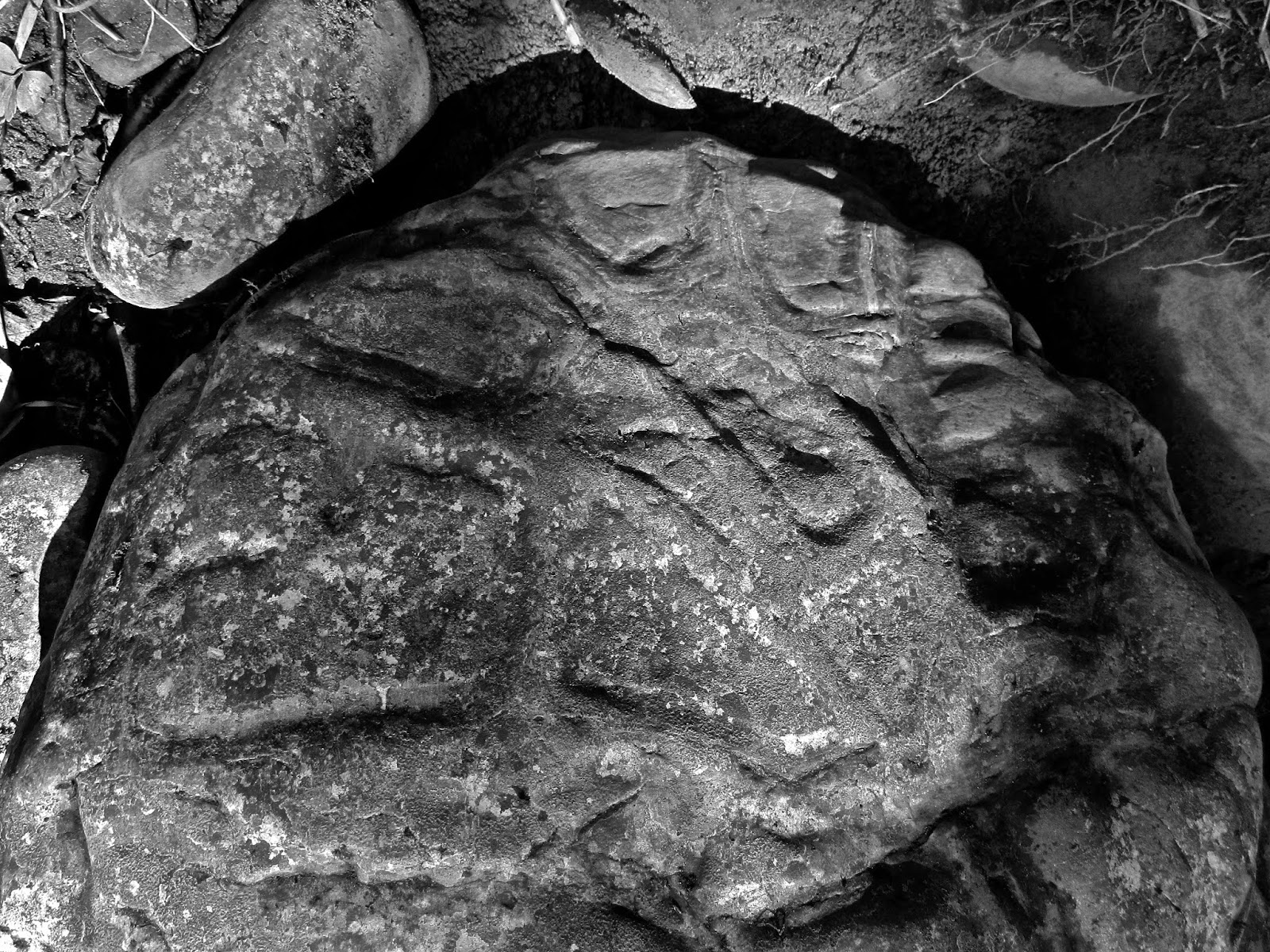
Do archaeology long enough, and you'll fill your bucket with tales of people who come to you with Important Discoveries. Often as not, they have found some really significant Rock Art that may Change History. Often as not, the rock is virginally free of human touch, or has been violated by a bulldozer, its scars mistaken for petroglyphs.

On the other hand, it shouldn't take too many years of doing archaeology to recognize that people do make bona fide Discoveries. Like the guy who took his kid fishing, wasn't having much luck, and noticed what looked like carving on a boulder.


The fisherman contacted the Tribe of that River, as well as some archaeologists for the state. The river rose over the boulder, and fell again. The machinery of state moved slowly, then quickly. The Tribe and the archaeologists agreed that this was a singular boulder, carved with a depiction of K'wati the Transformer, slaying Xa?lax the Lizard. It turns out that the Quileute have an oral tradition about these two, and places their fight about 200 meters up-river from where the boulder was found.


Do archaeology for a very long time, and you see that rarely does Tribal history mesh so well, so specifically. Do archaeology for not very long at all and you'll already notice that there's rarely much Art in artifacts. Mostly, we look at rubbish and broken old tools. Sometimes they're well made, even masterly, but the Calawah boulder represents something more, an artistic vision that wraps through (at least) three dimensions and weaves carving onto a net of red veins in the stone, transforming them into Kwati's comb and tongue, and a cranky red lizard.


Do archaeology long enough, and you witness enough looting that it's inspiring to see a case like this where the guy who found it told the Tribe instead of taking it himself or selling it. Do archaeology long enough, and it gets easier to cynically write off your profession as the production of rarely read reports and unexamined artifacts locked in boxes, so it's good to be part of a discovery destined to be adored by a People.

Be an archaeocrat long enough, and you know that it can be hard to achieve consensus around doing the right thing (not just legally speaking) with different agencies and sovereign governments involved. But in this case a Plan was devised, a Council Resolution passed, and a Permit issued in the course of a couple of days. The boulder was pulled from the River and brought downstream to La Push, where it sits safe and sound, protected by the Quileute Nation. For the discovery, for the mere existence of this multi-dimensional work of art, and for all the right steps along the way, I am thankful.


On the dimension of gratefulness, the boulder resonates further. My colleague shown here retired recently, but got to document and protect this petroglyph as the final act of this long career. Years of recording can scatters, isolated chert flakes, and other near-meaningless junk--not to mention all those days of finding nothing--and he was rewarded with this. It may not sound as scientific as people want archaeologists to be, but I really feel like the land thanked him for decades of his care and work. If you do archaeology long enough, and do it for the good of the sites, your good karma bucket gets pretty full and things like this happen.


09 August, 2013

It's the Watershed


Thanks to stevenl on olyblog for posting this down-Deschutes shot. He thinks the postcard dates to the mid-1970s, a time when the Olympia Brewing Company still ran strong, and was so proud of it's beige industrial sprawl they issued this image, rather than the charming old brick building.

Olympia's motto, of course, was "It's the Water," and we do have great water, our artesian wells are famous, delicious, and clean. But surface water is an other story, a sad one, as this shot illustrates.

In the foreground, the Deshutes River, in summertime flaccid flow. Could just be a dead-calm day, but I feel like there's an oil sheen. Maybe not.

As far as the river is visible, the brewery takes up the right bank. Since I'm too lazy to track it down, I don't know what they may have flushed into the river as part of normal operations, but up until about the date of this postcard, when Dick Nixon signed the Clean Water Act (what a liberal!), people and corporations did dump all kinds of things in the water. All this view shows is a treeless bank and acres of impervious surface, which when the rain kicks in will dump huge amounts of runoff compared to what the natural watershed would have, not to mention the sediment, railway grime, and other trappings of civilization.

Which the river then delivers to,...Wait, I cannot see. It disappears on the other side of the Capital Boulevard bridge, past more brewery buildings, over the spillway...I mean Falls, and finally past the old brew house, Olympia's most famous ruin. There's a park on the other bank now, and the old brewery is abandoned. You can kid yourself into thinking it's returning to nature as long as you deafen yourself to the I-5 din.

But really, the Deschutes is about to empty into Capitol Lake. Or, as stevenl calls it, the Fetid Lake Of Doom, or FLOD. Flotsam and sediment from the watershed settle out here. In fact, the muck contains the remains of Little Hollywood (Olympia's Depression-era Hoovertown), and before that a literally marginalized Chinese community, I think. The artificial lake relies on a dam that transformed the original estuary into a pond (yep, the reflection of capitol and trees sure is pretty) with a sluice being the only way out. So the estuary gets buried and eutrophies (yep, the low tides and summer algae blooms sure are ugly).

The postcard more or less hides The Isthmus, site of many a battle in this millenium. Positions on Isthmus development cause the city council to change, parts of it were Occupied, it is home to Olympia's second most famous ruin: the Mistake on the Lake. Walk around the lake, and you'll see signs explaining various positions in the Debate of the Lake: dredge it, restore the estuary, do nothing...There is no sign saying "Isthmus be Hell."

Meanwhile, the lake keeps filling with muck, and the water keeps flowing into Budd Inlet. The head of Budd is divided into West Bay, which is where the Deschutes comes in, and East Bay, which is where a culvert let's loose what's left of Indian and Moxlie Creeks. Most of the city between East and West is built on dredging spoils and fill.

West Bay is undergoing a transformation these days, as the buildings and piers of yesteryear's manufacturing concerns disappear. Some of it is undergoing restoration, as far as a railway embankment can be restored to a natural state. But people are not about to abandon the waterfront entirely, ceding it to nature. So pockets of "beach nourishment" gravel and chained-down "large woody debris" have to coexist with armored shorelines in a state that I will now call Percivaltory, after Percival's Landing on the waterfront.

In the postcard, it looks like there may be log booms in the bay. No more, although the POO (Port Of Olympia) is hopping, putting trucked-in logs on trans-Pacific ships. The watershed's wood (state timber excepted) flows all the way to China. 

23 June, 2013

Tilted

Tilted and saturated, but on track and no mirage.

FOX "NEWS" being just the most blatant example, "fair and balanced" means little these days. But they're not to blame for the media's enshrinement of "getting both sides of the story," which both reduces complicated stories with many angles to two views and misses the point that true objectivity is a delusion. We never have all the facts (and tend to prioritize them differently), and humans are subjective even when they try not to be; the belief in objectivity is a subjective choice. 

People like to trot out the hard sciences to counter this argument, but my dad was a physicist, something I mention to give myself the aura of osmotic knowledge before explaining that Quantum Theory means that every observation changes the act being observed. On the surface of it, this would appear even more true for human culture, which is built on communication among subjects, each reacting to the other not only for the words said, but a variety of other cues, constantly adapting. By Anthro 201, I'd been taught that an ethnographer going in and taking notes and collecting data and walking out with a sense that he has an objective knowledge of the culture is insane. 

One way anthropologists deal with this problem (if it is a problem) is through something called "participant observation," meaning you do not stand by and take notes, you take part. Spend time with the community, learn their language, do the things they do. Which of course will be different for a 25-year-old male student than a 55-year-old female professor, neither of whom will get the whole story on a culture. Even if they want to, even if they succeed in transcending boundaries in the culture (maybe especially then), their presence  shapes the behaviors; when the anthro arranges the data and writes it up, other factors in her history, campus politics, mundanities to be dispensed and crises to be dealt with will all lead to a certain flavor. 

Trying to be objective is not a bad idea, though, and anthropologists or journalists or judges who go in with preconceived notions, hardened biases, or dull axes can be dangerous. Being open to facts and contexts for them, presenting different points of view, and not making data serve message instead of the other way around are all laudable. 

But sometimes it is laughable that both sides of the story get equal time, particularly because in America all it takes is money to elevate looney views to legitimate policy alternatives. Sometimes, one side is just flat out wrong, or interested in the 1% at the expense of the 99%. If in the name of Objectivity, the journalist gives traction to, oh, let's say the Iraq War, he has just aided and abetted a great harm. If the anthropologist is too detached and writes the academic articles but sits out the political action, she's taking sides.

Hmm. Here I am writing about anthropologists, pointing out where they can go wrong, without so much as a PhD. No specialization, making a living doing archaeology yet presuming to write about living culture, working not on a campus but in a state office. This blog reveals me as opinionated, and probably extreme as far as the bloated center of a bell curve is concerned. I'm pretty open about my bias that native cultures have had it very hard in this country, and that we ought to do what we can to perpetuate them, even if that means putting aside the notebook and taking action. 

So to some, I'm a shame to the profession. Even here at the blog, my own spew zone, I've had the occasional comment that I'm not even-handed enough, or missed something, that I was too extreme. Among my family and friends, I'll cop to being on the prickly end of the scale; I've been described as "fierce" by one. Which is true in some cases, and of course I've written things that I regret, but that's the price of feeling free to speak up. 

I am not objective, and cannot detach from something I care about easily, so I take sides. Being fair is fine, but presenting both sides of the story as if they were always of equal merit? Nah, I can't do that. Maybe three sides, or five. Maybe a dodecahedron of perspectives. At work, I need to collect data and write about them, sometimes making recommendations based on particular circustances--there is a place for something approaching objectivity. But here, opinions and iconoclasty can run loose, and my political tilt is right up front.

22 June, 2013

Camas Fields Forever


For two weeks in a row, I've been blessed with fieldwork in a sublime Cascadian meadow. This last time, I encountered other western Washington folks who'd made the trip top see the legendary camas bloom--the place is so famed for this blue lily that it's common name is Camasland. Last week was the time to see the bloom at its peak, when the flowers are so thick that swaths of meadows turn blue; I offer these photos (which are pathetic  stand-ins for the real scene) to those who missed the day. Explorer accounts back to Lewis and Clark speak of camas meadows that appeared to be lakes, although to my own eye (connected to a mind that demands less sense) the biggest areas of camas looked like pools of sky, complete with fluffy white clouds of American Bistort.

Camas is just the best known of many plants in this meadow that are important to native people. This meadow is a treasure to the Wenatchi and other tribes that came here generation after generation, congregating in large numbers to harvest the roots, socialize, and later light the fires that kept the meadow from reverting to forest.  The soil is black from thousands of fires, dark rich testament to centuries and millenia of tending to this special island of meadow in the Cacadian treed terrain.


While the blue may look more like sky than water to me, the camas lily appreciates lower, wetter ground, which means that sometimes it lives in the silt of relict channels and silted in streams. Camasland is a flat meadow within a bowl of forested hills, and the stream that winds through it has meandered here and there over the years. The photo above shows the faint blue of camas in one of those old channels, with the yellow flowers and larger foliage of balsamroot on the banks. Difference in elevation between these zones is only a few inches, but that's enough to nurture quite different vegetation on each. The meandering blue is an echo of a stream, a channel living forever.


This landscape is special to modern people as well. Years ago, the state decided to conserve the ecosystem here, and set aside most of it. There are rare species involved, but the place is special also because of the abundance and cultural importance of some of the more common species present. Preserving this place forever means that the ancient yet fleeting beauty of a wildflower meadow will not become a housing subdivision (the fate of most prairies west of the mountains) or some other modern development that will be fleeting compared to the natural and cultural history of Camasland, but which could do irreversible damage.

20 May, 2013

Silence of the Lions

  
All archaeologists must endure the ignorance of a populace that thinks we dig up dinosaurs (that would be paleontologists) or look for gold (leave that to geologists, prospectors, pirates, treasure hunters,...pretty much everyone except archaeologists, who chose their profession in part due a pathological aversion to wealth). But those among us whose work is basically to maintain compliance with historic preservation laws must also face a public that cannot fathom that something a mere 50 years old is considered Historic. If I had a nickel for every time I've heard, "But that's just trash" or "Well hell, I'm historic then," (think again, pal, you need to be dead and abandoned for 50 years), then I'd be rich, and might therefore have to give up archaeology.

On the other hand, we occasionally get to see some interesting, if not ancient, things. Like the moldering and abandoned maritime heritage of WWII, for example. My agency disposes of these things, obstructing our waterways or fouling the water, boats and floats that are beyond repair, of interest to nearly nobody; my job is to wring whatever information I can from them before they become actual garbage.

The boat above was launched in 1944. I don't have the full history yet, but it became a Coast Guard boat after the war, and eventually was sold off. This is the second boat of about this size and age that I've documented recently; the WWII boats that are left are not doing well for the most part, and before long all but a few beloved ones will be gone. Many are steel, but WWII still saw production of a lot of wooden boats.

Mass production, to be precise. My grand-dad was a teacher who spent summers in tidewater Virginia building Liberty Ships. These may be the epitome of mass production, but the more WWII-vintage vessels I see (tugs, dry docks, patrol boats, and so on), and the more of them I investigate, the clearer it becomes that the majority never saw any action. Many were never really mobilized, launched in the last year or two of the war only to sit idly until they were  sold as surplus for pennies on the dollar. Eisenhower, administrative officer extraorindaire, probably recognized the waste, speaking out as he did years later (as president ordinaire) against the perils of a military-industrial complex; before said beast was a threat to our economy and freedom, it was guilty of (mere) overproduction. But in 1944, neither Ike nor FDR nor any of the (finally) employed shipyard workers was about to object to padding the reserves and making a few extras if it meant the Emporer and Fuhrer (oh, and the Depression) would be defeated. 

But the fact is, many of these machines of war never did roar, or even approach the action. They sat. They collected dust and rust until they could be sold off. 


Other materiel was just cut loose, apparently. This photo is of a float that held up anti-submarine nets deployed in Puget Sound. Again, I lack a detailed knowledge of the history, whether this system would have really worked if needed, or when the sub-nets were abandoned. But the floats have lived up to their name, and bobbed around Puget Sound for decades. The heavily galvanized bolts that hold together the deeply-creosoted timbers can sometimes still be loosened, and although many are starting to fall apart, others are more or less like they appeared for years. Well, less, I guess, since one of the problems with these is that they leach toxic creosote into the water. That and their tendency to obstruct navigation and damage shorelines is why they are being removed. 

Yes, there were lions that roared during the war. Great guns on boats that laid waste to Japanese fortifications on Pacific Islands and German ones in Normandy, landing craft disgorged hordes onto beaches. But many of those were sunk or so heavily damaged that they do not survive today, or were so important that they became shrines, no longer used. The overproduction, on the other hand, escaped notice like the floats, or was repurposed like the boats. They saw no action, and lived to see another day. And another and another, until time and the elements did to them what the Imperial Fleet and Admiral Doenitz could not. So I walk around them and crawl through them, mostly in silence, taking photos and writing notes that may be their last words.

18 May, 2013

It's the Fountain? An Olympia (and Tenino) Mystery Artifact


The front of a font, maybe.

Last Fall, I came across something that other people have probably seen for years, and others have forgotten about for even longer, but it was new and mysteriouis to me. Embedded in an old road berm on the Eastbay shore was a big piece of carved sandstone. Recently, I was around as a city crew pulled it free as they prepare for an environmental restoration project. In decades of archaeologizing, this stands out as one of the biggest and most interesting artifacts I've seen. It also holds a few mysteries.

Now that I've had the chance to look at it a few times, see the dirt it came out of, and talk it over with a few other archaeologists as we examined it, a few things are not so mysterious. Like, it was pretty obviously just dumped here along with concrete, asphalt, and brick rubble, part of the berm that blocked the mouth of a creek; a neighbor thinks the Salmon Club may have been involved, but it is also in a City park, at the bottom of an old road, and may have been deposited by them. I'll get to why I think that may be the case in a bit.

The stone is sandstone, and a partially obliterated inscription on one end is enough to convince me that it came from the Hercules Quarry in Tenino. The top features a square flanked by two octagonal basins, and a tunnel runs through it. There is rust surrounding one side of the opening, indicating that there was a metal attachment there, and along with pipes running from bottom to top, it suggests that this may have been a decorative fountain. The base, beginning immediately below the tunnel through the stone, at first appeared to be sandstones as well, but turns out to be stucco over concrete. The very bottom is unadorned concrete that contains glacial pebbles and bits of shell, more what you'd expect of a locally-mixed batch than what comes from commercial suppliers. More specifically, what you'd expect from a shoreline local batch than Tenino. (Ironically, the development of commercial concrete businesses is what did in the Hercules and other quarries in Tenino.)
The top.
And that's about it for what I know. A once fancy piece of stonework, stripped of metalwork and dumped on the Olympia shoreline. Maybe a fountain, and if my interpretation of the inscription (shown below, after considerable computer enhancement) is correct, it was a presentation piece. It just so happens that the abandoned road heading uphill from this spot leads to the former location of the "Swiss Chalet" that stood in Priest Point Park from not long after it's 1905 founding until the 1950s. Before that, the Chalet had been part of Olympia Brewing Company's pavilion at the Lewis and Clark Expo in Portland. A nicely carved fountain proclaiming a presentation and naming the quarry seems like just the sort of thing that may have appeared in that sort of setting, especially since Olympia Brewing even in those days was stating, "It's the Water."

Or, maybe the Hercules folks presented it to the park. Or, something else. Some sort of Park connection makes sense, though, given the proximity (seems like an awful big stretch to say that some Tenino resident hauled it all the way up here to dump it), and the fact that you need heavy machinery just to move the thing.

"PRESENTED BY HERCULES QUARRY, TENINO WASH" (Guesswork in grey).
Odds are, this modestly monumental stonework, dumped and forgotten for years, is likely to be recycled by the City of Olympia. Maybe placed in the park, or maybe elsewhere, but people once again see it as something interesting, worth using for some better purpose than shoreline armoring. Maybe it could be fixed up and one of Olympia's artesian wells could bubble forth from it.

In the meantime, if anyone out there knows about this, or has photos of the chalet in Portland or in our park, leave a comment and let me know. If I find out anything, I'll write an update. 

24 April, 2013

Obliterative Persistence


Yon shot shows the floodzone of Scottsville, Virginia, on the River James. Once, it was called by King James' subjects the River of Powhatan, the name they used for the local leader Wahunsenacawh (father of the one they called Pocahontas), but this is upstream of his territory, where Monacan people no doubt had their own name. 

The photo is dominated by the most recent development along the north bank of the river, the massive dike clad in grass; it protects a town where people travel by pick-up and, increasingly, crossover SUVs and hybrids, none of which appreciate being flooded. Just to the right is the penultimate development, black rails on a bed of gravel where grass nor weeds nor even the most beautiful shrubbery are tolerated. Under that, and perhaps in the trees to the right, lies the canal that was obsolesced by the railroad; old timey as it may seem, the canal was no less a scheme to make money off of development and the transit of goods to markets. The red brick building handled the trade, but now it's cut off by dike and a pair of rails.

Further right, the brownwater of the James peeks between tree trunks. Once, people and their stuff moved on the river itself. Canoes, then batteaux. Way before that, there was a low spot in the terrain that water sought in it's quest to become saline. Now, cities pump out of the flow so the masses may drink, and a warming globe sucks it dryer and dryer every summer. 

Even when I canoed this part of the river in the early 1980's and had to hop out and tow it (downstream, no less) through massive algae blooms in tepid water, the James seemed like a hard place to move even a lightly loaded boat. The canal meant to bypass seasonal shallows and permanent outcrops was first damaged by federal troops before succumbing to rail-borne manifest destiny. Railroads still run, but mostly for the most massive of commodities such as Appalachian coal headed seaward, while diesel trucks carry the bulk of consumer goods. The town of Scottsville feels safe behind it's dike, but this too is momentary, as it was not planned for the climate changes facing the good townspeople and everyone else. 

The town exists because there a road crosses a river. One transportation system lays itself over the last. The stay the same even as they change. What we are used to will change, and what we build will fall, but the river still flows to the sea.

14 April, 2013

Desecration is in the Eye of the Beholder

Do this to my grave and I will haunt the Hell into you.

Some people decide what's gonna happen to their bodies when life departs, willing the afterdeath: cremation, burial, embalming, burning viking ship, and so on, hoping the dearly un-departed will live up to the legal document, maybe even the dying wish. I'll cop to having considered all of the above except embalment, and can add a few more to the list, like: worm-food, fertilizer, being planted at the base of a tree, and something like the Zoroastrian end. 

Some people live in fear that somehow their corpse will be defiled, their burial site will be desecrated, their remembrance dirtied. As an archaeologist I've witnessed cases and heard reliable tell of epidemics of graves razed, bones bulldozed, and I'd rather it not happen to my bones, but I don't lose sleep over it, or even comprehend it as more than an abstraction.

But the other day I witnessed the routine maintenance of a US President's grave, a founding father, beloved by Virginians. A guy pulled up, trimmed weeds with one gas-powered machine before blowing trimmings with another. I don't speak for any dead presidents, singular or en bloc, but the racket and fumes felt like desecration to me. Said president remains synonymous with ambitious and creative husbandry, the idealized American nation of farmers, and so it's hard to imagine the guy being OK with a noisome din and gassy humors of the modern maintenance regime.

I don't blame people like the guy in the photo, and if you recognize him, don't be mean. He's just doing his job, and there's a lot to do for only a few staff, not the dozens of slaves and overseers that did everything in the President's day. Blame goes to that culture which cannot get things done without real slavery, or a mix of wage slavery and polluting technology. Maybe someday we'll be forced to do things by hand again, kill the leaf blowers and employ corps of landscapers at fair wages to weed, rake, and in all manners tend the grounds and graves, but I'm not holding my breath (until I die). Until I can keep gas-scaping from tending my grave, I think I'd rather be cremated and put where the weedeaters and leafblowers cannot reach, where the noise blows in on the wind and not out on the exhaust.

The dead were not issued ear protection.


29 February, 2012

The Other White Album

There will be no image for this post. Imagine an old-school album cover, a canvas of slightly over one gross of square inches where record companies could visually present their product. If this worked, or if dumb luck smiled up a string of hits, then the band could do a Concept Album, complete with specially commissioned airbrush art.


So imagine a young punk's joy at flipping through a bin at Plan 9 and eyeing an album with no damn art at all. Imagine your fingertips treading to the Beatles' "White Album"  (blessed occular nerve relief from Sgt. Pepper's Gaudy Arts Club Band).

Now imagine that you are some lame old longhair, and that in another section of the store is some punk kid looking at a real white album. No words. No fucking advertisement for the band, and sure as shit no critics coming along later and using this marring of White Album-ness pretentiously, as in "Only the original vinyl was thus embossed. Other pressings are worthless...except for the music I suppose."


Furthermore, this blank expanse of non-ink contained within it more or less the legendary album (even when the Sex Pistols were only stale, not historic) "Never Mind the Bollocks." The punk boy knew this because the counter guy said so. So it was a bootleg! Young punk boy didn't know much, but he did know that buying a legit album would just hand money to wankers. Neither he nor the record store, I think, ever figured out that selling certain albums in unmarked sleeves would incentivise insecure customers' purchases.


The vinyl did not disappoint. Banter not on Bollocks (he did know that meant balls or something) appeared on this disc, and at least one song from the album (that grand old abortion ballad "Bodies") had gone missing. The quality was probably shittier than the commercially real thing. Most of the songs sound different, and young punk boy convinced himself that he had real recordings of the band, and not the over-produced crap in the House of McCLaren album cover. 

And so said album was not hidden in shame, culled, nor abused so badly that abandonment remained the only course. This week, that punk boy (now incapable of a mohawk) rearranged some things in the garage, got the phono simultaneously spinning and plugged in and not scratching the hell out of records. It had been two out of three the last time, but that was a crazy set-up on a table saw. Now turntable rested on a heavy slab o walnut on foam strips atop a surprisingly vibration-free freezer, an elegant blend of opportunism and mechanical physics.


He listened with dulleder ears than he had when this smudged and patina'd album was new, when digital recording was unheard of, groove ruled, and once you done scratched, ain't no going back. He cleaned the vinyl, and it looked pretty good, but antiquity popped, wowed, and fluttered through each side. Which was intense, in that fuzzed up preservation of something rough to begin with adheres to the ethos more than a digitally manipulated (is that a redundant phrase?) version available at vendors these days. 

Alas, it was also untense, slack and slow by the hardcore that supplanted American punks' British fadscination by 1980. Johnny Rotten's relentless tooth-hamming remained audible, sneering clearly after all these years while the bass was hard to pick up anymore, but maybe that just what happens to punk boy's ears after standing in front of PA stacks too much as a kid. 

Even if he cannot hear it right, the Sex Pistols canon is preserved, historicized (I've never seen so many notes on a wikipedian entry: 238 as of today), and curated. The Sex Pistols refused canonization by the Rock and Roll Hall of Fame a few years ago, but they do still manage to cash in on their old man music. Meanwhile, God saved the Queen for a 50th and now 60th year of her reign, while Lydon still mugs for the camera for a few quid. 


Lost luster and ironic subsequencies didn't ruin the listen, though, and when the arm swung back to it's resting place and the turntable drifted to a stop, punk boy was a little less old man than he'd been half an hour earlier.

30 November, 2011

Anthropocene


In case you did not know, there is an International Commission on Stratigraphy. They decide the chronostratigraphic units that reckon our geological time. I'm not saying they deserve the entire credit, but without them, we'd be stuck in the Pleistocene, baby.

But here we are all smart and modern, in the Holocene Epoch, ever since 11,787 years ago this coming December 22. We know this because a shift in deuterium excess values was observed in the GRIP ice core in central Greenland, spelling the bitter end of the Younger Dryas cold period. Adios, Pleistocene, giant sloths, and dire wolves.

Many stratigraphic units are decided by extinctions, but more often of much smaller creatures than the megafauna that capture our imagination. This makes sense, because stratigraphers intent on finding minute changes tend to look in fine layers of sediment, and it's hard to squeeze a mastodon into one of those, not to mention the fact that for every giant mammal there are untold multitudes of rotifers. And when temperatures change, or atmospheric chemistry shifts, certain teeny species die, while others emerge from obscurity to fill new muds with their skeletons. The individual deaths and the mass extinctions were not for naught, though, because their ancient sacrifices have borne unto us just the sort of evidence we need that the earth changes, and is nearly a million times older than the stratigraphy-deprived biblical scholars used to tell us.

Not that the establishment of global stratigraphic units is completely automatic, uniformly legible to all geologists. I don't know enough of the ICS workings to state it as a fact, but I do have enough familiarity with academia to hypothesize that there exist disputes, heated disagreements, perhaps even feuds over just what comprises a certain boundary, or precisely how old it is. One area of disagreement I do know about has to do with the most recent epoch, on the candidacy of the Anthropocene.

"Cene" is the favored ending for stratigraphic series that define epochs, at least since the dinosaurs left the scene. "Anthropo" of course refers to the most hairless and arrogant of the great apes. So Anthropocene refers to a new chronostratigraphic unit corresponding to our presence on a scale that influences geology.

Not so quick, some of the ICS brethren say. Perhaps we are again over-estimating our importance, and geology will wipe us and our sediments away. But it looks to me like we've deposited enough concrete to make our mark.

Among the pro-Anthropocene contingent, there are various ways of reckoning its onset. Some argue for the beginning of agriculture as the threshold, since this is when humans really began altering soils and sedimentation, both with intentional acts like tillage and terracing, as well as mistakes and disasters ranging from burst irrigation reservoirs to the Dust Bowl. Personally, I think agriculture will prove to be too fluid a concept to nail down a global start date, besides which it may end up subsuming the entire Holocene and perhaps more, depending on how it is defined, and then what is the ICS to do? Backtrack? I think they'd rather not.

Other criteria abound. Such as the beginnings of cities, which create deposits of structures and artifacts that last long after they people move on or bury them under more stuff, as we are wont to do. Or, the wave of extinctions in our wake. Or, carry on with the atmospheric chemistry or global climate approaches that have defined other chronostrata--we've warmed the earth and perforated the ozone, isn't that enough to merit (to our own demerit, maybe) a human epoch? It took us a while to get to that point, but what about the creation of highly radioactive isotopes? It is no coincidence that the "present" in radiocarbon time is AD 1950, the years when enough atmospheric tests of nuclear bombs occurred to screw up any subsequent carbon dates.

Eventually, it won't matter what we say. Alien paleontologists will land on earth and reckon by their own system. They'll find a strata rich with large bipeds, and if they are lucky, they may find one of them clutching a laminated copy of the International Stratigraphic Chart.

30 May, 2011

A Compendium of Gathering

Bracken and Black (High-end forager supply company, or AC/DC allusion?)

Nettles are flowering, and the time is past to gather them, but as the year rolls on new opportunities arise low and high. In among the tangles of young trees, webs of bracken rhizomes have been sending up shoots for a while now, and last week I managed to snag a few in that liminal state between tight fiddleheads and loose leaves--not ideal, but not yet deadly. (Well, maybe. Bracken contains carcinogens, but so do a lot of things. I grew up on the East Coast, where all late-20th Century children were marinated in toxins, so I'm not worried about a few ounces of fern at this point.) If it snaps off easily, I figure it's still good. 

Nicely coiled fiddleheads are a little earlier, and harder to find, having not reached up through the unraveled blanket of last year's dead fronds. On the other hand, when you see a patch of the orangey leftovers of last year's patch, you know where to poke around. It's just a question of finding a place where you don't have to reach through too many blackberry canes or branch-tangles to get at them. Long ago, it was a lot easier, since tribes burned some areas to fertilize the bracken and thin out the competition. Yet another case where "gathering" is not so passive, and tending was the order of the day.


Wait, did I just make it sound like native gathering was in the past? No, it carries on. Generations of assaults by guns and germs, assimilation by churches and boarding schools, lost land and knowledge,...none of this has completely wiped out the old cultures of the northwest. In forests around the Salish Sea, tribes have answered the call of the rising sap, congregating around cedars to get boughs, bark, and roots. 

In the Days of Yore (Last Week)


As the Plains people used all the parts of the buffalo, so do the local tribes use all of the cedar. Wood becomes houses and canoes. Roots become baskets so tight and durable that you can boil water in them. Boughs might be woven more loosely into baskets that hold clams. The inner bark can become anything: hats and clothes, ropes, mats, diapers,...it's as versatile as plastic, and much more sustainable.

The practice is to take a little bit, allowing the tree to heal itself. While tribes don't depend on the tree to clothe everyone anymore, they do use the bark. The photo above is a group of kids from a tribal school, escaping their more urban home to connect with the trees and nature. Another tribe is gathering bark in preparation for hosting the canoe journey next summer, when they will need things made from the bark for themselves and for a big potlatch. To give a visiting elder a nice cedar hat in 2012, people have to be on the ball in early 2011, scouting trees, pulling bark, cleaning and curing it, and finally spending the long hours of weaving that produce the gift.

Every time a kid learns to pull the bark and transform it into gifts, she is adding a strand to the weave of culture. She is perpetuating traditions thousands of years old, and preserving knowledge that may be useful for thousands more. She adds her weft today, and becomes the warp that her kids will add to tomorrow. Every student who learns that the ferns are ready when they are ready, that gathering is governed by earth's cycles, that simple knowledge can be profound, that working with nature instead of trying to dominate it yields great rewards, is tapping into a flow that has sustained his people for millenia, and is a far greater hope for the future than our petroleum economy.

Spring arrives, the fronds stretch up and the sap rises. People who listen hear the call, and receive the treat.

NOTE!: Bracken would be hard to eliminate, but cedar bark worth harvesting is far less common. Tempting as it is to go pull some and try to making something, think twice and talk with the tribe whose territory you are in before even thinking about stripping a tree. There is a lot of spiritual and practical knowledge that governs how it is to be done, and if a bunch of people descend on the forest to gather, many trees will be needlessly damaged by the unskilled or over-harvested by even well-intentioned students of northwest native cultures. Undeveloped lands where tribes can exercise traditional and treaty guaranteed rights are becoming less common, and land managers have enough to worry about without an influx of people with no treaty rights gathering bark. 

In general, if you are going to forage, think about who will come next year, a decade from now, seven generations in the future. If you are cutting off their chance, you are not doing it right.

22 May, 2011

Same Old Same Old Paradox

Fresh-baked rock. But would I know that if it weren't so obvious?

Archaeologists face the challenge of reconstructing the past based on the tiny percentage of it that does not decay, wash away, fall prey to collectors, or otherwise get gone. But before we even get to coaxing tales from stones, we have to find them. In that search, human habits are both boon and bane.


Much as we want to think we are different, that we have higher intelligence, we are animals, mammals with habitat needs, habits hard wired. Until recent generations when urban living and industrial farming has been drained the countrysides and made possible lifeways disconnected from subsistence and survival activities that were typical since we spun off from the ape clan, we have not escaped the biological imperatives. Omnivorous us can adapt to all sorts of environments, but we need to be near fresh water, and we'd prefer some flat ground with a field of vision not entirely obscured by vegetation. 


Oh, and we burn things. Lots of people now live in bad habitat rendered acceptable by architecture and infrastructure, but even city dwellers like to have a campfire now and then, and when we head out to do this, often as not we end right back in what our brains' ape lobes recognize as good habitat. Places people camp now often end up having been discovered thousands of years ago. For that matter, a lot of cities are built where towns replaced villages replaced camps replaced the spot where the first human to lope through decided to stop and rest. Habitat preference narrows the archaeological search, because we tend to return to the same old places time and again.


But it also complicates the archaeological record, the stuff left behind by waves of ancient passers-by and rooted residents. For one thing, more recent inhabitants and visitors tend to remove the most obvious and interesting artifacts. Sometimes, people recognize a place as being rich in arrowheads or some other cool thing, and make a concerted effort to take them. Occasionally, the people doing this are careful about it, and make voluminous notes not just about the cool stuff, but broken and dull things as well as the dirt around it all; then it's called archaeology instead of looting. Methods and motivations don't affect the end result much at all, though, the archaeological record is non-renewable, and once disturbed cannot be studied again.


Even if they are not taking things, people make archaeology more difficult. They dig holes for trash or poop, make ruts and spin wheels, and do all sorts of things that churn up the layered sediments archaeologists rely on to tell time. Some of this can be sorted out.


But primitive imperatives also cause us to do things that distort archaeology not by removing or moving artifacts, but by adding imposters. Unless campers are kind enough to toss in some artifacts, a modern campfire can look just like an ancient one. Rock reddened and cracked by the fire, ash and charcoal settling in. All it takes is a few years of leaf fall or a river overflowing its banks and depositing silt to sink the modern campfire and make it harder to determine if it is ancient. Yeah, the technology exists to get a radiocarbon date from the charcoal or piece of deer bone, but the money is not often there. In my job, it's never there.


There was a place I worked at on Moloka'i where we found a bunch of C-shape shelters, a small stone wall (Shaped like which letter? Yes, a C. Very good.) that forms a little windbreak. Hawaiians made them all the time when they were not at their regular house, and when you find a large number, it can mean that the area was heavily used, or was used for a long time. The place I'm thinking of had some sweet potato fields and reefs with fish, so it made sense to find them here. But then I talked with a guy from the island who had joined the marines, and remembered being sent back to his home island for training. Thrilled that maneuvers had brought him to familiar turf (habitat whose subtleties he had previously mastered), he set about teaching the haoles in his unit how to make C-shapes and gather shellfish. The result was new "sites" that looked just like the old ones. Some probably made use of old ones, even. I'd noticed a few shell casings around, but on an island where lots of people hunt and military surplus rifles are common, had just assumed it was re-use of ancient features. 


Some tricks of the trade help archaeologists sort our the modern from the ancient, and on balance its better to be studying animals with definite habitat preferences than randomly peripatetic creatures, but human habits can mix things up. I hope we're getting past the 20th Century tendency to dump heaps of glass and metal and plastic everywhere we go, even if it did help sort out ancient from modern activity. The contemporary, environmentally sensitive camper or hunter who leaves behind nothing more than some organic material to decay, maybe some fire cracked rock and charcoal, may make my job more complicated, but I am glad that humans are still humans. It's comforting to look into the fire, chew on some local bounty, and see the past.

21 April, 2011

I Sat in Front of the King

A couple of days after my encounter with a queen in Wenatchee, eating lunch in Twisp, I sat in front of the king, an older gentleman who, every 4 minutes would make a pronouncement:

"I'm gonna pick up 3-4 more horses." No reason given.
"I ought to buy a few hundred head of cattle. Seems like the fish and wildlife Department won't even talk to ya about leases till you have a herd."
"The job those boys did on the fence,...I might ask 'em out to do the whole property."

Basically, listing things he would acquire in that odd monarchic tendency toward bucolic nostalgia. Like Marie Antoinette playing  milkmaid in Petit Hameau, a rustic Swiss-ish village she had built at Versailles. Do they ever really blend in? Heck no, but the rich spend a lot of money locally in their quest to feel like farmers, which is the modern capitalist version of the Prince and the Pauper, and acceptable to the peasantry.

Sometimes it works out well. The locals, or at least a family or two who do the king's dirty work, may get the run of the place during the 90% of the time when isn't around. Suppliers of feed and fencing, gear and luxury goods, have a new customer who not only pays on time, but can be counted on to spend extra if the seller so much as hints that some other guy is doing similar things. The king must win at the game of competitive consumption. 

But then, the king ain't from here, and he don't exactly understand some of the balances he is upsetting, the social and environmental  laws he's breaking. He overpays the young guy (who everybody knows is an idiot) while the dad (who everybody knows can fix anything and needs the work to stay off the bottle) remains silent and grows bitter. He fences off open range, brings in questionable stock, and when he grows bored (or scared) of nature goes on a building spree that bulldozes the old Indian village, paves the single best field in the valley, and pollutes the night sky with floodlights.

With any luck, the king gains a new fascination and moves on before he does too much damage. Without it, he falls so deeply in love with the place that it becomes his court away from court, and other nobles follow, inflating land prices and making it impossible to farm or ranch any more, ruining that which drew him there in the first place.  The occasional king is smart enough to notice and regret this irony, but most don't even recognize what happened.

25 January, 2011

Even More Complicated Once You Smoke It?

Obama just echoed a sentiment familiar to Washington government workers, about the need to simplify government. His favorite example (for some reason, Barak was not g-droppin' tonight, and curt intellect never plays well to the dullards who sit in both chambers, so he went with the sincere-sounding emphasis of certain words, heavily voiced but soft, vocalingus), his favorite example of what needs to be fixed is that the US Department of Interior regulates salmon in Fresh Water, while the Department of Commerce deals with them in salt water. And then the punchline, "I heard it's even more complicated once you smoke it."

Indeed, as any smoker can tell you.

Now, given that the US courts have also ruled that the treaty tribes get 50% of the salmon. Plenty of tribes here spend a lot of resources on salmon, have hired a lot of the best fisheries scientists. Hmm. So the question arises, if the US gov and the Native people have equal shares, why not let them take the lead? It may not be that complicated.

As any fish smoker can tell you.

Salmon cooked over alder in the thick of a run, or smoked and enjoyed long after the mudflat critters had disappeared the last spawned-out carcass, is simply good. This fall I had some, courtesy of the Nisqually Tribe, and as the guys were cooking them, I was wondering what generation they were to be doing basically the same thing on this river. Not far away is a 5000+ year old site, which would be 200 generations at 25 years per. Could easily be a lot more. I'm going with that recipe.

Alls I'm sayin' is, if people could manage to feed themselves for that long, managing to have enough salmon come back year after year for thousands of years (before 20th century fisheries regularly wiped themselves out), maybe those people should not just be asked to offer an opinion on how the feds want to run fisheries, maybe it should be the other way around for a while.

So Mr. President, I feel your pain, I know how you want to look less governmenty, and I offer you this advice: Seize the salmon by his tail, and toss him to the sovereign Tribal Nations. Simplify government.

04 August, 2010

2D, or Not 2D?


The map here depicts part of Nu'alolo Kai, where archaeologists worked for a decade to draw the whole village. Earlier generations had dug the hell out of this site, making it famous, and providing centuries worth of artifacts that helped us understand things like chronological variation of fishhooks and Hawaiian rituals.

The wiser portion of the public knows that archaeologists don't generally fight nazis with bullwhips, but still labors under the misapprehension that we dig all the time. I do carry a trowel in the field, but as much as a talisman as anything else, a fetish of the archaeology tribe that points north in photos and opens beers. Sure, I love the craft of digging, the coat of ancient dirt, the occasional cool find, but excavation has its drawbacks. Artifacts and samples must be bagged, cleaned, sorted again and again, analyzed, documented every which way, stabilized, curated forever...

Besides the thrill of a nice artifact emerging from the soil (archaeologists sometimes don't want to admit this drives them, it sounds perilously close to the visceral pleasure of treasure hunting), the allure of digging a buried site lies in exposing a time capsule, or better yet a sequence that lets us understand how a culture adapted or persisted over time.

This can come with a heavy cost, though. Sites don't grow back, and digging them destroys them. We cannot go back and use the charcoal discarded by generations of archaeologists before radiocarbon dating was invented, and the smart among us now cringe a little, wondering what we're tossing that will condemn us in the eyes of our back-looking progeny. Meanwhile, descendants of the people whose leavings we excavate include may who don't need to wait, digging equals disturbance, disrespect, even desecration. Then there's just the matter of completing the job. Many of the Nu'alolo artifacts were not analyzed and written up for decades; it is way too easy to backfill and move on to the next hole without following through.

But remove the depth, the stratigraphy, the third dimension, and you cannot get to the fourth, the dynamic flow of time. Or at least that's how a lot of archaeologists tend to think. And so maps often tend to be peremptory, schematic, or outright crap. Lacking subtlety, accuracy, precision, intended to dispense with the questions "Where is the site? Where did you dig?"

When my mentor, his beard just starting to grey in those days, taught me the archaic skill of using a plane table, alidade and pencil to make a detailed map appear on paper, he opened my eyes to the potential of a flat rendering to record time. I think I was open to this perspective for a couple of reasons. I'd had this geeky infatuation with two dimensional worlds since tripping across a Scientific American thing before I was able to get close enough to girls to want something more than nerdly pleasure. Later, I ran across the word "palimpsest' and become fascinated with the idea of a surface adorned and written on, erased and marked again, remnants and shadows and faintest traces preserving pasts.

And so my maps try to show chronology. A pit where stone was salvaged from a wall that collapsed long after it was built over that older foundation peeking out. The wall at odd angles that bespeaks a differently oriented occupation, the rough shelter erected from and on the bones of something older and grander. Finding and depicting joints and superpositions that indicate time passing.

UNlike digging, with it's long-lasting obligation to process and curate stuff, the work is mostly up front with maps. You may ink a clean copy, apply labels, digitize, publish, and argue over hat it means for years, but the real work is in walking around and making sure you understand what is going to be drawn. Clearing vegetation for revelation, walking through again and staring until your mind grasps the geography of this place, deciding what points will give you the anchors you need to draw all that lies between, shooting points with single-minded focus, and finally the drawing. I am just superstitious enough to believe that part of the reward of all this time--carefully clearing without altering and pondering the layout while taking a break--is that the site gets to know you, maybe appreciates the attention and reciprocates, revealing some crucial clue. I am just scientific enough to know that different light and conditions, repeated glances and stares, and all the other effects of spending more time on a site add up to a more thorough viewpoint.

Whatever the reasons, the best maps I've done are of places I'd walked before, spots that allowed me to stand there for days. Like the place where I knew the site was sacred, and walked carefully, finally sitting and wondering whether it would be OK to move some of the tumbled stone to get a better view of the solid construction beneath. After that few more minutes of quietly communing with the site, I tentatively turned a stone, revealing a red feather. The Hawaiians all understood this: a gift and granting of the go-ahead to shift rubble and map the structures beneath.

05 July, 2010

Cannery


After lunch on July 4th, I rounded up the girls and we went to the edge of town to a strawberry farm. One of those U-pick places, which every time I hear about make me think it must be run by the Yupik people, but there were none to be seen. You park, you pick up baskets. you go into the field where a girl points out your row. I felt like the guy at the stand insulted me by asking if I wanted just one basket. Like what, my girls cannot pick? You think I'm some yutz out here for a photo op, some family event bagged for the bragging in a christmas letter later?

Turned out that no, he didn't. It was just that I'd happened to arrive during the last hour of picking before they turned loose the commercial pickers. Out in the field, the row boss saw right off that we were there to pick, there to fill up a couple boxes. Apparently, my 5-year-old is a mighty picker for her age.

Most of the season, they put people on a row of lush plants that can absorb the collateral damage of toddling beginners and their bumbling parents. They eat some, they drop a lot, they seek out the biggest fruit and bring a pound or two home, where they discover another few ounces stuffed into one of the kids' underwear.

Since we were interested in jam-worthy quantities, and since we were able to pick the ripe without destroying the not yet, the row boss gave us a corner full of a small local variety. We raked in the clusters hanging out in the open. Swept one hand through leaves and picked with the other. Plucked and snagged and hooked. Hundreds of nickel-sized berries piling up.

The little ones are nice for jam: no need to cut, red-ripe through and through, full o flavor. Not necessarily big and photogenic, but then, I'm looking for sustenance and substance, not a politician.

I'm not a survivalist or a millenialist, not a farmer or feeder or families, but getting off the food grid, where everything arrives from somewhere else and tastes the same,...well that I like. Jam of our own (I swore to the kids we will do something in addition to strawberry this year, since they spent the last year with nothing but that) is a step in that direction. That leaves me about 1800 calories per day short of sustaining myself most of the year, and my summer garden is way too small to provide food enough for canning.

My grandmothers, born over 100 years ago, canned a lot of what they ate, but buying food eventually got too convenient, and one had to spend her days in a textile mill, which monopolizes the day with wages-earning and weariness. Still, I remember trips to the basement, shelves lined with jars of beans and beets, pickles and tomatoes. The trip from field to shelf to kitchen was a few dozen feet.

My mom continued some of that. We canned tomatoes and pickles a few times. Mostly because there were too many tomatoes and cukes, but partly because they tasted better just knowing we had grown them (and partly because we tended them well and didn't put them in a truck for days and a shelf for months). Buy a can, and you miss the rich steamy aroma, the satisfaction wrung from a hot tomato peeled without burning your fingers, the ritual steps that yield a proper pickle.

Buy the can, and never know where the stuff came from. Maybe the risk of cantamination is lower these days, but you have no idea what was sprayed on them beans, what campesino lost his familia farm and spent his days picking this for a corporation. Buy the can and get the same dull product time and again; it is uncanny for vegetables to be so uniform.

Dry it, freeze it, or can it yourself--especially if you grew or picked it yourself--and you can taste the life. You can walk again through that strawberry field, make it last forever.


16 May, 2010

New Old Tools


Ever since I stopped passing myself off as a landscape professional, diverting always some share of the income to new toys, I've had to curb the buying. Garden purchases mostly come in 4-inch pots. And to avoid debt, the total budget for gardening has been cut back pretty hard this spring.

So having a couple of new tools in the past week has been a treat. And these are the best kinds of new tools: old ones.

First, I took a handle-less shovel I'd found and cut away all but the leading edge and the, uh, handle-hole, or whatever that's called. Then I ground the resulting crescent to a sharp edge all around, taking the time to douse it in cold water every few seconds, preserving the temper. Fortunately, a branch I'd just cut off an alder fit the tool just right, it's long arc perfectly swooping up so I can stand there and shuffle the blade across the ground, slicing roots quickly and ruthlessly. Works like a dream (if your dreams are as strange as mine). So there you have it: trash to tool, abandoned spade reborn as a weed-slayer.


Then there's the thing I picked up at a local school yard sale. Lovely leaf-shaped blade, tapered also from a stout center to the sharp edge, worthy of a lance in some forgotten emperor's honor guard. The handle is basically a D welded to the base end, hammer marks evident. The name engraved on the blade is "C Wells & Sons, Rochester NY," which turns out to be a firm operating in the 1890s. No idea what it is, but the history alone is worth the 5 bucks I paid (maybe even $5.50), and I've already used this to pop some old growth dandelions from their earthfast homes, slice some edging to crisp perfection, and scare the kids. Once again, yard sale preservation at work.

14 July, 2009

Skate Creek

So, since last time, where have I been?

Trout Lake, pulling a John Henry as I tried screening as fast as a Bobcat with a 12" auger (and after falling further and further behind, finally snapping off a leg...screen's leg, not mine). I'd show you pictures, but it was a cloudy day and all I found was that the ash is thick downwind of Mt St Hellions.

Before that was east a ways on highway 12, near Randle and Packwood. Not too far from where the Cowlitz as a river gives way to manifold montain headwaters.


You're looking down Skate Creek here, not all that far from the Packwood megalopolis, but even closer to where one of the mountain chiefs kept house. He's most famous in print as the go-to guy for crazy white men who wanted to climb Rainier.

But you get out on the land, or even just peek at the GIS, you can get the bigger picture. The "Indian's Cabin" shown on an old survey map is by Skate Creek, which feeds the Cowlitz from headwaters near the upper Nisqually River, which flows in a completely different direction, down to the Puget Sound instead of the Columbia. Besides which, there are big meadows up there, so people and ponies can eat.


My humble tent is shown within a few hundred yards of Sluiskin's place, near the big boulder dividing the stream in the top photo. The one where you could stand and net or spear fish. Because yeah, it's nice to have a trail up-valley and all, but food is what's gonna make it worth having a house.

Spent a day and a night there, and even though the Indian's House was obliterated when somebody went ape-shit with a dozer, the place is still great. Just before the hills close in, not too far from the village, lots of strawberries, plenty of room to dry fish, elk trails everywhere, and tasty water.

12 February, 2009

Piling Up the Work


So yeah, I mentioned the pilings, which I love to hate. A few years ago, the gov decided that removing pilings would be a priority for her, since they leach creosote into Puget Sound, the Straight of Juan de Fuca, the Pacific, the Columbia, and the rivers and lakes that make this such a water wunderland.
Removing pilings with docks on top and boats tied up ain't so popular, so the government's preferred prey are the wasted wharves, decaying docks, punky piers, and derelict dolphins. Historic preservation law being what it is (which is, anything 50 years old or more is "historic"), I get to review these to learn whether they are significant, and if so, what the state intends to do about it. So I swoop around in GIS space, investigate archives, and surf the infonet.
But it ain't all desk jockeying. People being what they are (which is large bipeds fond of seafood and navigable channels, as long as they are not too far from fresh water), piers tend to pop up in the same places where the First People landed canoes. So I consult the tide auguries and take to the mudflats to look to see whether the piles were driven though ancient sites. This being work, I don't dig clams, or even grab crabs (like at the Dungeness Wharf above.) Mostly, I find junk that people toss off docks and boats, but now and then there is the thrill of fire-cracked rock.
Then, there are the trips out to watch other people work, in case artifacts turn up stuck to the pilings. Also to look around again in case there's something on the shore. Or maybe it's just the fun of watching giant cranes on barges. Grrr.
If anyone tells you it's just to avoid the office, the spend time on the placid Puget, they're mean and don't understand the rigors of nautical archaeology, which include frigid wet wind, diesel stench, and hostile birds. Not just the gulls, which can poop twice their own weight every day, but also the cormorants, those reptilian devils whose penchant for perching on pilings and gulping young salmon all day is maybe a more urgent reason than creosote to get rid of pilings. If you don't believe me, ask any fisheries biologist familiar with the emperiled Columbia salmon runs and the concomitant cormorant population explosion.

Not all of the birds are vicious, at least not to humans. Like this osprey, feasting on something. (OK, maybe also a salmon, but ospreys lack the dinosauric creepiness of cormorants.) Lots of eagles, too. A few months ago I watched one dive into a flock of floaters (gulls) and fly away with one in it's talons. Cool show, and not taking any food off the tribal table.