Does the word that just popped into your head show up here? Find out:

Showing posts with label northwest. Show all posts

20 November, 2016

Your Local National Leaders

Brian Cladoosby*

America has elected its Drumpf, just as Weimar elected its Schicklgruber,** leaving many of us in a bind: Do we abide by the process? Do we accept a haranguer who hastens our  descent from international beacon of freedom to a dumb mob? Or, do we break the laws and smash the pipelines by whatever means necessary, risking another kind of dumb mob?

Maybe the answer, or at least an answer, to escaping the mobs is to look to the tribes.

Most Americans are unaware that they live on ground ceded or sold (or just stolen) from tribes that still exist. More than 550 tribes are sovereign nations, many with treaties that just happen to be supreme law of the land in the US. They are not subject to other states or even some kinds of interference from the federal government. Their own councils decide their own laws.

It's not that tribes offer some sort of arcane legal end run, or that they are some sort of haven where we could seek asylum. It's not that tribes have so much casino money that they've got political power over the rest of us, and I have no pretexts that tribes bludgeoned by our nation for centuries are all in peak condition, utterly unaffected by generations of enforced poverty and assimilation. It's not that tribal governments are always wise and never corrupt any more than tribal people are noble savages.

But it is that tribes, at least where I live and in many places I read about, are emerging as nations with talented leaders and strong visions for the future. Fawn Sharp (below), chair of the Quinault Nation on the Olympic Coast, is a national leader in addressing climate change. Beginning at home, she has worked hard to save the environment and look at how humanity as a whole can deal with climate change.

Billy Frank Jr. with Fawn Sharp
Where I live, the Squaxin, Nisqually, and Chehalis Tribes are my closest neighbors; the first two ceded the land where I live in the Treaty of Medicine Creek. All three tribes and dozens of others in what is now Washington State are active in funding projects that keep the salmon viable for all fishermen, environmental restoration projects that benefit the entire public, and public health programs that reach beyond the rez.

More fundamentally, tribes are places where the leadership has ties to the land and people that have never existed in US politics. When you serve on a council responsible for governing the small remnant of land where 500 generations of your ancestors lived, you may not feel so free to shift with the latest political winds. When your constituents include an extended family made not just of cousins and aunties, but salmon and eagles, you tend to look at the health of the whole instead of the profit of an individual. When you serve a nation that measures in the hundreds or thousands, accountability is much more immediate--it's hard to have elites who never touch the earth, who can escape the angry auntie forever.

Brian Cladoosby, pictured at the sop of this post, has risen as a leader of the Swinomish Indian Tribal Community, of Puget Sound tribes, and for a few years now as President of the National Congress of American Indians. But he still participates in his community. He fought the dentists lobby to bring free dental care to his tribe. He's opposing petro-trains that pollute Swinomish lands and waters and cut the community off from the rescue squad. And he's working with a broad coalition of tribes to address pollution and climate change on national and global scales.

At Standing Rock, a less formally governed tribal super-nation has emerged. Hundreds of tribes have converged to join with the Great Sioux Nation to try and stop an oil pipeline, a great black snake that many of them have known for generations would get out of control and poison the water. Maybe because it's rooted in a particular piece of land, this encampment is more focused and ultimately more powerful than the Occupy camps of a few years ago. Maybe it's because the environmental struggle, and specifically the fight to keep oil and coal in the ground, is at once globally imperative and locally relevant. The Water Protectors are leading a non-violent and deeply revolutionary movement, and this time it's not the white career environmentalists calling the shots.

Meanwhile, back on what's left of the Reservation, Councils are mulling over what the Trump Presidency could mean. He fought dirty with certain tribes when trying to protect his Atlantic City casino interests, and he may well have animosity toward Native Americans in general for their apparent congeniality with Obama, Bernie, and Hillary. The GOP congress is inclined to cut spending, so the already watered-down federal gravy train will likely deliver even less in the future.

But then again, the Republican hatred of big government and desire for local control could result in tribes having a greater say on federal lands, especially where they neighbor reservations. Sure, the Right would prefer to just privatize everything, but tribes have long histories and deep experience with land disputes and federal courts, where they are sometimes astoundingly successful (even if it takes decades to translate into real life benefits). Many tribes have already been working with federal land managers on cooperative management of everything from huckleberry patches to wildfire response. So even if President Trump wishes to dismantle the US, tribal precedents and politicking and organization may just cut him off at the pass.

Wherever you are, find your local tribe. Learn whose land you're on, and whose descendants are protecting it. Get to know them, and what they do in your community. Visit their community, and support it. Work together to protect your part of the earth as they always have, with an eye toward generations yet unborn. Join your local sovereign nation in spirit, and our American Nation will benefit.


* My apologies to Swinomish Tribal Chairman for placing his photo next to my rant, but as a public figure this kind of thing will happen from time to time, and he's not the kind of guy to unleash a 3AM tweet-war against me, so here goes.

** Adolf Hitler's dad changed the family surname from Schicklgruber. The Donald's grand-dad anglicized Drumpf to Trump.

02 January, 2015

Re-emerged

First there is a building, then there is no building, then there is* -Donovan (If he'd been an archaeologist)

The ebb and flow of humans on the land fascinates me. Most people see the forest and figure it's always been there, big trees out beyond civilization's paved domain, wild lands untouched, or at least not covered with buildings. Even for those who recognize second or third growth and know that there's not really any "pristine" anymore, stumbling onto the wrack of some past society's highest tide comes as a surprise.

But I should let that tidal metaphor alone, because a lot of the stuff left behind by retreating humans in this part of the world comes not from moderate daily motion, regular as the moon and achieving balance over time. True, people have walked all over this landscape since time immemorial, but until the past century or two they just didn't create that much trash for archaeologists to find. Twentieth Century Homo sapiens, though, they created a splash, a flood that reached just about everywhere in the blink of an archaeologist's eye. For enough generations that we don't even think of it anymore, this has been because of cars and the places we need to go in them (including trailheads and campgrounds tucked in the wilds), but the underlying source of this inundation of landscapes by metal and concrete lies in the resource extraction economy that the Territories and then the States relied on so heavily.

I don't have to get metaphorical or writerly about it, because the language is right there. Men seeking minerals and timber experience boom and bust; only to someone with a drawn out sense of time does it look like an ebb and flow. Discover gold, and there's a Rush.

Hidden in the forest was a lumber mill.
By the same token, when the trees are cut or the ore peters out--or larger economic forces make the investment unwise or untenable--people tend to walk away without delay. Often quite suddenly, but usually not before removing whatever's useful, to the point of prying up the rails and ties and loading them onto the last train out. Scavengers continue to pick at it for a while, but the forest eventually cloaks even big mill buildings and then takes it's sweet time devouring what's left. A place where hundreds of people lived and worked populated by animals, train whistles replaced by bird calls.

That is, until the trees get big enough to harvest. Then it may turn out that that mill is a historic site, or at least an archaeological ruin, and someone like me gets called in to be the ironic bureaucrat. A plan to cut down trees may be complicated by the presence of an archaeological site composed of the remains of: a timber mill. The place where thousands of acres of clear-cut were sawed into boards and shingles may have, in the years since falling silent, have developed a patina of historic significance that merits its protection from: a timber harvest. Yep.

Or maybe not. Not all old stuff is meaningful. Archaeologically speaking, the place I've pictured above does not have much potential, especially considering that you can go back into archival sources and get orders of magnitude more information about what happened there than you can from the few artifacts left behind. People only lived there for a decade or so, their household trash was hauled somewhere other than the place where the trees were cut, and much of the area was tidied up with heavy machinery after abandonment. Other than agreeing not to knock the building down unless it becomes clear that there's imminent risk of it falling down (maybe on a litigious history buff), the landowner didn't have to alter his plans much.

As long as the mill walls stand with no trees around, the mill lends scale to the few other remains of this former town: a few houses along the road, the concrete bank vault sitting alone in someone's yard, and the building down the road that used to be the school. Trees are more likely to grow back than this particular town, but for the time being you can drive by and marvel at the vine-covered walls. Just don't go crawling around too close, because it might fall on you, or you might drop into one of the deep concrete caverns.

* I wrote about this place previously in a post called "Swallowed." You're welcome for me not calling this one "Regurgitated."


28 December, 2014

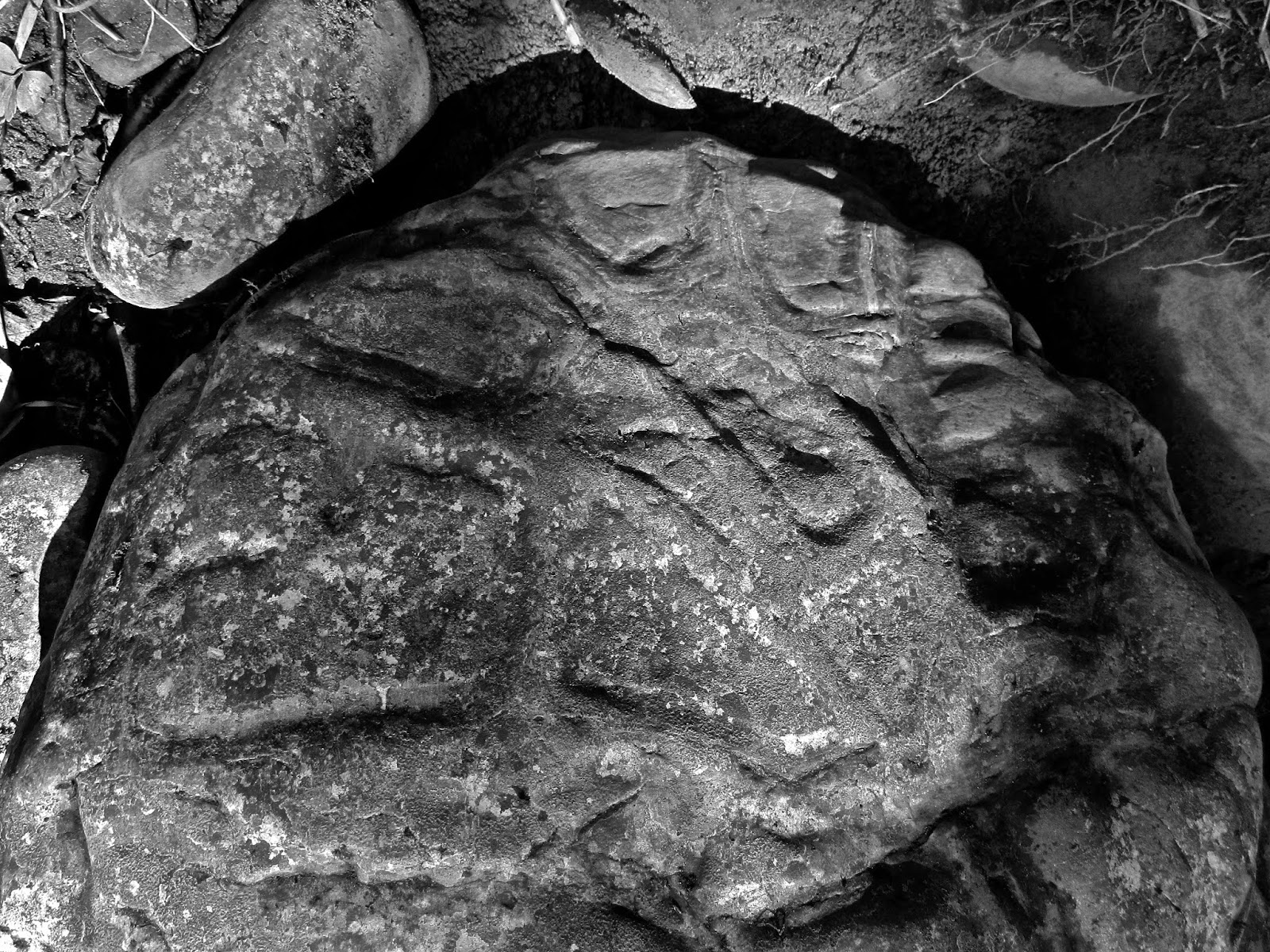
Yon Rock Art Rock Art


Do archaeology long enough, and you'll fill your bucket with tales of people who come to you with Important Discoveries. Often as not, they have found some really significant Rock Art that may Change History. Often as not, the rock is virginally free of human touch, or has been violated by a bulldozer, its scars mistaken for petroglyphs.

On the other hand, it shouldn't take too many years of doing archaeology to recognize that people do make bona fide Discoveries. Like the guy who took his kid fishing, wasn't having much luck, and noticed what looked like carving on a boulder.


The fisherman contacted the Tribe of that River, as well as some archaeologists for the state. The river rose over the boulder, and fell again. The machinery of state moved slowly, then quickly. The Tribe and the archaeologists agreed that this was a singular boulder, carved with a depiction of K'wati the Transformer, slaying Xa?lax the Lizard. It turns out that the Quileute have an oral tradition about these two, and places their fight about 200 meters up-river from where the boulder was found.


Do archaeology for a very long time, and you see that rarely does Tribal history mesh so well, so specifically. Do archaeology for not very long at all and you'll already notice that there's rarely much Art in artifacts. Mostly, we look at rubbish and broken old tools. Sometimes they're well made, even masterly, but the Calawah boulder represents something more, an artistic vision that wraps through (at least) three dimensions and weaves carving onto a net of red veins in the stone, transforming them into Kwati's comb and tongue, and a cranky red lizard.


Do archaeology long enough, and you witness enough looting that it's inspiring to see a case like this where the guy who found it told the Tribe instead of taking it himself or selling it. Do archaeology long enough, and it gets easier to cynically write off your profession as the production of rarely read reports and unexamined artifacts locked in boxes, so it's good to be part of a discovery destined to be adored by a People.

Be an archaeocrat long enough, and you know that it can be hard to achieve consensus around doing the right thing (not just legally speaking) with different agencies and sovereign governments involved. But in this case a Plan was devised, a Council Resolution passed, and a Permit issued in the course of a couple of days. The boulder was pulled from the River and brought downstream to La Push, where it sits safe and sound, protected by the Quileute Nation. For the discovery, for the mere existence of this multi-dimensional work of art, and for all the right steps along the way, I am thankful.


On the dimension of gratefulness, the boulder resonates further. My colleague shown here retired recently, but got to document and protect this petroglyph as the final act of this long career. Years of recording can scatters, isolated chert flakes, and other near-meaningless junk--not to mention all those days of finding nothing--and he was rewarded with this. It may not sound as scientific as people want archaeologists to be, but I really feel like the land thanked him for decades of his care and work. If you do archaeology long enough, and do it for the good of the sites, your good karma bucket gets pretty full and things like this happen.


09 November, 2014

Woodpecker D Adze


This is an adze that I made in more or less traditional Salish style, what anthropologists call the "D-adze" because of the handle shape.


The blade was made from a chunk of serpentine I picked up from a road cut on Cypress Island, ground down by rubbing it on concrete. Lashing is split cedar root over pine sap. The wood is the only non-local material, being from a black walnut board my dad bought decades ago in Ohio (which has been dragged to Virginia and now Washington, awaiting the time when I'd figure out what to do with it).


Salish adzes were sometimes adorned, and I chose to put a woodpecker head on this one. At first, it was because I wanted to stick with a fairly literal image (woodpeckers being carvers, like adzes), since I don't know enough about the person or Tribe I was making it for to choose something for its cultural significance or meaning. On the night before I gave it, though, I ran across a story of Dokwibatl, who came across a man who was trying to chop down a tree by banging his head on it, and transformed the poor human into a woodpecker. My intent with this gift was to honor a man who helped in my transformation from ignorant outsider to reasonably competent Northwest archaeologist, and so the woodpecker seems apt.

The wood that became this adze handle came from the same board that I carved into a sturgeon years ago, and which I gave to the Chair of Lower Elwha. The adze went to the Chair of Swinomish (who is also president of NCAI these days), with a special thanks to the THPO of that tribe. In between, another sturgeon went to Nisqually, a big halibut serving tray to Suquamish, and a stone fish club to a young Skokomish fisherman.

I'm not a talented carver, but not a horrible one either, and I still have all my fingers. I have not even attempted to match the Native Northwest formline style, and may never feel adequate to do so. I've never sold a piece, but I enjoy giving them away, and feel like I've been paid more than enough by having the chance to give them to host Tribes and have them be accepted. It's a lucky life.

22 October, 2014

The Autumnal Reader Surge

In the foreground coffeeshop, someone is reading (probably about tattoos).

I don't know about the rest of the internet, but here at MT* readership goes up in the Fall. There must be many reasons why, but I always imagine it's because that's the time of year when people go back indoors.

Bricxellated image.
Part of MT's annual autumnal surge comes from people searching for information about heatilators, the passive airflow heaters installed with some masonry fireplaces. For a while, the heatilator posts were the biggest ones by far, as Recession-pinched households sought warmth and found that I was one of the only people in internet that produced heatilator content. I don't have a heatilator anymore, and cannot tell you for sure it's safe to put a TV above one. Besides, heatilator purveyors have pushed me aside on internet, dominating search results and burying me so far down that not even my ego can maintain interest.

The other Fall readers are people who hate leaf blowers, coming for my subtly titled "Kill the Leaf Blowers" post. Sounds gonzo, but beneath the bluster, it's a pretty sensible policy with benefits for public and environmental health, education, and even national security. The only downsides are for crappy motor factories and cut-throat landscaping contractors. I won't repeat that rant here. Root Simple already did, which led to a bump on my stats this October. More than blog hits, getting rid of leaf blowers would make me happy.


An infinitesimal mote of earth's human population reads this blog, but at this hour there are millions of people reading something, many of them settled down in Autumnal night with eyes on a page, flipping screens or leafs. More than people reading this, knowing that people still read makes me happy.

*I'm gonna stop calling the blog Mojourner Truth whenever I turn reflexive or meta. For one thing, there's a fine line...no, there's no one line between a riff and a ripoff, and there have to be a lot of people out there who'd be pissed off at some middle-age middle-class white guy even sidling up to the likes of Sojourner Truth, much less swapping out a letter for his own benefit. My apologies, but I'm not trying to make money or affiliate myself with Ms. Truth.

l aim for multi-dimensional titles, being such a fan of kaona, homophony, and so on, and her historic personage was one level of many. MT works because it could stand for many things, is too short to look like a government acronym,and will garner me a certain number of lost Montana googlers. I'm sure I'll think of more, retroactively imbuing the name with meanings. Plus, just say it. "M T,...MT,...Empty." Ha! Perfect. Self-deprecation is a good dimenzen for any title to have.

Hopefully, though, I won't have the meta reflex for another year or so. I wonder if I'll remember to call the blog MT?

23 September, 2014

The Rain is Back, and So am I


All of a sudden, I see it's been months since I posted here (if that makes any sense). Today, we've finally returned to prototypical Northwest weather: rain, the horizon blurred by a liquid sky, drizzle-drop-drench. I was just talking to my kids, and they agree, it's a relief.

So we must be fully acclimatized to this place. Last week, even though it was a full 20 degrees cooler than "sweltering" in the land of my birth, I was sweating, unable to keep count of how many sunny days we'd had in a row. The girls agree: too many days of bright blue skies in a row becomes oppressive. We welcome the wet blanket now.

Summer rarely reaches the white-sky, humid hellishness of a mid-Atlantic summer here, and it's true that we all soak it up, enjoy it, and retreat from the indoors. It's no accident that Northwesterners spend so much time hiking and camping and such. (OK, not me, but other people, whose jobs keep them inside most days.) This summer more than most, I took a hiatus from blogging and other trivialindoor pursuits. Instead: gardening, fieldwork, and gazing into the yard that became my own, and moving.

So, a new season, a new (old) house. Through great willpower, I've managed to put off doing yardwork at the new place, but that's about to change. For one thing, the communal/community garden is starting to wind down. For another, who the hell wants to dig up the yard when it is hot(ish) and the ground is hard? For yet another, there were side gigs and wildfire-chasing to do while the sun was out.

Now, as the drizzle softens the glacial outwash that is my yard, it's time to dig in. Now, as the Equinoctal threshhold has been crossed, there will be time to write. (As opposed to just clicking in photos at Anthrowback, my minor-effort summertime diversion.) Now, as Winter wrings the glare of Summer sun into a pool of mild Autumnal reflection, it's time to seek shelter under roofs and with kin.

20 June, 2014

Swallowed

On the Road to Now-nowhere
The archaeologist hacking his way through the jungle, parting the bushes and glimpsing a Mayan pyramid in the grasp of lianas rising toward the canopy, is as easy for most people to imagine as the other archaeologist (this time wearing a pith helmet) kneeling at the base of an Egyptian pyramid in the desert.

In this part of the world, tribes built no pyramids, and the rains made ruins of their mightiest longhouses before archaeologists got to them. There are no ancient lost cities in the Northwest rainforest, at least not anything as obvious as you would see in Honduras or Peru.

What does exist are more recent cities, no less festooned in ferns or draped in vines. Entire towns that thrived into the 1940s have been swallowed by our temperate jungle. You might realize you are approaching one when you find yourself on a causeway, smaller trees in your path and a slit of sky above, as in the first photo. This path used to be a road, or if flat and not so curvey, a railroad. Rails and ties are gone, because like the towns, timber railroads flowed and ebbed; when the trees were cut, the rails were lifted and sent elsewhere to haul out another forest.


Once upon a time, this perspective would be under a railroad.
Huge swaths of western Washington were stripped of their trees. It started with the California Gold Rush, when Puget settlers found a ready market for logs and lumber, but the pace and scale really took off a generation or two later, when steam power jumped ashore in the form of donkeys (a machine used to haul logs) and iron horses. Instead of a few lumberjacks and teams of oxen (I don't see much evidence that actual donkeys played a major role in NW logging, ever), logging became an industrial affair. Men who had cut their fill in Minnesota in the 1870s moved west and by 1900 were engaged in technologically and logistically more advanced logging.


As Europe crept toward WWI, its New World sons built mills to saw the great Northwestern forests into boards and shingles. As the war erupted, they kept on cutting and eve picked up the pace. Huge mills sprang up by rivers and streams, no longer because a water wheel provided the power, but because dammed waterways made ponds capable of holding vast quantities of logs dumped from trains, sorted, and fed to the machines before being hauled back out as lumber destined for markets nationwide.


The scale of some of these operations boggles the mind, given their seemingly remote locations to modern residents of Pugetopolis. Substantial amounts of capital were sunk into towns stretched out along rail lines in places where less-traveled road pass today. Hundreds of people answered the work whistle every day in places that now boast a few trailer homes and little more, or that have been completely swallowed by resurgent (of degraded) woods.

Because of Wobbly Slavs, Commie Finns, and their other organized comrades, the mill owners built housing and infrastructure to attract and retains the hundreds of people needed to cut the trees and run the mills. They sometimes got electricity and sewage before their neigboring communities. Though the work could be brutally demanding and dangerous, workers came, and the Company was ready with houses for the family men and hotels and pool halls for the lone lumberjacks, ready to circulate the paycheck back into company coffers. There would be an office in town, but nearly always, the money ultimately flowed to Seattle or back east.

Didn't I see this in Myst?
Workers' fortunes flooded and ebbed with strikes and strike-backs. Owners went boom and bust as markets rose and fell. But ultimately, few of the early 20th Century timber towns escaped the inevitable: when forests became stumps, there was no money to be made. Companies that owned the land they'd harvested might eke out a few more bucks enticing hapless outsiders (among them, Dustbowl refugees) to buy clearcut land for farming, but the towns went down. As soon as the timber ran out, so did the companies, salvaging what they could of the machinery and rails before they pulled out.

Workers went elsewhere, voluntarily or otherwise, and the businesses that served them went under. Salmonberry settled and alders arrived, vanguards of a long distant old growth forest that may see the whole cycle repeat. Wooden buildings were burnt or demolished or just left to collapse. Mill roofs fell in, leaving only concrete shells of the buildings. Log ponds were colonized by beavers or eutrophied on their own.

And now, less than a lifetime after many of these towns heard the whine of saws and hoot of the whistle at the end of each shift, only the birds and wind make noise. Trees, vines, ferns, mosses, and untold numbers of microbes and arthropods colonize these old towns in the name of nature. Even in my limited awareness, there are dozens of these abandoned towns, sprouting timber (some of it now being harvested). The high water mark of civilization's tide is way back in the woods these days, and towns that were are swallowed.

08 April, 2014

I Guess You Can Call it "Work"

Call it Shooting Star, Dodecatheon, or Curlew's Beak, it's blooming this week

Monday, 5:15 AM.  The alarm on my phone buzzes, ending the fantasy that my wake-state could be followed by more shut-eye. There's but a single working clock in the house--definitely not in my room--but it seems like on the rare occasions when I set the alarm, my body gets a jump on the electronics. Maybe because it's usually prelude to fieldwork, and I love fieldwork.

6:26 finds me on the road, half a pot of coffee in my belly, and the other half in various travel vessels. I used to hate driving, but back then a trip of any length involved Interstate 95, too many lanes, and essentially no variation in the scenery: shrinking forest, burgeoning burbs, and Cracker Barrels. Today, I face a couple hundred miles of I-90, but it will rise into grand stands of conifers, pass through snowy crags, descend into elks among pines, wind through smaller hills, blow past windmills and orchards, shoot along fields, and finally let me exit into a forgotten town just in time for lunch. Then, from arterial to lateral to a gravelly capillary, not another vehicle in sight.

12:12 PM, and I am standing by the women who planned the project and will operate the machinery. My job is to watch and see if any archaeology turns up. Monitoring, as this work is called, is an exercise in bi-polarity, similar to descriptions I've read about being a soldier at war. Mostly nothing (or worse yet, senseless fulfilling of duties with no plausible reward), and then MAYHEM! No incoming artillery for the archaeological monitor, just the skull rolling off the excavator bucket, and the prospect of being universally reviled while trying to navigate a path that will satisfy interests deeply at odds.

2:02 PM rolls around, and it's clear that this project will only have the monotony pole. They're digging through what turns out to be silt dug out of roadside ditches and dumped here, and will never get down to the original soil. I decide to go walkabout and check out what I can of the 1 square mile of property.

4:24 in the afternoon, and by all rights I could knock off and head for the hotel, having turned in more than the 8 hours I'm supposed to. But I keep walking. I've already recorded one site--just a collection of 100-year-old trash, but something beats nothing--and feel like walking further. So I meander out toward where a 19th Century map said there was a wagon road. Plenty of daylight left, and this far from Olympia, I am loathe to stop. Who knows when I'll be here again?

6:36, in what even in the post-Equinox period must be considered evening. Besides flushing out a coyote (every outcrop in this place has the gnawed bones of some creature eaten by a coyote, along with a celebratory poop), I found a site that seems to have been a rest stop on the wagon road. Bottles of booze and medicine (i.e., booze with an excuse), cans capped with solder, tobacco tins, and so on. The older the glass in the Northwest, the prettier: aqua with bubbles of 19th Century breath and air, once-clear glass tinted purple by the marriage of sunbeams and manganese.

7:27 PM, and I'm nearly back to the truck, having noted an oddly elaborate fence post and a culvert passing beneath an old rail grade along the way. Normally, there is nothing less fascinating than a culvert, but in this case, it was made with a beautifully glazed terra cotta pipe, frags of which I'd seen before dumped at the depot. Wondering what the hell that fine pipe was doing out here had been bugging me for the past couple of weeks, and now I know. The Chicago, Milwaukee, and St. Paul railway did not skimp, even out here near the end of a decidedly minor capillary. Plus, this culvert seems like a nice den for some critter, and I am a big fan of the reversion of civilization to wildness. [Oh, and I did have time to check out the monitoring site, confirming that it would have been a waste of time to stay put.]

8:38, and it's pretty much dark. I've driven to the hotel (40 more miles of driving this day), and am in search of food. The options in Moses Lake for late dining are limited, and I end up at Safeway. Besides dinner, I now have tomorrow's lunch and some beer, in case I am awake enough to drink it when I get back to the hotel.

9:36 PM. I should be asleep, but instead I stay conscious for a while longer. I call the kids and learn about their day, enumerate the animals I have seen. No writing, but I check out my sister's blog. I even watch some TV, an exotic experience, and luck out with an episode of South Park about Haoles and "Native" Hawaiians. Yes, it is late and I am loopy, but it's hilarious, even though I forgot to drink the beer.

11:11 PM (plus or minus). I close my eyes and drift off, meadowlark song echoes in my ears, visions of purple glass and lines of shorn wheat on my lids.
So, that's one day, much abridged. Lots of driving with sub-par radio choices. Lots of walking while being whipped by winds carrying grit. Easily more than 12 hours of "work," but nothing I would change. I saw a lot, got to know some new ground as you only can at walking pace, and didn't have to deal with any monitoring emerencies. From my employer's perspective, I managed risk and kept them legal. For me, though, it was mostly fun.

I'm still amazed that I ended up this way, doing what I do. It's tempting to take credit and claim it was all the plan, but there are any number of junctures at which random chance changed my career path. The most I did was recognize the right times to pounce on opportunities. And now, whatever time of day, I find myself pretty happy with what I do for a living.

30 March, 2014

Silence of the Dams Lifted (Temporarily)

Emergence.

Recently, I walked what had been the bottom of a lake for the past 50 years. A crack had appeared in the dam plugging that stretch of the Columbia, and as a precaution, the lake had been mostly drained. The fat placid bullfrog of a lake became a snake, flaccid flow replaced by rapids.

Shallow soundings, deep sounds

With the water level dropped, rocks and riffles raise their voices.  The Big River (translation of many Tribes' names for the Columbia) sings its song for the first time in decades. Some say that there's a stretch just below the Priest Rapids dam where the river runs free, but for the most part, the Oregon/Washington part of the river (hundreds of miles) has lost its voice in the age of hydro-electric power and irrigation diversion. Hearing riffles and rapids amounts to time travel, and I was lucky enough to hear that past, now. 

One goose says to another...

With the Columbia back in it's channel, creatures from geese to archaeologists walk the flood plain again. Minus the muffling waters, footsteps echo, gravel slips and crunches. The old fords become visible again, instead of dark placid waters crossed only by bridges and damns. 

Threatening to fight, even in death.
On the other hand, dropping the level of a dam lake leaves a lot of creatures accustomed to the sodden past 50 years high and dry. What the photos don't convey is the smell of millions of mussels rotting in the Spring sun, the stench of crayfish turning to rotten goo in their exoskeletons. Weirdly, there was little evidence of gulls and crows Columbia Gorging themselves on this buffet. No wheeling and squawking birds, and the aquatic critters even more silent than usual.

Hopefully, I'll get back again before the dam is fixed, and waters rise again to swallow the roar of rapids, the rhythm of riffles.

27 January, 2014

Towers o Power

As Hawaiian Petroglyphs Foretold, These Forms Rise Above the Land

For whatever reason, this week offers multiple news stories about the risks of trainloads of oil, which brings up the risks of pipelines of oil, not to mention trainloads of coal. Transporting fossil energy, it turns out, requires the occasional sacrifice of life and lung.


Here in the Green Northwest, several of us have spoken out against trains and pipes full o petrochemicals crossing our turf, because we do not want to breathe the exhaust from Asians burning Occidental fossils, because we do not want to abet climate destruction, and because we are sometimes obstreperous. Meanwhile, our lands are criss-crossed by power lines originating from the not-yet-fossilized rivers where dams harness The Flow for our own energy needs, and harness the damned flow of salmon people and their human allies.

The path to this post
I've gone as far as to divest, to forsake fossil fuel, but that does not absolve me of the damage done by power lines and the fishes diced and birds sliced by dams and wind turbines. Dams don't blow up like a trainload o' crude, and turbines don't spew toxic clouds, but the power lines emanating from them speed up the invasion of thistle and blackberry into heretofore native ecologies, not to mention the arrivals of yahoomans who leave behind a trail of 4-wheeler ruts and garbage.

A hill just outside of Anytown, USA

Whether the web be of rails, or pipes, or copper, it has been joined in recent decades by another web of ether. Throughout the republic, eminences, peaks, knolls and knobs are topped by towers relaying sellphone cignals and who knows what else across the air.

It is hard to find a spot anymore where towers of power do not intrude on the landscape. It may sound superstitious, but it's hard to think of this and not recall the words of elders on some of the Hawaiian islands as they noted that something changed when electricity and poles arrived, that a richer (and sometimes scarier) night gave way to something more predictable, but less awesome and interesting. Outside of a very few areas (some of them, ironically, maintained by the same government so interested in snooping on everywhere else), it's impossible not to be in a grid traced by transmission towers wired and wirelessley knit together.

20 January, 2014

More Ice


In my last post, I forgot the bell-bottomed ice-cicles. Not far below the blobular clusters, these stalacticicles dripped from overhanging moss to the stream,...only to be swept away. The terminal drips knocked off again and again, each time a little bit splashed back up to the descending column. What should have tapered, flared.


Fluidity rushing by beneath, while gravitational accretional forms try to grow longer, but only get fatter. Not great photos, and even if they were, not the most amazing of natural phenomena, but I like 'em, and they do not reveal themselves in many of the places where people congregate, so they are all the more special.

Lili's remix: heavily altered, but somehow more true.

18 January, 2014

Ice Zoom


From 50 miles away, glaciers may gleam, but ice's intricacy is expressed simply as a reflection of the underlying landscape and overlying light. This shot is from Paddle Park in Olympia, but a spate of recent fieldwork (yes, replacing culverts so fish can get through is a good thing; no, it would not be good to take out an archaeological site in the process) got me in the neighborhood of some pretty ice, expressing a few of its many moods.


A cool thing about frozen water is that sometimes you can glimpse the crystal structure on a pretty large scale, no magnification required. Here on this beaver pond, the freezing surface is only a few millimeters thick, but there are lines a couple of feet long, shooting out in all directions, weaving a web over the whole surface. Between the lines, smooth mirrors of the frozen stuff.


On another beaver pond, the glassy interstices were few. The whole surface was adorned with slivers and feathers of ice.


Meanwhile, by a stream, the spray of a small fall gets locked to a twig in blobular clusters. Not crystalline at all to the naked eye, more like ginseng roots or some other living thing.
 

14 January, 2014

Four Mountains

Tahoma, its lenticular cloud drifting inland.

Late Fall and Winter are not supposed to be prime viewing for Cascadian peaks, but a drive today during which I could see Rainier and St. Helens pretty well reminded me that I've been inordnately fortunate this season. Like the week befor Turkey Day, when I got this shot of Tahoma (aka Tacobud, aka Mount Rainier, aka several other Salish and Sahaptian names) from the north. Far to the north, zoomed way beyond the lens capabilty and into the low-end camera digi-zoom range. What the image lacks in resolution, it gains in poetry, with the whisp of peak-cloud above and the rolling Cascadian holls below.

Il Posteriori de Montana Santa Helena

A few days later, and many miles south, I snuck up behind Mount St. Helens (various native names, many of which amount to "smoking mountain") and got the shot above. As I recall (dimly), I was standing on the edge of a gravel quarry full of bullets and cartridges and garbage, but lift the lens above ground and shoot into the distance, and beauty repoaces ugliness in the memory of that day.


Not far away in distance or in time from the St. Helens shot, I was able to spot Mount Adams (ask the Yakama about the name, because I just don't know). This is the west side, more or less, and in November, it was still not so snow-covered as you might think on the brink of December. Snow was late this year, and no doubt it looks different now.


And finally, here's Hood (I'll let the Oregonians talk about their names for this one). Shot from the north or northwest, way across the Columbia. I have better photos of this, but it's not bad, and it's from that same week, it's the pick for this post.

These shots are from different perspectives in the space-time continuum. I've had what they call a "five mountain day," when I was high enought (strictly elevationally speaking) to see the peaks of five of the snowy Cascadian volcanoes from a single spot. Jefferson, Hood, Adams, St. Helens, and Rainier, viewed from Table Mountain above the Bonneville damn.

The regular Cascades seem high enough (thousands of feet higher than the Appalachian chain, which formed the pinnacles of my growing up years), but when you get to one of those peaks, and see these snowy monsters looming high, you begin to understand big mountains. Hawai`i Island has similarly large volcanoes, although the tropical clime robs (or disrobes?) the snow mantle of its awe-inspiring potential, and the full mass is hard to appreciate without being well out to sea. Even in Olympia, Tahoma looms large, even larger when you remind yourself that it is 50 miles away, but still imposes itself on the horizon of any clear day.

I am pretty sure that the closest I will ever get to these peaks are the flanks, and that most of my appreciation will be from a distance. There's no inner drive to conquer and avail myself of "summit" as a verb. But as long as there are clear days and cameras, I will pull over and take a minute to appreciate and take a photo for memory's sake.

09 January, 2014

Not-so-tiny Bubbles, in the Brine


The other day at high tide, I kept seeing little geysers of bubbles working their way to the surface. More so from the gravel than the mud, but not just emanating from the rocks, where you would expect the instices to harbor air until the relentless tide forced them to exhale. As if from a pod of tiny sub-benthic whales, a spout would appear, then peter out, only to appear somewhere else.


As a kid, growing up near swamps and lakes where turtles lurked--and not just harmless sliders sunning on logs, but big cooters waiting to snap off the supposedly worm-like toes of kid--someone in the pack would always identify bubbles as a big snapper. We'd tiptoe across fallen trees, but keep our fearful feet high and dry. Now, I'm more inclined to suspect decaying plants, farting, especially if it's a place where I happen to know that organic material was recently buried. Besides, any turtles caught in Puget Sound in January are not gonna be breathing.


The simplest explanation is that this was a really high tide, and when the ocean over-runs land, air makes it's way out of not just the interstitial spaces in gravel, but from burrows, worm-holes, old root channels, and all the other disorderliness that happens in the living soil.

Trouble focusing? It's not you, It's The Water.

The simplest explanation is often right, and no doubt it had something to do with all the tiny bubbles in the brine, escaping, amassing, and enlarging before drifting off on the ebb or effervescing into air. But leaning in for a closer look, another answer could be seen. Where bubbles rose, the water swirled, its transparency changed to a thousand warped tendrils. This is fresh water entering salt, rain that fell a day or month or decade ago coming to the surface. Any other day, this water would seep slowly, maybe even stick to itself just below surface, but with a half foot of saltier water above, fresh water joins the bubbles in an eruption. Eventually it mixes, helping the South Sound keep it's corner of the sea a low-salt haven. Ah,...sweet entropy.


01 January, 2014

Obligatory New Year Post

The cycle continues

For Americans, this is the day of the New Year, an occasion to reflect and resolve, to mark the cycle's turn. In places where people did not dump the moon for a calendar solely solar, the New Year comes later. For me, the Winter Solstice is when one year clicks over to the next, and this Gregorian conceit that begins the new year a week and a half later means little.

But, it does come with a day off work, and therefore some time to write. Maybe also to reflect backward resolve forward.

The grimacing corpse of 2013
Looking back,...I'd rather not. The first year of the new Baktun (what? nobody wants to use the Mayan calendar now that it does not portend the End of Everything?), was not great. Coulda been worse, though, and I guess bad years just help make the other ones look good, and whatever dies becomes the soil for future fecundity. Not that I'm a relentlessly positive person, mind you; it's not as much "If life gives you lemons, make lemonade" as it is "If life dumps a load of shit at your door, make compost."

This year's run transmogrifies into a monster and fights itself to death, but also creates a new round of growth and life.
Looking forward,...I guess I'd rather not do that either, except in the most general way. I have no specific resolutions other than to continue trying to make the patch of earth I occupy a bit better. The compost should come in handy.

Ugh. All I really wanted to do today was post these photos of the 2013 chum salmon run on Kennedy Creek (photos date to a few weeks before the Solstice). Maybe I should have written nothing, instead of risking this maudlin run into a Message. Maybe I should just stop now and leave you with New Years Resolutions by Greg and Teddy Wayne (via McSweeney's):

  • 640 × 480
  • 800 × 600
  • 1024 × 768
  • Get into jazz

Happy New Year, whenever it begins. 

02 November, 2013

Feeding the Hand that Bites You

"So long, and thanks for all the fish."
The last book I read was about the Nez Perce war, and right now I'm working on one about the Puget Sound wars, treaties, and trial of Leschi a generation earlier. It ain't pretty, and ties into why I'd rather fill out "Other" than "White" or "Caucasian" on forms that ask for ethinicity. I have to assume that a large percentage of "Others" are similarly aware of "white" misdoings (I'll leave the "Caucasian" misdoings to that Caucasus favorite son, Joe Stalin).

Another Joseph, the Younger Joseph of the Nimipu (Nez Perce) was betrayed and hunted like a disagrreable neighbor's rabid dog a generation after Leschi of the Squally Absch (Nisqually) was killed like,...the same. The reason for this was not that either of these men, their forebears, or their kin, had done wrong by American settlers. To the contrary, Nimipu and others saved Lewis and Clark from starvation, provided guides, and even horse-sitting services, without which the Corps of Discovery would not have reached the Pacific, much less returned home. Leschi and others accomodated Hudsons Bay men and even attempted to deal with the Bostons (Americans) and their psychopath Governor of Washington Territory. 

As in Jamestown and a thousand points of dark in between, tribes in the Columbia Plateau and Puget Trough first dealt with west-hungry explorers and settlers by feeding them. Thanks for the Giving.

But food for the small settlements only led to hunger for everything outside the pale. Lewis and Clark handed out medals, but later American settlers grabbed and acted offended when the natives wanted to stay free on the land they'd tended for millennia. Even in the middle of the Pacific Moana, sons of missionaries who had depended on the kindness of kanakas turned around and plantationized islands, pauperizing most of the inhabitants.

Fresh out of native people to rob, the American elite eventually turned to stealing Africans and distilling wealth from their sweat (yeah, the Yankees did it too, with shiploads of human cargo headed to the plantations). Once they ran out of brown peoples, the uber-white people turned their attention to their unter-brethren, continuing to concentrate wealth among the few while consigning the masses of crackers to poverty. The process continues unabated (accelerated, even) until today.

But none of this would have happened had not Wahunsenakawh (Powhatan) fed the hand that would eventually bite him and eventually everyone else in Indian Country. As my people say, "No good deed goes unpunished."

01 November, 2013

Magic, Or Just Happy Happenstance?


The other day, as a ferry was bringing a bunch of artifacts to the Suquamish Tribe's museum, close to where they were excavated decades ago, a large number of orca bagan playing around the ferry. Sure, the whales have been active all week in the area, but to see so many around a ferry is unusual, and to have it happen when artifacts from ancient times are on their way home...it's just way too cool to dismiss as coincidence.

I was raised by a physicist, and I even make efforts to do archaeology in a scientific way, but I've also got enough experience and intelligence to know there are things I do not know and cannot explain. If people who descend from the ones who made the artifacts, from hundreds of generations of people who fished alongside the orca and recognized them as relations, if they see this as a welcome home gesture from the whales, who am I to argue?

12 October, 2013

Agriculture and Bias

Orchards count as agriculture

In the past day or three, I've been reminded of how weird our understanding of agriculture is in modern America. Another blog that I regularly read, written by an educated, smart woman, linked to an article about the novel theory that the introduction of agriculture actually led to instability and population collapse in Europe. Then today, working with some other archaeologists and archaeologists-in-training, we talked about how generations of our forebears (and their cultural anthropology kin) have sworn that in the Northwest there was no indigenous agriculture or horticulture, just hunting and gathering.

Like most children of Western civilization, I was taught that the rise and refinement of agriculture allowed production of surplus, which was what allowed humanity (some of it, at least) to step off the dreary treadmill of subsistence, so that some people could become businessmen, priests, bureaucrats, artists, and all of the other divisions of labor that make up a civilization. Even among the cynical who viewed some of these jobs as blights upon humanity, there were few that argued the basic tenet that by making the transition from gathering and hunting wild foods (yes, in that order, if you are to be honest about where the calories came from) to farming domesticated crops represented an advance, creating some respite from the struggle for survival.

Only, if you look at it from an evolutionary point of view (so long, Bible Belt readers), agriculture does not provide stability. It is inherently unstable. From a diverse spectrum of wild plants, adapted to local conditions over millenia and more, people came to depend on a select and quite small group of species, using temporaryu success to grow larger human populations. Over time, this became more pronounced. Hundreds of wild starches gave way to dozens of grains and roots, and ultimately to a handful of cereals and russet potatoes, often grown outside their optimal range through generous application of non-renewable chemicals. Nomads moved to villages, which became cities and morphed into megalopolises. We stand now as the coyote did in the old road runner cartoons, over a canyon on a board nailed to a board nailed to a board, cantilevered so far out on a gamble that we are doomed to fall, unable to skitter back to solid ground. Evolution punishes monocroppers and urbanites who forgot how to find or grow their own food.

In our hubris, we have assumed that human selection can successfully replace natural selection, when in fact all domestication amounts to co-evolution. From corn's point of view, it has caused humans to adapt their behavior toward its own ends. We winnow down the gene pool to emphasize the parts that maximize kernel production, eliminating competition from weeds and even regional maize variants, maximizing acreage, extracting fossil fuel to fertilize and distribute the crop. Zea mays has domesticated and trained Homo sapiens to its benefit, not ours.

What amounts to genocide of other grains and the once diverse array of locally adapted cultivars of corn has resulted in such a narrow, patented gene pool that we are now at greatly increased risk of collapse in a major element of our food supply (and the same goes for soybeans, rice, wheat, and any other major food crop) should evolution create super-bugs, fungi, weeds, or diseases that could rip through the millions of acres planted in the same damned genome. Or maybe  the dirty work will be done by climate change, or the growing scarcity and cost of the chemical additives and artificial genetic alterations that are already deeply entrenched responses to the biological and climactic threats we already face.

Our smug modern bias that by replacing a "primitive" society (in which nearly every family produced its own diverse and locally adapted bread, vegetables, and protein) with a few corporately owned farms churning out the national output of food and food-like subtances is misplaced. Even before evolution engineers collapses in production, the elmination of diversity and removal of people from the healthful effects of working the land has created epidemics of heart disease, diabetes, and the other diseases of civilization that decrease individual fitness and create increasing drains on social resources. More angioplasty, less art.

Camas fields do not count as agriculture

But let's step back from that brink, back to the early days of agriculture. The domesticated crops all began as wild plants. As a young anthro, I was taught that this happened in a few select places: Mesopotamian cereals, Mesoamerican grains, Andean tubers, and a few others. While this select club would be expanded from time to time, membership rested on transformation of primitive forms to highly productive domesticates. People who ate "wild" foods were not agriculturalists, or even horticulturalists. They were foragers.

A prime example of that class were the indigenous tribes of the Northwest, who stood out among hunter-gatherers in having a higher level of social stratification and cultural elaboration than anthtropologists expected of tribal, non-agricultural peoples. Being an exception only proved the rule, however, since it was pointed out that a peculiar natural abundance of food, from salmon runs to camas meadows, was what allowed them to advance beyond, for example, their Great Basin counterparts.

But the more we look, and the more we listen to the Native cultures, the more we see that the Northwest tribes (and although I am ignorant of the details, I would have to suspect the tribes in other parts of the country) were not passive collectors of a random bounty. People burned meadows to return nutrients to the soil to such a degree that once-poor glacial outwash became black loam, while at the same time arresting succesional processes that would have liked to establish forest where berries and root foods grew. Harvesting techniques aerated the soil, gave next year's crop room to grow, rotated the burden of harvest, and propagated new generations of food. There was weeding and transplanting. Just because Tribal knowledge acknowledges first and foremost the role of Coyote for the origin of many foods does not mean that the actions of mortals played no role in the perpetuation of those foods. My suspicion is that the "wild" characterization of foods like camas and cous has as much to do with our lack of investigation as with absolute reality--the same people who weeded out the death camas, who harvested roots and berries over millennia, am I to believe that they never rooted out smaller, sicklier plants in favor of tastier or more productive ones? Are we supposed to think that because a food plant is found within it's "natural" range, it was not the result of transplanting or establishment of patches convenient to trails and settlements? I find that hard to swallow.

But our bias is that if a plant is native to its range (typically defined thousands of years after people began eating it, hmm...), it is wild. If it is not ridiculously oversized, the food part dwarfing the other elements, it must not be domesticated. If it is merely tended, rather than planted in rows or milpas, it is not agriculture. Our bias is that hard farming work, rather than knowledge of how best to feed off of natural systems with minor inputs, is superior.

We see what we want to see (I'll admit that I want to see humans who adapted to a place over millennia as pretty wise to its ways), and so Euro-Americans who conquered continents generally want to see that as progress. Casting agriculture as a noble effort, even as a single God's will that Man exercise dominion over the earth and its lesser creatures (Indians included), serves that goal. Defining what everyone else did as inferior helps make the stealing and subsequent transformation of the land more justifiable to most Americans, eases the guilt of wiping out thousands of little societies attuned to nature to make way for a large one attuned to itself. Bad as that particular bias may be, the one that may come back to haunt us more deeply is that other bias, the one in which we presume that civilization is always getting better, that we are exceptional, and our agriculture is smart and sustaining, rather than unstable, a dangerous taunt toward evolution.