Does the word that just popped into your head show up here? Find out:

Showing posts with label culture. Show all posts

13 February, 2017

The Anarchy A


Recently, people keep reminding me that the Circle-A symbol is associated with anarchism,...maybe even with Anarchism.

No shit.

One woman kindly commented on a post of the above sign to let me know that the anarchist crowd uses that, and she wasn't sure if I did it on purpose.

Ahh...yup. Thanks.

A sixty-ish photographer somberly asked me if I knew what that A-in-a-circle meant as he got a shot of my daughter and I at a rally. He looked grim when I confirmed:

Si, Professor.

Maybe especially around here, people think anarchist and they envision black bloc ninjas throwing rocks through windows, but there are degrees and species of Anarchy just like there are of any other -ism.

To begin with, some reject anything but little-a anarchy.

My anarchy dropped orthodoxymoronic Anarchism years ago. My anarchy fails the purity test (I'm a government worker, for Marx's sake). My anarchy doesn't mind government  preventing corporations from poisoning the earth and ripping us off, and it knows damn well that NO government just means the armed and greedy get their way. My anarchy begins in the womb, where no government should be tolerated, and lives in a body and mind that should not be violated.

My anarchy is old and likes naps, but it ain't dead yet.

So yeah, I'll continue to march with Womxn and support Planned Parenthood and protect Mother Earth with my "Dads Against the Patriarchy" sign. Lots of people have said they liked it, shot photos, and been very supportive. Lots of them know what the A means, some of them are really supportive, and a few people get uncomfortable.

Which is good. The Circle-A hasn't lost all its power.

20 November, 2016

Your Local National Leaders

Brian Cladoosby*

America has elected its Drumpf, just as Weimar elected its Schicklgruber,** leaving many of us in a bind: Do we abide by the process? Do we accept a haranguer who hastens our  descent from international beacon of freedom to a dumb mob? Or, do we break the laws and smash the pipelines by whatever means necessary, risking another kind of dumb mob?

Maybe the answer, or at least an answer, to escaping the mobs is to look to the tribes.

Most Americans are unaware that they live on ground ceded or sold (or just stolen) from tribes that still exist. More than 550 tribes are sovereign nations, many with treaties that just happen to be supreme law of the land in the US. They are not subject to other states or even some kinds of interference from the federal government. Their own councils decide their own laws.

It's not that tribes offer some sort of arcane legal end run, or that they are some sort of haven where we could seek asylum. It's not that tribes have so much casino money that they've got political power over the rest of us, and I have no pretexts that tribes bludgeoned by our nation for centuries are all in peak condition, utterly unaffected by generations of enforced poverty and assimilation. It's not that tribal governments are always wise and never corrupt any more than tribal people are noble savages.

But it is that tribes, at least where I live and in many places I read about, are emerging as nations with talented leaders and strong visions for the future. Fawn Sharp (below), chair of the Quinault Nation on the Olympic Coast, is a national leader in addressing climate change. Beginning at home, she has worked hard to save the environment and look at how humanity as a whole can deal with climate change.

Billy Frank Jr. with Fawn Sharp
Where I live, the Squaxin, Nisqually, and Chehalis Tribes are my closest neighbors; the first two ceded the land where I live in the Treaty of Medicine Creek. All three tribes and dozens of others in what is now Washington State are active in funding projects that keep the salmon viable for all fishermen, environmental restoration projects that benefit the entire public, and public health programs that reach beyond the rez.

More fundamentally, tribes are places where the leadership has ties to the land and people that have never existed in US politics. When you serve on a council responsible for governing the small remnant of land where 500 generations of your ancestors lived, you may not feel so free to shift with the latest political winds. When your constituents include an extended family made not just of cousins and aunties, but salmon and eagles, you tend to look at the health of the whole instead of the profit of an individual. When you serve a nation that measures in the hundreds or thousands, accountability is much more immediate--it's hard to have elites who never touch the earth, who can escape the angry auntie forever.

Brian Cladoosby, pictured at the sop of this post, has risen as a leader of the Swinomish Indian Tribal Community, of Puget Sound tribes, and for a few years now as President of the National Congress of American Indians. But he still participates in his community. He fought the dentists lobby to bring free dental care to his tribe. He's opposing petro-trains that pollute Swinomish lands and waters and cut the community off from the rescue squad. And he's working with a broad coalition of tribes to address pollution and climate change on national and global scales.

At Standing Rock, a less formally governed tribal super-nation has emerged. Hundreds of tribes have converged to join with the Great Sioux Nation to try and stop an oil pipeline, a great black snake that many of them have known for generations would get out of control and poison the water. Maybe because it's rooted in a particular piece of land, this encampment is more focused and ultimately more powerful than the Occupy camps of a few years ago. Maybe it's because the environmental struggle, and specifically the fight to keep oil and coal in the ground, is at once globally imperative and locally relevant. The Water Protectors are leading a non-violent and deeply revolutionary movement, and this time it's not the white career environmentalists calling the shots.

Meanwhile, back on what's left of the Reservation, Councils are mulling over what the Trump Presidency could mean. He fought dirty with certain tribes when trying to protect his Atlantic City casino interests, and he may well have animosity toward Native Americans in general for their apparent congeniality with Obama, Bernie, and Hillary. The GOP congress is inclined to cut spending, so the already watered-down federal gravy train will likely deliver even less in the future.

But then again, the Republican hatred of big government and desire for local control could result in tribes having a greater say on federal lands, especially where they neighbor reservations. Sure, the Right would prefer to just privatize everything, but tribes have long histories and deep experience with land disputes and federal courts, where they are sometimes astoundingly successful (even if it takes decades to translate into real life benefits). Many tribes have already been working with federal land managers on cooperative management of everything from huckleberry patches to wildfire response. So even if President Trump wishes to dismantle the US, tribal precedents and politicking and organization may just cut him off at the pass.

Wherever you are, find your local tribe. Learn whose land you're on, and whose descendants are protecting it. Get to know them, and what they do in your community. Visit their community, and support it. Work together to protect your part of the earth as they always have, with an eye toward generations yet unborn. Join your local sovereign nation in spirit, and our American Nation will benefit.


* My apologies to Swinomish Tribal Chairman for placing his photo next to my rant, but as a public figure this kind of thing will happen from time to time, and he's not the kind of guy to unleash a 3AM tweet-war against me, so here goes.

** Adolf Hitler's dad changed the family surname from Schicklgruber. The Donald's grand-dad anglicized Drumpf to Trump.

28 December, 2014

Yon Rock Art Rock Art


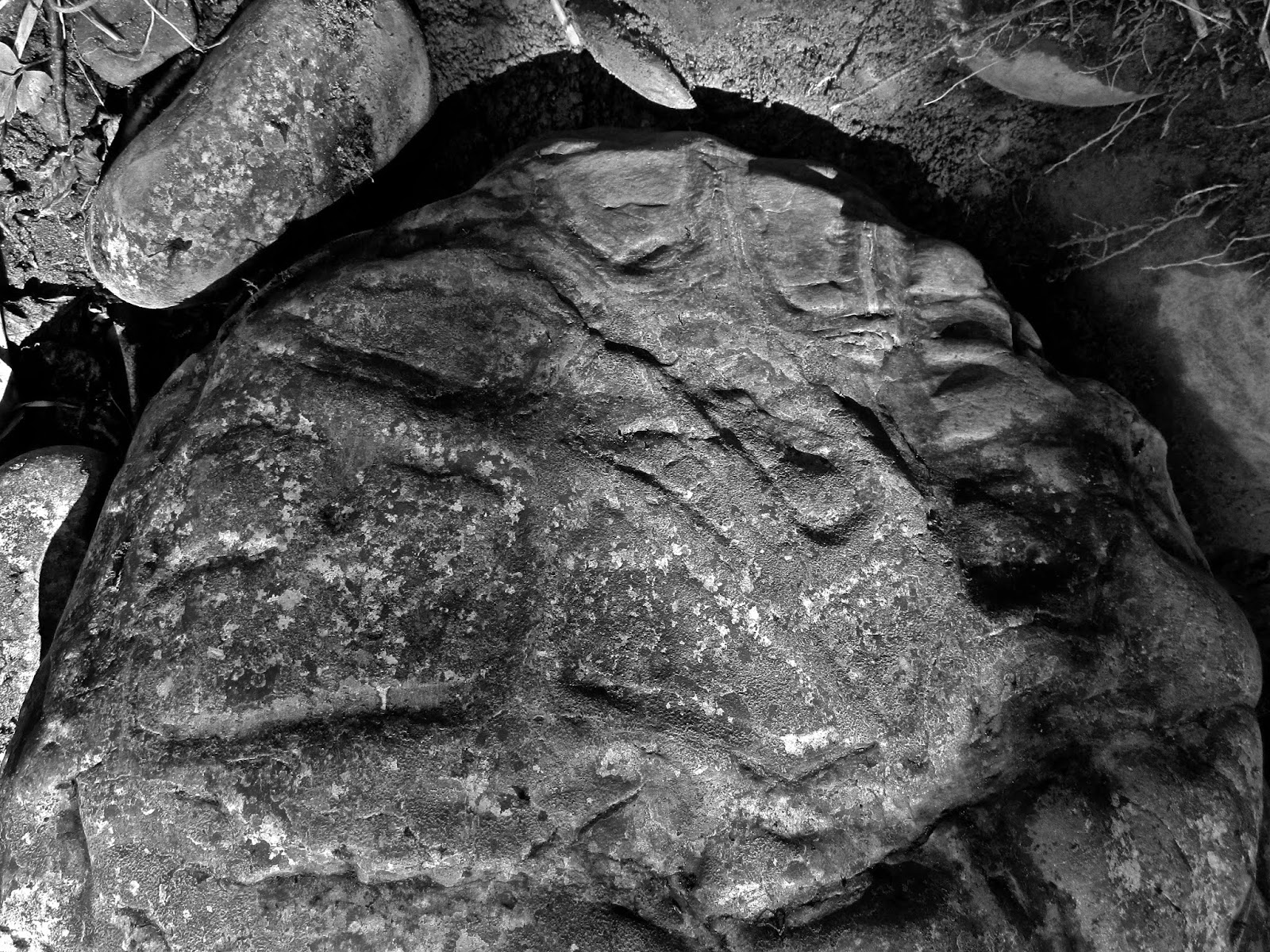
Do archaeology long enough, and you'll fill your bucket with tales of people who come to you with Important Discoveries. Often as not, they have found some really significant Rock Art that may Change History. Often as not, the rock is virginally free of human touch, or has been violated by a bulldozer, its scars mistaken for petroglyphs.

On the other hand, it shouldn't take too many years of doing archaeology to recognize that people do make bona fide Discoveries. Like the guy who took his kid fishing, wasn't having much luck, and noticed what looked like carving on a boulder.


The fisherman contacted the Tribe of that River, as well as some archaeologists for the state. The river rose over the boulder, and fell again. The machinery of state moved slowly, then quickly. The Tribe and the archaeologists agreed that this was a singular boulder, carved with a depiction of K'wati the Transformer, slaying Xa?lax the Lizard. It turns out that the Quileute have an oral tradition about these two, and places their fight about 200 meters up-river from where the boulder was found.


Do archaeology for a very long time, and you see that rarely does Tribal history mesh so well, so specifically. Do archaeology for not very long at all and you'll already notice that there's rarely much Art in artifacts. Mostly, we look at rubbish and broken old tools. Sometimes they're well made, even masterly, but the Calawah boulder represents something more, an artistic vision that wraps through (at least) three dimensions and weaves carving onto a net of red veins in the stone, transforming them into Kwati's comb and tongue, and a cranky red lizard.


Do archaeology long enough, and you witness enough looting that it's inspiring to see a case like this where the guy who found it told the Tribe instead of taking it himself or selling it. Do archaeology long enough, and it gets easier to cynically write off your profession as the production of rarely read reports and unexamined artifacts locked in boxes, so it's good to be part of a discovery destined to be adored by a People.

Be an archaeocrat long enough, and you know that it can be hard to achieve consensus around doing the right thing (not just legally speaking) with different agencies and sovereign governments involved. But in this case a Plan was devised, a Council Resolution passed, and a Permit issued in the course of a couple of days. The boulder was pulled from the River and brought downstream to La Push, where it sits safe and sound, protected by the Quileute Nation. For the discovery, for the mere existence of this multi-dimensional work of art, and for all the right steps along the way, I am thankful.


On the dimension of gratefulness, the boulder resonates further. My colleague shown here retired recently, but got to document and protect this petroglyph as the final act of this long career. Years of recording can scatters, isolated chert flakes, and other near-meaningless junk--not to mention all those days of finding nothing--and he was rewarded with this. It may not sound as scientific as people want archaeologists to be, but I really feel like the land thanked him for decades of his care and work. If you do archaeology long enough, and do it for the good of the sites, your good karma bucket gets pretty full and things like this happen.


04 December, 2014

Loosies, Not the Sky of Diamonds


Plenty of people are posting about racism in law enforcement, as they should. Black and brown men have reasons to worry that don't really affect a white guy like me.

"Like me," including Middle Classness, and it's class and money that I want to speak about, to add to the conversation. Plenty of poor white people also have reason to worry about law being selectively enforced, and force selectively applied, but this post is not about saying white people suffer too.

No, I just want to ask why Mike Brown (alleged cigar thief) and Eric Garner (alleged seller of single cigarettes, or "loosies") met with deadly force in the course of their alleged crimes. Even assuming that the one guy was stealing smokes and the other selling them, it's hard to imagine that these were the most serious crimes of the moment, much less offences so heinous that the perpetrators needed to be shot multiple times or choked to death.

At the same instant when Eric Garner was executed extrajudicially in a part of New York where selling single cigarettes is a survival strategy, in another part of town men who stole billions of dollars, crashed the economy to an extent where selling loosies is a thing, and then extorted the US government for bailouts walk free. Not just free, but assured that they not only will not be stopped and frisked (or, in the 1%-er analogy, forensically audited), but that were a cop to ever lay a hostile hand on them, massive lawsuit-induced windfalls would follow.

Racism is real, even if race is not. White cops using superior numbers or firepower to overwhelm brown suspects is a shame and a problem; ultimately, it's a threat to democracy.

But so is the fact that police attention is strangely affixed on petty crimes. Call in four cops to take down one alleged cigarette seller, but leave the corporate executives alone. Hell, offer the oligarchs any out conceivable: from paying fines with shareholder money, to bankorruptcy protections, to failing to convene a grand jury identify individuals for indictment. They have diamonds on the soles of their shoes, so the criminal justice system shall not touch them; the sky's the limit for them.

Meanwhile, in the mud beneath the lowest societal rungs, poor people die at the hands of the police.

25 November, 2014

Cavalier Attitudes

Shut up and take it, b****


[To my one steadfast reader, who has noticed some Virginia-bashing here, I regret to inform you that it's happening again. Click elsewhere and come back next week, knowing that there are Virginians I love and admire, including you, sister. Likewise, good people who happen to be associated with University of Virginia, sorry you have to be connected with the subject of this post.]

Once again the Old Dominion has hit the news in a most sinister way. This time, it's the Rolling Stone article calling out University of Virginia for its utter failure to tamp down the rape impulse throbbing on Rugby Road, Frat Row to what is arguably Virginia's most prestigious institute of higher learning.

I never made such an argument. Being a smart kid in a suburban Richmond high school, I was of course encouraged to seek admission to UVA, but balked at the idea, much to the bafflement of certain counselors and teachers. Partially, this stemmed from a budding rebelliousness; fuck if I was gonna go where all the uber-preppies went, worship the old dead white guys, and give in to The System. After my knee-jerking settled down, though, there were other reasons to avoid UVA: people I knew who were most enthralled with it tended to be assholes who genuinely believed that "nice" clothes equate to civilization, a founder who fucked his 14 year old slave and sold off some of their progeny didn't inspire the same reverence in me as it did in the spawn of Virginia's finer families, wearing ties and swilling cocktails didn't strike me as recreation, going to college less than an hour away didn't seem like much of a horizon expansion,...and so on.

The Rolling Stone article scratches the surface but does not draw blood from the beast that is the Entitled Rich White Boy. He whose dad was a Wahoo, and whose son will be. Maybe he earned the grades to deserve entry, maybe he's even smart at something. But he's gonna sow his wild oats for a few years before moving on to daddy's firm. And those girls better comply. The article failed to name any of these rapists, and won't send any of them to jail.

In addition to the inexplicable "Wahoo," the UVA teams are known as the "Cavaliers," which is illustrative. Originally, Cavaliers were the royalists who opposed Cromwell's rebellion. It doesn't take a Cromwell apologist to suspect that Cavaliers were the vicious dandies who supported the old elite order. In the Crown's Virginia Colony, the influx of cavaliers came when the Roundheads were winning, and the self-proclaimed noble fighters took off rather than nobly face the music. Somehow, this dubious legacy became a swashbuckling logo.

Echoing this history, UVA has in my lifetime (and I suspect at least back through my William & Mary and Mary Washington educated grandparent's matriculations) been a refuge for elites and elitists. Sure, others make it there, but the aura of one of our nation's "Public Ivies" has long been one of wealthy entitlement. Graduate from there, and people acknowledge your academic achievement as well as suspect your birthright, even if you didn't, ahem, "earn" it by being born rich.

Even as "The" University's admissions policy has slipped into allowing non-FFV's, women, and black people to attend, UVA fraternities have proudly flown the Cav flag and maintained sanctuaries for Entitled Rich White Boys.

Women stepping foot into one of these refugia along Rugby Road risk rape. Sadly, women in any college stand a greater chance of being raped than women in general. Unsurprisingly, women walking into a frat house on any campus stand a greater chance of being raped than college women in general. Understandably, both fraternities and universities have a vested interest in protecting their reputations, and tend to deal with the spoilsport women who object to being raped through means other than law enforcement.

At UVA, the ability to avoid having the cops come in and arrest violent felons is enhanced by wealth and tradition. I don't have empirical evidence (such as that available to prove all of the previous paragraph's assertions) to prove this, but the Rolling Stone article makes a pretty good case, and my experience as a Virginian and American certainly fits. Rich guys avoid imprisonment pretty well. Reinforced by the aura of a centuries-old institution founded by a Founding Father, consistently rated highly as an academic institution, posessed of many traditions and a well-heeled sense of Decorum (whatever that is), UVA is not easily dragged through the mud. Not that long ago, one of it's drunken preppie athletes murdered his girlfriend, and yet the Rolling Stone article is still presented by many as an anomaly, an affront, maybe some sort of deviant leftist (or feminazi) plot.

Where Power is worshipped and Money talks loudly while it's partner Tradition silences dissent, people get raped.

11 November, 2014

The Hipster Effect and other Models

Image by Getty, Fair Use by This Guy's Nephew

A mathematician recently posted an article (available at arXiv as a pre-print, to be published in a refereed journal soon) called "The Hipster Effect: When anticonformists all look the same." I'm too slack to learn the math, which apparently helps explain why so many people who reject the mainstream still end up conforming, just to something else. It has to do with the delay between a mainstream trend existing and the non-conformists realizing it and rejecting it, and looks like this:


As an anthropologist, I have some non-mathematical ideas about how and why hipsters end up sharing so many traits. As a human, I tend reject simplifications of our behavior to mathematical functions. But Touboul is clear that his model is just a model, and not an explanation of culture or even something that can encompass all hipsters, so it's fine for what it is. Also, the fact that some image sprange to your mind when I said "hipster" proves that he does have a point. Facial hair, clunky black glasses,...

This guy read the Hipster Effect article before I did, and was already appearing in blogposts about it days ago.
As if to prove Touboul's point, there has been a delay, and then a bunch of hipsters blogged about it (huh, blogging, it's so old-school, so they must be posting ironically) along with all the other non-conformists. I'm too late to be a hipster, having learned of the article in the Washington Post (online, at least, and not on some dead tree).

And yet, I exhibit signs of being a hipster. I'm in phase with them as far as clunky black glasses, facial hair, brewing ale with hops I grew, and so on. As I write, I am listening to the local, listener-supported, volunteer-powered community radio station called KAOS. I am in phase with a fair number of hipsters.

Partial View of an apparent Hipster, Courtesy of some Model

But is it because I react with similar intent and mathematics to the others? In some ways, no. Hipsters' oscillations are much more rapid than mine, and I was wearing this kind of glasses and growing a beard decades ago (and not in a "I did it before you did" hipster kind of way). I just hate to shave, and always wanted glasses that came from that era when all men wore the same kind of glasses. Like my uncle in the first photo. He was not a hipster, but he was an enigma, a guy who wore "normal" clothes, but to a degree (khaki pants and white oxford shirts for decades on end) that was decidedly atypical. He served in the military for a little while, got a job, and raised a family, a model citizen. But also one who was deeply subversive in some ways, whose thoughts boggled minds and defied models.

Were I in the data set being compared to Touboul's model today, I might well become empirical support for mathematical supposition. But I represent a much longer oscillation if I represent one at all, and the "why" of my seeming hipsterism may be a lot different than that of people who know enough about contemporary mainstream culture react against it.

09 November, 2014

Woodpecker D Adze


This is an adze that I made in more or less traditional Salish style, what anthropologists call the "D-adze" because of the handle shape.


The blade was made from a chunk of serpentine I picked up from a road cut on Cypress Island, ground down by rubbing it on concrete. Lashing is split cedar root over pine sap. The wood is the only non-local material, being from a black walnut board my dad bought decades ago in Ohio (which has been dragged to Virginia and now Washington, awaiting the time when I'd figure out what to do with it).


Salish adzes were sometimes adorned, and I chose to put a woodpecker head on this one. At first, it was because I wanted to stick with a fairly literal image (woodpeckers being carvers, like adzes), since I don't know enough about the person or Tribe I was making it for to choose something for its cultural significance or meaning. On the night before I gave it, though, I ran across a story of Dokwibatl, who came across a man who was trying to chop down a tree by banging his head on it, and transformed the poor human into a woodpecker. My intent with this gift was to honor a man who helped in my transformation from ignorant outsider to reasonably competent Northwest archaeologist, and so the woodpecker seems apt.

The wood that became this adze handle came from the same board that I carved into a sturgeon years ago, and which I gave to the Chair of Lower Elwha. The adze went to the Chair of Swinomish (who is also president of NCAI these days), with a special thanks to the THPO of that tribe. In between, another sturgeon went to Nisqually, a big halibut serving tray to Suquamish, and a stone fish club to a young Skokomish fisherman.

I'm not a talented carver, but not a horrible one either, and I still have all my fingers. I have not even attempted to match the Native Northwest formline style, and may never feel adequate to do so. I've never sold a piece, but I enjoy giving them away, and feel like I've been paid more than enough by having the chance to give them to host Tribes and have them be accepted. It's a lucky life.

30 October, 2014

"I Feel Your Pain," and Similarly Presumptuous, Phony Bullshit

Someone's scorched earth. Avert your eyes.

A week ago, a kid shot his friends, and then himself. I can tell you no more than that, even though I may 'know' more about the situation than you do. This one happened closer to where I live than usual, and when I spoke with family elsewhere, they mentioned it and expressed regret, but did not dwell on it and did not pretend to make sense of it.

On the other hand, another friend who had not been in touch for a while emailed a message fraught with 'concern' for how my own high school daughter dealt with it, seemed to fish for inside info, and mentioned how a mutual acquaintance sorta kinda knew (OK, recognized) the guy who has been arrested in a notorious murder in her part of the world.

How the hell would I know what happened with that kid, even if I knew him? Why would I speculate if I didn't know him? Why would having fewer degrees of separation from the anguish of several families and tribes make me an 'expert'?

Many people in our society play a sick sick game in the aftermath of murders and suicides. News media try to find out why, and adopt variously sensitive approaches to their prying into victims' and relatives' feelings, often as not posting interviews with people the killers and the killed would never have thought would speak for them. People with no real connection concoct one. The unaffected try on trauma to see how it befits them. 'Sensitive' people affect a variety of emotional effects, and in so doing display an appalling insensitivity to what is for someone (but not them) a tragedy.

It disgusts me and pisses me off, for reasons I won't tell you. You don't know how the killers and the killed felt, and if you are not an immediate relative or friend, or maybe a member of the same tribe, you never will. You should shut up and leave them alone until they ask you to say something.

Suicide is the ickiest paragraph of this sick commentary. Like whe Robin Williams killed himself, and every Tom, Dick, and Henry Rollins* needed to express their personal feelings about it. Aside from a handful of humans, nobody had the authority to speak to this, yet we were all besieged by co-workers, family members, reporters, media-friendly psychiatrists, and publicity hungry celebrities telling us why, or angstily telling us they didn't recognize the signs, or some other brand of bullshit. He might not even have seen it coming until it was too late. The people ostensibly bemoaning his loss did nothing productive, saved nobody, and displayed their own self-centeredness by treating tragedy as opportunity.

Mourn the dead if you knew them. Feel sad even if you didn't. But stop acting like death(s) you heard of on TV or the internet or the radio are personal to you. They are not, and it is an insult to the dead and their loved ones to make it personal to you. If some killing moves you to become an activist against guns or whatever, OK, but don't appropriate the souls of the dead to your cause. "He would have wanted..." is one of the all-time most presumptuous, bullshit-infused opening clauses in the English language. If you are just using someone else's tragedy to act sensitive, or publicly wring your hands, then you are full of crap.

Some people go beyond the show of mournfulness and try to figure out why. They won't know, and should cut it out. Killers and self-killers don't necessarily know why, so who is some outsider to waltz in and speculate?

*Former punk rocker and current media whore, who published an essay about how he no longer respected Williams, and was rightly excoriated for saying so.

22 October, 2014

The Autumnal Reader Surge

In the foreground coffeeshop, someone is reading (probably about tattoos).

I don't know about the rest of the internet, but here at MT* readership goes up in the Fall. There must be many reasons why, but I always imagine it's because that's the time of year when people go back indoors.

Bricxellated image.
Part of MT's annual autumnal surge comes from people searching for information about heatilators, the passive airflow heaters installed with some masonry fireplaces. For a while, the heatilator posts were the biggest ones by far, as Recession-pinched households sought warmth and found that I was one of the only people in internet that produced heatilator content. I don't have a heatilator anymore, and cannot tell you for sure it's safe to put a TV above one. Besides, heatilator purveyors have pushed me aside on internet, dominating search results and burying me so far down that not even my ego can maintain interest.

The other Fall readers are people who hate leaf blowers, coming for my subtly titled "Kill the Leaf Blowers" post. Sounds gonzo, but beneath the bluster, it's a pretty sensible policy with benefits for public and environmental health, education, and even national security. The only downsides are for crappy motor factories and cut-throat landscaping contractors. I won't repeat that rant here. Root Simple already did, which led to a bump on my stats this October. More than blog hits, getting rid of leaf blowers would make me happy.


An infinitesimal mote of earth's human population reads this blog, but at this hour there are millions of people reading something, many of them settled down in Autumnal night with eyes on a page, flipping screens or leafs. More than people reading this, knowing that people still read makes me happy.

*I'm gonna stop calling the blog Mojourner Truth whenever I turn reflexive or meta. For one thing, there's a fine line...no, there's no one line between a riff and a ripoff, and there have to be a lot of people out there who'd be pissed off at some middle-age middle-class white guy even sidling up to the likes of Sojourner Truth, much less swapping out a letter for his own benefit. My apologies, but I'm not trying to make money or affiliate myself with Ms. Truth.

l aim for multi-dimensional titles, being such a fan of kaona, homophony, and so on, and her historic personage was one level of many. MT works because it could stand for many things, is too short to look like a government acronym,and will garner me a certain number of lost Montana googlers. I'm sure I'll think of more, retroactively imbuing the name with meanings. Plus, just say it. "M T,...MT,...Empty." Ha! Perfect. Self-deprecation is a good dimenzen for any title to have.

Hopefully, though, I won't have the meta reflex for another year or so. I wonder if I'll remember to call the blog MT?

09 July, 2014

Freedom Inc.

Phoneto by Zonk'em

Outside of Buck's Spice Shop and Darby's, two businesses I gladly choose to support, there is an interstice of green in the sidewalk. Grey, gray,...grass! There's a little (but still larger than the li'l lawn) brass plaque identifying this space as a park. Now and then, there's the sign you see here, miniscule but effective.

"Keep off the grass*" resinates this week, what with the opening of the first legal pot stores outside of Colorado. As my family waited on Sunday morning for a table at Darby's, we saw the sign and the roach** thoughtfully tucked into the park to stack on another entendre***.

We laughed, and took a few photos, inspiring other people to do the same. My kids didn't start doing drugs, I managed to hold onto my job, and breakfast--although served to Led Zeppelin live--was delicious, and in no way a freakshow. Legal pot in 2014 Washington is,...so what?

It was interesting to hear reports on NPR that actually spoke of today's opening of pot stores here in terms of "civil rights," maybe not on par with gay marriage (local reaction: we're totally used to it,...so what?), but a great day for freedom, in the words of a guy who'd been in line since 4AM (sorry, guy who showed up at 4:20) to be the first to buy legal weed,**** only to say he'd light up to "Dark Side of the Moon,"***** sorta like he has for 33% of the 1,287 bags of reefer****** he's bougth before, illegally.

Equality for people who don't fit in the archaic man-woman identities and roles is a civil rights issue, but what happened today is a consumer issue. In Americo, though, consumer freedom has increasingly stood in for and even pushed aside the more basic freedoms in the Constitution.

Today gets reported by those who worry as the Beginning of the End, gateway drug to utter debauchery and decay. Meanwhile, others spout some crap about Freedom when what they're being offered is a chance to pay premium prices plus 25% tax (that's right, Washington State imposes a 25% tax on this freedom) for something that's actually pretty easy to get outside of the official stores. The saying "Freedom isn't Free" needs to be amended, "And it's Heavily Taxed".

So, light up and celebrate if you must, but don't let the ability to go to a store and light up legally make you think you're more free, don't let THC be the opiate of the masses, and don't develop memory loss about more fundamental freedoms at stake in this changing AmeriCo. For real freedom, don't feed the stores that will compete and merge and take-over and consolidate into the same corporate creature that stalks every revenue flow; go chip a park out of the concrete.


* an archaic term for psychoactive cannabis
** an archaic term for the remains of a partially smocked grass cigarette, or "joint"
*** a French term. I only explain archaic terms, so you're on your own for this one
**** archaic term for grass*
***** archaic stoner music
****** archaic term for a joint** or maybe weed****

09 June, 2014

One Seventh

Seven Slices Make a Wheel

Geez. The last two up-to-date posts were depressing, so here I am regressing to nostalgia.

Someday, I'll get around to the post about reinventing the wheel, a popular 20th Century pastime, but for now I' happy just to post a pic of a wheel. Behold yon wagon wheel. Rims of steel (maybe iron) round hub and circumferance of wood (I know not which species).

Look close, and you'll see that the 14 spokes radiate to seven sections of wood, each 51.42857 degrees of a circle. Sure, it would have been easier to go with an even half dozen 60-degree arcs, easy to mark, nothing more than a radial length required if you know the trick, calculation rendered superfluous.

But at what cost? The wheel divided by six is a wheel divided in half, prone to buckling, vulnerable to folding when you hit that rock cockeyed. Divide the wheel into sevenths, and opposite each joint is a solid stretch of strong wood grain. There is strength in oddness.

Do you see?

Maybe not. In which case, I draw to your attention the seven-sliced pie (sorry, no photo). I grew up hearing the legendary prowess of my grandmother, who could slice a pie into even sevenths. Any fool can do eigths, and sixths are pretty easy too, but the seven-sliced pie requires a keen eye. No zipping the knife all the way across; she had to know the center, the 51-point-something angle. Each cut depended on confidence in the face of chaos, each slice an expression of asymmetry that would add up to: symmetry.

The seven-slice pie was not a matter of neccesity. It was a luxury. She had a family of six. The extra slice was for the hard worker home after a long day (her, often enough, because not only granddad went to the mill), the kid who excelled, the neighbor whose kindness merited recognition. Or, he-hee, the cook whose hand made it. Number seven was the extra. They were not rich, grandma and grand-daddy, but they could still live large. 

03 May, 2014

Procession of the Species Watchers

Urban arboreal species Homo Zacchaeusii

The human species that invented the Procession of the Species probably remains the most interesting to us anthropologists, and this year I enjoyed watching how humans watch parades. Enjoying evidence (see above photo) that despite having evolved enough to create an urban habitat and stainless steel sippy cups, we have not entirely escaped our arboreal origins, or fascination with watching unusual things. Or (cue next photo), with being social, gathering in crowds.

"We don't know you, and do not take orders from kelp."

The actual point of this photo is that anthropologists should shut up and listen. As we rounded a corner, I asked this crowd to take photos (because some synaptic tic of mine makes me want to take pictures of people taking pictures), vainly attempting to manipulate the situation, in clear violation of the Prime Directive. Immediately, most people lowered their cameras; the few people shooting photos in this shot happened not to have heard me.

Hey, I know them!
Professional angst fades quickly in the midst of The Procession, and wasn't even a memory when we rounded the next corner onto 5th Avenue. The street heavily bedecorated by kids and kid-minded adults, the crowd thick to the point of becoming a humanity canyon, drums echoing off Olympia's architecture. I love these blocks on a normal day--eating at Darby's and looking at the Capitol Theater marquee, aroma of the bag of spices I bought next door warming me as much as the coffee--but when it's filled with happy paraders and watchers, it pulses with energy and I'm grinning like an idiot, a blissfully happy idiot. Even happier when I zoom into this photo and see not only a friend and her kids, but off in the distance, another arboreal rebel perched on the marquee in front of "Nirvana Tribute," an event the night before at a place where Nirvana played in the early days. Grin widens.

The anthropologist in me remains just present enough to notice how thousands of people from Olympia and beyond--not knowing each other, maybe allied to different cultural or political or religious values--are all having fun together. Organically and peacefully, they self-organize: kids in front, parents minding kids, strangers making room for each other, and pedestrians passing by behind. Sure, some streets have been blocked off so cars won't ruin the fun, but beyond that, not much in the way of a plan or rules. Yet it all comes off fine, and again the anthropologist is overwhelmed by the grinning primate within.


We hang a left up Washington Street, and again the crowd jumps in magnitude. Mountains of people, spilling into the street and stretching up the lawn and old capitol steps. I cannot even register what individuals are doing, so dumbstruck am I by the numbers, grin slacking down to a dropped jaw. Holy crap. Considering the minisculality of Olympia and the rain coming down, it's amazing how many people are here.

The Watched become the Watchers while the Bees keep Beeing Killer

A half-dozen or so blocks later, somewhere around the finish line, the crowd is thinner, but the Procession does not stop. Many of us who finished first step into the crowd's gaps and watch as the rest of the Species processed on by. Nobody slacking, dancers and drummers going full-bore to the very end. Everyone is soaked, a few costumes are shredding in the rain, but people are happy. Family and friends stationed at the end meet their species, help them out of a costume and under an umbrella, and begin the trek home together.

15 April, 2014

Goat Have Ready Now


Last post mentioned my first artisanal meme, "Goat Have Not Ready," and it's variously dark and crypto-ornithological permutations. It also mentioned Gayle Waters-Waters, who my eldest girl-son and I saw perform live last weekend.

Then, it turned out that Gayle's alter-ego, Chris Fleming, posted this shot on tweetbook with the caption "Hey Seattle, I found your goats." [OK, he didn't punctuate or Capitalize, and technically I guess it's a selfie on facebook, but I'm too old to know those things, so deal with it.]

Having made a couple of goat-memes, I've become something of an expert on the genus Capra, and I can tell you, that is one blissed-out goat. She loves the smell of his hair (probably because of the dog shampoo he uses to get into Gayle character), and is about to take a big bite of it.

Anyway, it got me to thinking about goats, and mangoes, and then goats again, and how our Capran friends deserve to be happy too, even though they have eyes no less creepy than Hypno Toad. Also, I realized that the Gayle show hit the intertubes two Aprils ago, the goat-memes one April ago, and that things cycle round and round, back again just the same except a little different. I mean, April even witnessed the cherry trees blooming again,...just like last year. Eerie.

I'm not a superstitious man, but man, when the omens drive me back into the meme-smithy, back into the meme-smithy I go. And now the world is one goat-meme richer.

13 April, 2014

The Week In Pictures


A lot of times, people find this blog because of an image. They're looking for a photo of a mountain top, or the NRA logo, or something, and find a shot from this blog. This week, some Germans were interested in the shot here, a product of my on-again, off-again dabbling in artisinal meme-smithing. The person is Gayle Waters Waters, the most hilarious woman on Youtube. The text is a swiveling nod to the episode "Chibby Point" and to my first meme.

Egret Have Not Ready is one of my more consistent image hits. Partly, my daughter's hipness made me an early adopter of Gayle so I posted ahead of the pack. Gayle's popularity is rising, and the meme could float on that tide, which would be funny. Not as funny as Gayle and her daughter Terry Gross Waters Waters, who we saw live in Seattle this week (a year after the Egret post--this must be the season). They went on for about 90 minutes, following a plot along with plenty of tangents; not forced Improv, but improvising more laughs, so many it hurt.


Goat Have Not Ready also gets a bunch of hits, and was my first meme. Thank you, whoever took that photo. This hit the net last April, as well, when I first proclaimed my meme-smithing intentions. Later, I did a version based on "Scapegoat," a William Holman Hunt painting + Comic Sans:


But nobody wants to look at that one. It makes a mockery of horror. Humans have not ready for this.

What the French were ready for this week was a photo of punks dancing. Specifically the thrash pit (nobody said "mosh" until the scene was commercialized, much later) in front of Minor Threat at Benny's in Richmond, Virginia, circa 1983 or '85. Cindy Hicks took this shot (her collection of punks and their bands, including GWAR and the recently departed Dave Brockie, is an amazing archive). I'm in it, somewhere.


So yeah, that's what the French got from me this week, a photo of a room full o sweatosterone from guys who are now about 50, many of us incapable of even growing a mohawk now. I think the Germans fared better this time.

Here, I've rambled on and on and not even posted a photo from the 600 or so that I shot this week. Maybe another time.

01 February, 2014

February

The Mountain in February, as seen through a donut o' snow.

People love to hate February. Once the Superbowl is over, so is the American patience with Winter, no more holidays, just dreary months ahead before things warm up. I had a friend who whined through the whole month last year, and the sentiment is widespread. A Winter's worth of griping gets packed into 28 days.

Oh well.

I like February. Around here, it's one of our many Springs. Bulbs are popping up, alliums putting on growth in the lengthening days. Even on the colder Plateau, this month is when the first of the First Foods emerge. The days have been getting longer since December, but the light of January is still just a slanting sliver. In February, we're halfway to Equinox, and they days are finally brighter enough to notice, especially is we're graced with the Week of Gleaming Sun that pries open most Salish Winters.

Snow donuts, pretty even on a cloudy day.
Not that the only things February has to offer are meteorological. There's 42 Day, when you can celebrate anything or nothing, or maybe throw a Burt Reynolds themed party in honor of the mustache legend's birthday. The usual February also lays claim to being the only month that presents a nice neat four-week package. No other month is so in synch with the lunar cycle.

Then there's February 29th, a day so precious it comes but once a quadrenniad. An extra day, and a reminder of February's trickster nature. Not pinned down to a particular duration, an extra "r" whose pronunciation confuses many (it's mastery requires subtle refinement, and is an aural secret handshake to the non-deaf cogniscenti). February can lull you with a beautiful day or grind you down with a rough one.

What? Am I admitting that February days can be cold, that the weight of prior months of Winter does not press down on this diminutive month? Yeah, I guess I am.

But then I'm a stoic, to a degree. If all you can do in the face of sub-ideal conditions is whine about them, then by all means, enjoy your misery. If the only way you can deal with the tail end of Winter is by looking ahead toward some imaginary Utopian Spring, then fine, but you're missing Now. I get some grim satisfaction from staring down the cold rain and knowing I'll outlast it. There is joy in crouching down on creaky joints and reaching fingers into the earth again, dead frigid as it may feel now, clearing the first weeds and planting the first seeds (without some toil, that Spring won't be so idyllic).

I know the temptation is there to scapegoat February for all your long-Winter, post-Holiday blues, but try to enjoy it. Small beauties emerge this month, the Trickster is planting surprises. You'll get through it just fine.

02 November, 2013

Feeding the Hand that Bites You

"So long, and thanks for all the fish."
The last book I read was about the Nez Perce war, and right now I'm working on one about the Puget Sound wars, treaties, and trial of Leschi a generation earlier. It ain't pretty, and ties into why I'd rather fill out "Other" than "White" or "Caucasian" on forms that ask for ethinicity. I have to assume that a large percentage of "Others" are similarly aware of "white" misdoings (I'll leave the "Caucasian" misdoings to that Caucasus favorite son, Joe Stalin).

Another Joseph, the Younger Joseph of the Nimipu (Nez Perce) was betrayed and hunted like a disagrreable neighbor's rabid dog a generation after Leschi of the Squally Absch (Nisqually) was killed like,...the same. The reason for this was not that either of these men, their forebears, or their kin, had done wrong by American settlers. To the contrary, Nimipu and others saved Lewis and Clark from starvation, provided guides, and even horse-sitting services, without which the Corps of Discovery would not have reached the Pacific, much less returned home. Leschi and others accomodated Hudsons Bay men and even attempted to deal with the Bostons (Americans) and their psychopath Governor of Washington Territory. 

As in Jamestown and a thousand points of dark in between, tribes in the Columbia Plateau and Puget Trough first dealt with west-hungry explorers and settlers by feeding them. Thanks for the Giving.

But food for the small settlements only led to hunger for everything outside the pale. Lewis and Clark handed out medals, but later American settlers grabbed and acted offended when the natives wanted to stay free on the land they'd tended for millennia. Even in the middle of the Pacific Moana, sons of missionaries who had depended on the kindness of kanakas turned around and plantationized islands, pauperizing most of the inhabitants.

Fresh out of native people to rob, the American elite eventually turned to stealing Africans and distilling wealth from their sweat (yeah, the Yankees did it too, with shiploads of human cargo headed to the plantations). Once they ran out of brown peoples, the uber-white people turned their attention to their unter-brethren, continuing to concentrate wealth among the few while consigning the masses of crackers to poverty. The process continues unabated (accelerated, even) until today.

But none of this would have happened had not Wahunsenakawh (Powhatan) fed the hand that would eventually bite him and eventually everyone else in Indian Country. As my people say, "No good deed goes unpunished."

29 October, 2013

Velvet 6 Feet Underground

Last Shot. October 2013, lifted from loureed.com
Flags at US Government facilities were ordered flown at half-staff today. Officially, this commemorates the recent death of Tom Foley, former Speaker of the US House of Representatives.

Un-officially, let it mark the death of Lou Reed, representative of the avidly un-official.

12 October, 2013

Agriculture and Bias

Orchards count as agriculture

In the past day or three, I've been reminded of how weird our understanding of agriculture is in modern America. Another blog that I regularly read, written by an educated, smart woman, linked to an article about the novel theory that the introduction of agriculture actually led to instability and population collapse in Europe. Then today, working with some other archaeologists and archaeologists-in-training, we talked about how generations of our forebears (and their cultural anthropology kin) have sworn that in the Northwest there was no indigenous agriculture or horticulture, just hunting and gathering.

Like most children of Western civilization, I was taught that the rise and refinement of agriculture allowed production of surplus, which was what allowed humanity (some of it, at least) to step off the dreary treadmill of subsistence, so that some people could become businessmen, priests, bureaucrats, artists, and all of the other divisions of labor that make up a civilization. Even among the cynical who viewed some of these jobs as blights upon humanity, there were few that argued the basic tenet that by making the transition from gathering and hunting wild foods (yes, in that order, if you are to be honest about where the calories came from) to farming domesticated crops represented an advance, creating some respite from the struggle for survival.

Only, if you look at it from an evolutionary point of view (so long, Bible Belt readers), agriculture does not provide stability. It is inherently unstable. From a diverse spectrum of wild plants, adapted to local conditions over millenia and more, people came to depend on a select and quite small group of species, using temporaryu success to grow larger human populations. Over time, this became more pronounced. Hundreds of wild starches gave way to dozens of grains and roots, and ultimately to a handful of cereals and russet potatoes, often grown outside their optimal range through generous application of non-renewable chemicals. Nomads moved to villages, which became cities and morphed into megalopolises. We stand now as the coyote did in the old road runner cartoons, over a canyon on a board nailed to a board nailed to a board, cantilevered so far out on a gamble that we are doomed to fall, unable to skitter back to solid ground. Evolution punishes monocroppers and urbanites who forgot how to find or grow their own food.

In our hubris, we have assumed that human selection can successfully replace natural selection, when in fact all domestication amounts to co-evolution. From corn's point of view, it has caused humans to adapt their behavior toward its own ends. We winnow down the gene pool to emphasize the parts that maximize kernel production, eliminating competition from weeds and even regional maize variants, maximizing acreage, extracting fossil fuel to fertilize and distribute the crop. Zea mays has domesticated and trained Homo sapiens to its benefit, not ours.

What amounts to genocide of other grains and the once diverse array of locally adapted cultivars of corn has resulted in such a narrow, patented gene pool that we are now at greatly increased risk of collapse in a major element of our food supply (and the same goes for soybeans, rice, wheat, and any other major food crop) should evolution create super-bugs, fungi, weeds, or diseases that could rip through the millions of acres planted in the same damned genome. Or maybe  the dirty work will be done by climate change, or the growing scarcity and cost of the chemical additives and artificial genetic alterations that are already deeply entrenched responses to the biological and climactic threats we already face.

Our smug modern bias that by replacing a "primitive" society (in which nearly every family produced its own diverse and locally adapted bread, vegetables, and protein) with a few corporately owned farms churning out the national output of food and food-like subtances is misplaced. Even before evolution engineers collapses in production, the elmination of diversity and removal of people from the healthful effects of working the land has created epidemics of heart disease, diabetes, and the other diseases of civilization that decrease individual fitness and create increasing drains on social resources. More angioplasty, less art.

Camas fields do not count as agriculture

But let's step back from that brink, back to the early days of agriculture. The domesticated crops all began as wild plants. As a young anthro, I was taught that this happened in a few select places: Mesopotamian cereals, Mesoamerican grains, Andean tubers, and a few others. While this select club would be expanded from time to time, membership rested on transformation of primitive forms to highly productive domesticates. People who ate "wild" foods were not agriculturalists, or even horticulturalists. They were foragers.

A prime example of that class were the indigenous tribes of the Northwest, who stood out among hunter-gatherers in having a higher level of social stratification and cultural elaboration than anthtropologists expected of tribal, non-agricultural peoples. Being an exception only proved the rule, however, since it was pointed out that a peculiar natural abundance of food, from salmon runs to camas meadows, was what allowed them to advance beyond, for example, their Great Basin counterparts.

But the more we look, and the more we listen to the Native cultures, the more we see that the Northwest tribes (and although I am ignorant of the details, I would have to suspect the tribes in other parts of the country) were not passive collectors of a random bounty. People burned meadows to return nutrients to the soil to such a degree that once-poor glacial outwash became black loam, while at the same time arresting succesional processes that would have liked to establish forest where berries and root foods grew. Harvesting techniques aerated the soil, gave next year's crop room to grow, rotated the burden of harvest, and propagated new generations of food. There was weeding and transplanting. Just because Tribal knowledge acknowledges first and foremost the role of Coyote for the origin of many foods does not mean that the actions of mortals played no role in the perpetuation of those foods. My suspicion is that the "wild" characterization of foods like camas and cous has as much to do with our lack of investigation as with absolute reality--the same people who weeded out the death camas, who harvested roots and berries over millennia, am I to believe that they never rooted out smaller, sicklier plants in favor of tastier or more productive ones? Are we supposed to think that because a food plant is found within it's "natural" range, it was not the result of transplanting or establishment of patches convenient to trails and settlements? I find that hard to swallow.

But our bias is that if a plant is native to its range (typically defined thousands of years after people began eating it, hmm...), it is wild. If it is not ridiculously oversized, the food part dwarfing the other elements, it must not be domesticated. If it is merely tended, rather than planted in rows or milpas, it is not agriculture. Our bias is that hard farming work, rather than knowledge of how best to feed off of natural systems with minor inputs, is superior.

We see what we want to see (I'll admit that I want to see humans who adapted to a place over millennia as pretty wise to its ways), and so Euro-Americans who conquered continents generally want to see that as progress. Casting agriculture as a noble effort, even as a single God's will that Man exercise dominion over the earth and its lesser creatures (Indians included), serves that goal. Defining what everyone else did as inferior helps make the stealing and subsequent transformation of the land more justifiable to most Americans, eases the guilt of wiping out thousands of little societies attuned to nature to make way for a large one attuned to itself. Bad as that particular bias may be, the one that may come back to haunt us more deeply is that other bias, the one in which we presume that civilization is always getting better, that we are exceptional, and our agriculture is smart and sustaining, rather than unstable, a dangerous taunt toward evolution.

21 September, 2013

Add an Extra Shot

Not a High-Res Shot. You're welcome. (Oh, and I am welcome: image courtesy of Christian Science Monitor)

Last week, Starbucks asked customers not to come in carrying firearms. Gun rights advocates were incensed, even though their manual already tells them to steer clear of possible queer places, such as Starbucks, which serves foreign-sounding drinks to liberal effetes.

I used to despise Starbucks, not so much because of their progressive yuppie vibe as for their global corporate domination, but now I live where they are legitimately a regional business, besides which they do make a point of making it corporate policy to not discriminate against same-sex enthusiasts and to request that people not come in armed. Nobody wants a caffeine-jittered finger on the trigger.

Starbucks made it clear that their request was just that, and that gun-toters could still come in and offer to the coffer their US dollars, but other businesses have gone all-out and banned guns on their premises. Places like Buffalo Wild Wings (no kidding, allowing guns in a place with men drunk on Coors and angry that there are no hooters would be a bad business model). Of course there are the upscale 'liberal' places like Whole Foods and California Pizza Kitchen where nobody would think to bring a gun in the first place. But then there are bastions of childhood like Toys R Us and Disney World (although to be honest, Disney only has that policy to discourage local crackers from getting season passes and sullying the magic kingdom for the Yankee tourists).

And therin lies the magic and doom of our market based society. The very same government despised by the right wing, the socialist-UN-nazi-Obamacare conspiracy that wants to take away our American guns is powerless to do so (precisely, and ironically given the tea party fears, because government--unlike corporations--must be reponsive to vocal minorities). But corporations sure as hell can ban, and they are. If companies really thought banning guns would hurt their bottom line in a substantial way, they would not go out on that limb, if for no other reason than the shareholders would not let them. Turns out, though, that more people feel safer with a gun ban in place than they do with the alleged deterrent of allowing every Zimmerman on the block to pack a glock. If the tea partiers have their way, public schools will be full of guns; meanwhile, the market will speak and part of boutique chic will be the metal detector at the door.

20 August, 2013

Cocktail Attire

That is one weird cock-tail.

Due to some oversight, I was invited to my high school reunion. They must've forgotten the omnidirectional scorn that characterized my relationship with most everyone I graduated with. Or, because another member of the Virginia Diaspora (a legally married lesbian!?!) tipped me off.

I did show up for the sesquidecadal reunion, for the same reason that most people show up to such things: spite. "Yes, preppie kids who stuck around town and do boring shit and glom onto our parents' revenue stream," I thought, "I am a fucking archaeologist,...in Hawai`i."


Well, no more. Now I am a fucking archaeologist in the Pacific Northwest. Which will sound less cool to them, but only due to their ignorance. And I am happy enough to stay home and skip their forced revelry.

Which includes: drinks at a place named "Bar Louie," (turns out to be a franchise chain, one that did not even exist when we were in high school, located at an "upscale" mall that was a farm at the time; in so being, it is a multi-dimensional  tribute to shallowness and land-rape), a football game (we were a new high school, booted around by every other school, but I guess we're supposed to forget that), and a reunion at the country club (apparently, it is no longer segregated).

For the latter, we are advised to come clad in "cocktail wear." According to the internet, this is a clothes-class I do not own. I do have a suit, but someone has to die for me to wear it, and it is probably full of moth holes by now anyway. Fixation with the idea that there are "correct" outfits is one of the main things that turned me off to these people in the first place. I'd have thought they'd have grown out of it, but apparently not.

And I have not, it is now clear, grown out of my disdain for the money-worshipping fools of western Henrico County. Pose at your upscale bar. Go to the football game as a bloc, and pretend you were never the jealous backbiting bunch you were. Live it up at the country club while darkies and the wastrel sons of millionaires serve up drunken dreams. I'll be home, or in the field, doing something worthwhile instead.