Does the word that just popped into your head show up here? Find out:

Showing posts with label DIY. Show all posts

07 December, 2014

Admint Calendar

So crazy it just might work.

Being both a mint junkie and a anti-garbage saver of containers, I have on hand a bag full of little plastic disks that once contained mints. I've used some now and then for seeds, but consumption has out-paced re-use for a while now. This fall, however, inspiration struck my younger daughter and I, and we vowed to invent the Admint Calendar.

Decorating the tree. Painting and layout by the child genius.
After some discussion, we settled on cutting out a Christmas tree shape from a scrap of 1/4-inch plywood, painting it green, and attaching the mint containers. She determined the shape by laying out the containers to fit on the board we had; beginning a single one at the apex, her formula for subsequent rows was "add two, then substract one, then repeat." Making the tree took a few minutes, followed by an hour under a fan to dry it enough to do the next step.

Attaching the containers: over-engineering by the dad. (Not pictured: fat ring o' glue)
We have a genetic predisposition to build things to last, perhaps at odds with the surficial preoccupation of some crafters, and so we attached the containers with a glob-ring of gorilla glue and staples slammed deep into the board. Conveniently, the tops of the containers can be pulled off to allow the staple gun to do its thing.

Stashing the candy. Goodbye 'til Christmas day, Eggnog Chocolate.

All that remained was to snap on the lids and install the treats. Maybe the best thing about making your own Adventskalendar is that you get to put good candy in it. Not stuff that was made years ago. No opening up the door to disappointment. It turns out that Seattle Chocolates fit perfectly, and we happen to love them.

No product endorsement intended, but thanks for the glittery labels, whichever corporation markets this stuff.

So, there you have it. The Admint Calendar. The only one of its kind.

03 May, 2014

Procession of the Species Watchers

Urban arboreal species Homo Zacchaeusii

The human species that invented the Procession of the Species probably remains the most interesting to us anthropologists, and this year I enjoyed watching how humans watch parades. Enjoying evidence (see above photo) that despite having evolved enough to create an urban habitat and stainless steel sippy cups, we have not entirely escaped our arboreal origins, or fascination with watching unusual things. Or (cue next photo), with being social, gathering in crowds.

"We don't know you, and do not take orders from kelp."

The actual point of this photo is that anthropologists should shut up and listen. As we rounded a corner, I asked this crowd to take photos (because some synaptic tic of mine makes me want to take pictures of people taking pictures), vainly attempting to manipulate the situation, in clear violation of the Prime Directive. Immediately, most people lowered their cameras; the few people shooting photos in this shot happened not to have heard me.

Hey, I know them!
Professional angst fades quickly in the midst of The Procession, and wasn't even a memory when we rounded the next corner onto 5th Avenue. The street heavily bedecorated by kids and kid-minded adults, the crowd thick to the point of becoming a humanity canyon, drums echoing off Olympia's architecture. I love these blocks on a normal day--eating at Darby's and looking at the Capitol Theater marquee, aroma of the bag of spices I bought next door warming me as much as the coffee--but when it's filled with happy paraders and watchers, it pulses with energy and I'm grinning like an idiot, a blissfully happy idiot. Even happier when I zoom into this photo and see not only a friend and her kids, but off in the distance, another arboreal rebel perched on the marquee in front of "Nirvana Tribute," an event the night before at a place where Nirvana played in the early days. Grin widens.

The anthropologist in me remains just present enough to notice how thousands of people from Olympia and beyond--not knowing each other, maybe allied to different cultural or political or religious values--are all having fun together. Organically and peacefully, they self-organize: kids in front, parents minding kids, strangers making room for each other, and pedestrians passing by behind. Sure, some streets have been blocked off so cars won't ruin the fun, but beyond that, not much in the way of a plan or rules. Yet it all comes off fine, and again the anthropologist is overwhelmed by the grinning primate within.


We hang a left up Washington Street, and again the crowd jumps in magnitude. Mountains of people, spilling into the street and stretching up the lawn and old capitol steps. I cannot even register what individuals are doing, so dumbstruck am I by the numbers, grin slacking down to a dropped jaw. Holy crap. Considering the minisculality of Olympia and the rain coming down, it's amazing how many people are here.

The Watched become the Watchers while the Bees keep Beeing Killer

A half-dozen or so blocks later, somewhere around the finish line, the crowd is thinner, but the Procession does not stop. Many of us who finished first step into the crowd's gaps and watch as the rest of the Species processed on by. Nobody slacking, dancers and drummers going full-bore to the very end. Everyone is soaked, a few costumes are shredding in the rain, but people are happy. Family and friends stationed at the end meet their species, help them out of a costume and under an umbrella, and begin the trek home together.

01 December, 2013

What's That Smell?

I must be doing something right, because I only started the kim-chee this afternoon, and already the kitchen smells like cabbage gone bad.

This must be a theme, or a season. In the few days betwixt Thanksgiving and Get-Back-to-Work-It's December, I've harvested a few quarts of sauerkraut, started a few more, pasteurized and bottled vinegar, and just now got kimchi going.

23 July, 2013

Building a Treehouse

That dog is one hell of a supervisor.

A couple weekends ago, the kids and I built a treehouse. I guess "house" is an exaggeration: no walls, no roof, and not much room. But, it is attached to a tree, and you do have to climb a ladder to get there.

Some people think vice is not a good foundation, but occasionally it works out. (That black thing in back is the bumper-seat, not haging beneath the structure.)

The treehouse begins with the tree. In this case, no dendritic cradle, and not even any useful branches, just a slightly off vertical pillar of conifer. For that reason, and because I rent this place and may be required to tear it down someday,* my idea was to use 2" x 8" boards more or less like a vice. Four threaded steel rods, bolted tightly together clamp the boards to the tree (a couple of nails held them in place during drilling and tightening, but would not be enough to support weight by themselves). The result is that the treehouse is minimally bothersome to the tree; as it grows, the bark below will swell a bit, increasing the support. The bolts could be loosened if it looks like the tree is getting squeezed too much, but I doubt that will happen.

Architecturally, I think treehouses should be vernacular and adaptive, expressions of the tree and the inhabitants, and not a static imposed design. So the basic cantilevered vice idea, which may have supported the kids, but not me, required some changing, and we added posts to the outer end of the beams. The joists, rather than being parallel and evenly spaces, radiate slightly to accomodate the geometry of our platform, and the sheet of plywood for the floor has a cutout that hugs the tree.

Those posts express another aspect that I've always thought crucial to a genuine treehouse:they are salvaged. Each consists of a couple of 2 x 4's that used to be a neighbor's bathroom wall, nailed together and cut to fit the odd lengths between beam and the rocks I dragged into place. Ascent is by means of half a step ladder whose braces and other half were getting rickety, and wwas removed; it is lashed into place with some rope salvaged from a boat headed to a landfill.

Almost done. The skinny post was a temporary support, and the real ladder is not in place, but you get the idea.


The treehouse will continue to evolve, and the kids will accesorize it. Already, we added a seat beneath, consisting of a big floating boat bumper suspended from more of that rope. The space beneath the floor, I should mention, was designed so I can stand up under it, out of the rain. The campfire ring nearby may need to scoot over a few feet for safety's sake, but will remain along with the sod-sofa that has been in place ever since I dug the last garden bed. Together, they are becoming a nice little outdoor living space.

30 May, 2013

Oops!


Maybe May be a rough month for my hands. Last year, I was perhaps the 21st Century's first digging stick laceration. Today, it was a machete. I was lopping off branches from some bamboo and feral shrub sticks to make poles for beans and hops to climb.

A neighbor was clearing out the side jungle, and I made off with the poles. Walking down the street with a 12-foot bundle of vegetation for the first time in a long time felt good. The neighbor offered a pair of loppers, but for some reason I am always afraid I will accidentally remove a digit with thise things, and there's something so satisfying as the sing and sing of a Brazilian blade slicing through twiggery. My regular machetes (the hand-carved hog-hilted one, and the one with the nice copper handle grip) were either in the truck out front or not immediately obvious, so I went with a miniature one, noticing that it had an unusual single-bevel edge, not very sharp.

With the blade sharpened only on one side as it was, I should have been cutting left handed, but due to terrain and laxness I did it the other way around, with the bevel making the knife glance away, and within a few swings, into my small finger (which in my way of typing, is completely unnecessary). Turns out, the dull blade is still enough to hit bone when all it hits is the weak skin on the backside of a pinky.

Annoyingly, holding my finger tautly straight was not enough to hold the wound shut, and I was forced to suspend operations within a minute or two. As per my own feral sense of medical treatment, I let it bleed a bit to flush out the wound (and, per my superstitious sense of spiritual treatment, to make a blood sacrifice to maybe flush out, as they say, some "recent unpleasantness") before heading in to hunt for a butterfly bandage. (Note to Self: Get some replacement butterfly bandages soon.)

One quick wash, pressure napkin application, and house-wide search later, I slathered on some triple antibiotic ointment, laid a tiny bandaid along the slice, butterfly over that along the finger, and finally one of those ever handy extra-long bandaids to seal the deal. Seriously, it is pointless to deal with any finger injury that's not on the very tip without the extra long bandaid. Go get some now. Having the right bandages and of course the miracle triple antibiotic has saved me thousands of dollars in emergency medical treatment over the years, as has my loose attitudes toward hygiene, which bestow upon me a diverse and infection-resistant microfauna.

So anyway, all is well. I mean, the hops poles are not done yet, but the finger is fine. Nice thing about a clean linear cut, they seal back shut without much trouble. However, next May I may avoid sharp objects.

05 December, 2012

The Punk-Funk Dream

In my eyes, by the '80s we'd done gone beyond fear and loathing to specific dreads: corporate control of government, the finger on the war-button belonging to the puppet shill of corpirates and mean fixers like Cheney and Rumsfeld. Dark times indeed.


But not without bright spots. One light was very dark, and that was hardcore punk, which lashed out at tyrants, amped up the rebels, and screamed revolutionary words across this nation. Even in Richmond, VA, a disillusioned generation beyond the boom spoke up, as a few Richmonders are wont to do thus always to tyrants. Up north in the bigger capital city was a scene blessed not only with the sendipitous harDCore logo triumph, but a critical mass to have more bands, more thrill from rebelling in the heart of the beast.

Also, DC was the home of "Straight Edge," the monkish no sex or intoxicants or tobacco movement that proved to be a gateway drug for some kids entering the scene, a good long-term adaptation for many, and then again sometimes just a preachy irritant. Minor Threat wrote the songs, other bands picked up the theme. Some kids eventually got too militant about it, but on the whole less alcohol equals less violence, so Straight Edge was not such a bad thing for a crowd of angry youth in a squalid bar, experiencing dreads specific and loathings general. Plus, DC got more t-shirt sales (most Richmonders made their own, or kept wearing the old harDCore shirt).

Another thing Minor Threat did was try to reach out to the city's other homegrown music, go-go. Punk shows were pretty damn vanilla, and go-go shows similarly chocolate. But both styles blurred audience-performer distinctions, both were local flavors, and both figured it might help race relations in a city traditionally divided. 

In my eyes, the punk-funk shows happened repeatedly, even though I only went once. Threatbase, a website database of all the band's shows, only lists a single appearance with Trouble Funk, the last before the list ends in 1983, a few months before Minor Threat broke up. Maybe someday I'll find that this is just a data gap, and not history's cold book snapping shut on a dream. Then again, maybe one day I'll be wasting more time on the internet, and I'll find the t-shirt. Thus always to freedom dreams live on.

[NOTE: The logo fixation in this post partly stems from the wikipedia legend that the 45 jacket on the right was ripped off by Nike, which replaced the combat boots with their shoes. They changed "Minor Threat" to something similar. Yes, a giant corporation selling sweatshop-made conspicuousness used the essence of DIY ani-corporate rebellion to sell its products. Minor Threat made them stop and issue an apology.]

05 February, 2012

Menehune Action


A recent discussion at Olyblog got me to thinking about civic responsibility, the roles of government and the private sector, and common sense. It started when someone said that the city had told them it was fine for folks to pick up wood from trees being trimmed and felled in the aftermath of a big storm. Then they posted again, saying that no, the City had informed them that this is not the policy. I chimed in with the opinion that it probably boils down to liability, and that city government must officially say no, lest every joker who hurts themselves comes looking for a big payoff.

But what really interested me was the next comment, from a resident of Legion street, where some beautiful but doomed oaks were damaged. Under normal circumstances, she said, the city crew would cut, and the neighbors would then come through and salvage the wood. But this storm hit too many trees, and a contractor was hired that proceeded to block access to locals, while allowing someone from out Delphi Road way to come in and load up with prime firewood. The commenter said she called the City, which said that no, the contractor was not entitles to the wood.

Yet again, we see how transfer of a government function to the private sector can devolve to piracy. I don't know whether the load of firewood is destined for the market, or just heating some guy's house. But I do know that putting up barriers and preventing the neighbors from getting a share is wrong. I also see that when all is said and done, private entities will have lined their pockets with government funds, even if they are not ripping off firewood, for work that some of the neighbors would have done for free.

When I lived in Hawai'i, and worked for a chronically cash-strapped government, we sometimes relied on neighbors. Sometimes they formed a group, and signed an agreement, and became official curators of a place. But just as often, they pitched in, doing at least some of what needed doing. This kind of work came to be known as "menehune action," a reference to the menehune, ancient Hawaiians known for getting big jobs done with amazing speed and prowess.

In modern tourism-dependent Hawai'i, the menehune have been cutesified and co-opted, turned into grinning big-eyed munchkins and pressed into service selling everything from keychains to bottled water. (Disclosure: Menehune water was my favorite, but more because I knew it came from deep below Halawa Valley than for the logo.)
Long ago, Hawaiians themselves mythologized the menehune to some degree, noting their strangely short stature and ascribing to them incredible feats such as building fishponds and other massive public works in a single night.

I don't doubt the power of a determined group of hard workers unfettered by red tape, but there is at least a little of the phenomenon in which elites unaccustomed to manual labor exalt the physical ability of their laborers. The word menehune derives from Tahitian for commoners, the people who worked for the chiefs. Hawaiian lore, however, enriches this relationship with some complexities. For one, the menehune are often described as being the first people, or at least the ones who were in a place before the big Hawaiians and the bigger south sea chiefs. Also, no matter how high a chief, mistreating the menehune or ignoring their demands to work in privacy, led to them disappearing and not completing the job.

The secrecy of their work, often under cover of darkness, usually without tolerating non-menehune, survived in some of the menehune action I knew of. Where the state insisted on complicated and onerous work rules, volunteer labor sometimes evaporated like water on hot lava. Where the menehune saw something really needed to be done, and the officials were oblivious, it would sometimes mysteriously happen. Some of these officials knew exactly what was happening, their blindness was really just a long wink at their menehune partners.

Like the city guy who said take the wood. No City Official will say in print that people can come with saws and wedges and work in a right of way, but plenty of city workers know the deal, and wink or turn the other way as they drive past our own northwest menehune, cleaning the land and getting firewood.

The subject is rich, and I could go on, but it seems like now is a good time to go get some wood. The chiefs don't often work on Sundays, so I won't be bothered. I suspect that they'll be happy on Monday, judging from the number of other menehune I've seen this weekend.

building

08 November, 2011

Occupy Walmart

One of the litmi of the Left is Walmart. "I Don't Shop at Walmart" stickers appear on bumpers of old Volvos, Prius's, and other awkward-to-pluralize brands preferred by progressives. Labor protests the poor wages (poorer still if you are a woman) and the anti-union stance of the company. Liberals smirk and giggle at that People of Walmart website.

And strangely enough, it works in the other direction as well. The Right--or at least the rank and file, the commoners with the votes, the LumpenRight--shops at Walmart. Scoop up them Asian goods, even though it meant your brother got laid off. Buy that beflaggled patriot wear and the disney princess crap. Squint and grunt at them commies who would let unions into Walmart. Swipe the card while Walmart swipes your paychecks. And for God's sake, vote Republican.

So, with this powerful symbol of piratical capitalism run amok, amidst every community with a 15 acre pad site and the critical mass of consumer households to offer, we are occupying parks? Parks?! Land that already belongs to the public?

Granted, marching into a Wall Street Bank or a Walmart Street retail establishment and setting up a tent invariably results in arrests, whereas most cops are just letting the protesters stay in the parks, entertaining themselves at the seeming cluelessness of some college kids, and the un-bra'd chests of others. Occupying private property is frowned upon in the US, and it's really hard to imagine Occupy Walmart lasting more than a few days, ending in the ozone and burnt hair aromatic aftermath of taser fests of the rent-a-cops and eventually the real ones.

But, we can protest outside. We can hold up signs about jobs outsourced and landfills bursting, about grandpa serving his country and working all his life only to be humiliated as Greeter because he cannot afford retirement. OK, that's a long sign, but you know what I mean.

And, stealthily, we can protest inside. Pick up something and replace it on the wrong shelf. Try on the maximum number of clothes every time, ask for assistance, do whatever it takes to make the workers work more, because that's the only way they'll get more hours and more cash, the only way Walmart will create more jobs (crappy though they may be). Get yourself hired there, and then invite in a union. Go in and apply stickers with "This Used to be Made in America" or some other clever shit I cannot think of right now.

Or not. You don't need to sneak and snivel. Get in their face. Rouse the rabble, yell crazy stuff or go all yippie-theater on them 'til they escort you off the premises, making everyone there a little freaked out, a little less inclined to hang around and spend more. You don't even have to go there physically, just write letters to the editor, blog, expend your own breath ranting and exhorting (or, if you are not a blowhard like myself, riffing reasoning). Talk to your Walmart-shopping friends about how the place sucks money out of localities (not just what you spend there, but jobs lost, taxes unpaid, resources expended on their behalf, not to mention that act that someone who works at Walmart is eligible for welfare because the pay is so shitty).

Occupy Walmart however you see fit. Squelching the flow of customers, shaming the company in the public eye (all you gotta do is tell the truth for that to work), or advocating for their workers. Whatever you want to do. Just don't buy anything there.

25 September, 2011

Garden 11: The Hoop House

September, and tomatoes are finally ripening.

I tend to go with the flow (Disclosure: rarely in the main stream, sometimes along a flux as inscrutable as neutrinos through granite), and opt for simply ept over the fancy engineering available to today's gardener.
But the flow's so slow with the maritime Northwest Spring, especially this year. The sun may climb quickly from it's root-bound Winter Nadir to the sunshine daydream of a Salish Summer, but the clouds wet and dark rob the light and waylay the warmth. So to get some early(ish) greens and tomatoes and beans going, I decided to goose the flow a little this year. 

June 2011: The plastic comes off.
This photo shows only the hoops, but imagine it covered in clear(ish) plastic, trapping air to tap photons that make it through the clouds; these shivering ragged survivors do manage to warm things up a bit. Not enough to affect soil temps, though, which I measured frequently and never saw get past the low 40s Fahrenheit before I yanked the plastic and let the real summer in. 

Anyway, the shot from the roof there illustrates my approach, which stems from frugality and some would say lassitude, though I prefer to think it is clever(ish).
  • Dig a 12 by 4 foot bed sloped slightly down south.
  • Lay out a 25 foot soaker hose up and back.
  • Get some skinny pvc, stick one end in the ground in a corner the bed.
  • Go down the long side, planting another every 2 feet.
  • With the help of a boathook or friend, bend these over and stick the other end in the ground.
  • Get a roll of heavy clear plastic sheeting, and lay it over the hoops and secure the long edges.
The only thing you cut is the plastic sheet, and there's no exotic material required. Easy. Cheap.


Spring's greenhouse reborn as Summer's tomato cage.
Plastic retraction time comes when the tomatoes start pushing against it, which as luck had it this year was when we started to get real stretches of clear sky, sun showering down on chlorophyll for hours on end. At which point I took a couple of old tomato cages I'd made a while back out of leftover fencing, and laid them over the hoops. Just guide shoots up where you want them and they'll flop on top, maybe even sling a few of the branches below. Watch for fruits growing into wires, but otherwise you're pretty much done til harvest. 

South of the tomatoes, I had lettuce and spinach, some of which had an extended growing season as the growing tomatoes kept the sun from hitting tender leaves all day. To the north was a single row of string beans, climbing twine to a line strung from eave to eave on the end of the house, but that's another story.


From the post-Equinoctal perspective, the hoop house seems like a worthwhile investment. Digging the bed was by far the most labor intensive part of it, and that gets easier over time. Everything is off-the-shelf and inexpensive, and one person can make it in under an hour. The tomatoes alone pay for it the first year. I'm glad I finally did it.

01 September, 2011

HI NW

Maybe you knew about it all along, but it was not until I was fully grown that I learned about the Hawai'i - Northwest connection. Cook and then Vancouver sailed (and ailed and aled) between these places in the late 18th Century, and there are those who feel that certain petroglyphs in Bella Coola may demonstrate that the Hawaiians had already done so before. The Hawaiian islands provided sandalwood and firewood, provisions and crew (weary and horny Anglos jumped ship in Lahaina, and adventurous Hawaiians took their places) during the fur and silk trade. Maybe because they both loved kings, the Hawaiians and British took to each other, among the expressions of which was a minor migration of Hawaiians to the Columbia and points north, in country that was then more Brittanic (or Gallic, maybe Russki).


I moved to Hawai'i before I knew any of this, and so I was a little surprised to find that a favorite dish there, and pretty much the only local kine grind with land-based non-starchy vegetables in it was something called lomi salmon. Tomato (hard to grow in the islands since diseases and fungi caught up, but historic sources indicate it did alright soon after introduction), onion, and salt salmon. It looks like this (but tastes even better):


"Lomi" derives from lomilomi, the Hawaiian art of massage. You need to turn the ingredients together with your hands to get the  tomato juice on the salmon, to bleed onion spice into the tomato, and to spread the salmon salt throughout. 


I made this last week with the trimmings from a king salmon I'd inexpertly filleted. Salted and drained and resalted and redrained and salted again the bits o salmon. Rinsed and dried and added a diced Yakima tomato and homegrown progeny of Walla Walla onion. 


None of the girls would share it with me, because they figured the salmon was raw. True, it was never cooked, but the salt basically dehydrates it, so it does not seem so raw. Not exactly jerky tough, but the salmon ends up being a salty, slightly chewy nugget in the soft tomato matrix. The onions add crunch, sweet allium crunch. I had no ogo, but may try to get some next time. 


This dish marries the Northwest and Hawai'i Nei, transcending a swath of the world's largest ocean. To eat it is to consume history, to break open the barrel of salt fish in a Honolulu house, to hybridize cuisines in a Kanaka Village kitchen on the Columbia. To have it here and now, with a sun-ripened tomato, a sweet onion from my yard, and a salmon that swam the morning before it was salted, is delicious beyond description.

04 July, 2011

Garden 7: Volunteers


They come every year, volunteers. If they didn't, I'd despair at the bare areas. Even when their aim is off and I transplant them to another spot, I depend on these plants that come back on their own, no tilling or planting, no slaving at saving seeds and protecting them from damp weather and damned predators.

The volunteers just pop up. Some I've come to expect. The calendulas, dill, and red shamrock pictured above all fall in that category, just like the little Hawaiian currant tomatoes that I plant exactly once at each new abode, thereafter peeking between and beneath each Spring's growth to spot the volunteers that will ramble and rove, dropping enough seeds by fall to ensure the next generation. 

Some gardeners look down on volunteers and weed them out. Even varieties they like, they want from new seed or starters, placed in their appointed position. These may be the same folks who pray to a god for some particular outcome, who think that deity and power concerns itself with placing all the pieces of creation just so, with dictating their moves forever after. Me, I'm happy to be a lackadaisical creator, casting some seed and letting evolution take its course. Maybe now and then playing the vengeful god, ripping out a greedy weed, cutting short the life of an underachiever, unnaturally selecting out the obnoxious and weak. 

But then again, I tolerate a fair number of what some people call weeds. It might be different if I gardened in a more pristine environment, but I live in a residential development, in what was once an orchard in what was once a clear-cut in what was once a successional forest in what was once a prairie in what was once a virgin forest. Maybe not all of those, but a disturbed landscape nonetheless, where a red shamrock or a tomato does no real harm. If the weed be yummy, fragrant, or otherwise delightful, it is a volunteer.

In enough abundance, a patch of volunteers might be thinned into something approximating a row, but their nature is never so boring as that. A geometry more fractal and chaotic than linear, expanding sometimes exponentially, their math has what my dad always loved about that field, wonder and elegance, something very different than the cut and dried thing it is thought to be by the unimaginative.

Each volunteer is a mystery and a miracle. I never know how many there will be, or where they will emerge. Some, I don't remember having planted last year, or maybe ever. They may be gifts or offerings from the birds and rodents who also enjoy the garden. They may have awoken from some long dormancy, echo of a garden decades old. Some trickster may have planted them to see whether I could recognize a gift. Others reappear year after year, sensing that they are wanted and loved.

Every volunteer is a step on the evolutionary journey. Drifted from the carefully selected product of the seedsman, perhaps, but closer to being perfectly adapted to this place. Diversified and crossed, selected by nature so local it knows my yard better than anywhere else. Roots feeding hyphae feeding soil, growing a horizon particular to this garden, which will spawn who knows what new variation. Volunteers save us from the hubris of over-selection, from the trap of uniformity sought by the big corporate seed builders. 

And besides, who can hate something that pops up on its own, offering gifts? Whoever cannot love an echo that returns and blooms is deaf to the joy of creation.

29 June, 2011

Garden 5: Urban Herbin'

Beeing busy, it's nice to have some things going on in the garden that don't require so much attention right now. Fruit trees and berry bushes, pruned and carrying on by sheer momentum as I dig, plant, thin and weed. Perennials pushing skyward as I fuss over their seed-dependent neighbors. And herbs.

27 June, 2011

Garden: 4. Going Up


Urban gardeners constantly crave space. On a lot less than 1/4 acre in area, with a house, driveway, alder shade (and roots) and a few other things gobbling up arable land, I am always seeking out  new ground, including the labor or ripping up a gravel RV driveway. But eventually, short of demolishing the house, there just is no more land. And then it's time to garden vertically.

26 June, 2011

Garden: 3. Tis the Peason


Not that I don't enjoy the planning, digging, and all the other jobs that lead to a garden actually producing, but when harvesting begins, happiness makes a quantum leap. Earlier in the year, my thickly planted garlic bed offered up scalliony goodness during thinning operations. Catch it before clove formation, and you can slice right through end to end, nothing wasted. 

June crept up on me before the snow peas started coming in, but now there is a flood. Every morning starts with a garden walk, pods crisp and dewy are my first meal of the day. And then part lunch, snacks, and dinner. Some become stir-fry, but most just go straight in my mouth, and my kids. The younger one, especially, sits in the circle garden of peas, munching. There's probably only about 16 row-feet, but the abundance knows no  bounds at this time of year. Yet, this is one crop we never get bored with, never get caught in the zucchini conundrum: what new recipe can we plan to hide the sameness of the ingredient? The green purity of peas, the prep-less package pops in your mouth. Done.

The direct joy of eating gets better with the subversive spice of eating without paying. A couple of bucks for seeds, yeah, but not 5 dollars a pound for the flaccid grocery store pods, or even more for the good stuff at the farmers market. (I love you, local farmers, and truth be told will still be buying most of what I eat from you.) Expanding the garden each year means that freedom is growing, or at least that I get to eat better stuff for less money. Both amount to a bit of divestiture from the globalized food machine.


Meanwhile, scapes escape the leaves on the garlic, offering up it's second meal. Diced, thrown in whole just to exude flavor,...however you want to go about it, they're a welcome taste of summer. And harvesting them can be a sensual dance. Slyly slip a forefinger inside the curve, a comforting thumb pressing on the back, and slide toward the tip until snap! the scape finds release. Cutting seems so brutal, besides which you can end up with tough stuff, nearly woody, no fun to chew. As with just about any picking, it's good to take what comes easily, if you're pulling hard your timing is off, or you're doing it wrong and hurting your plant. 


The other thing coming in now are strawberries. The first are a mystery variety from the neighbor's leftover shoots planted last summer. They carpet the ground under and around blueberry bushes. Birds peck at a few, but they are not as ambitious as a 6-year-old, who is eating nearly as many of these as the peas. This year seems much better than last for the berries, or maybe just the joy of harvest seasons beginning has me all blissed out. 


Lettuce prey has fallen to garden forays as well by now, and Olympia spinach, too. Cilantro still does not seem at home here, but is better than last year, reinforcing my garden superstition that seeds from far away--in this case the southeast--takes a few seasons to acclimate. Garden superstitions abound, even in my often science-bound mind, which suspects that they pertain to phenomena perhaps unexplained, but not necessarily inexplicable or supernatural. Seems like somethign I'll write about eventually.


But for now, it's time to glory in the abundance. To revere the reawakening of earth's generosity. To maybe, as Mr. Lowery says, sing songs of the fecundity of life and love.

25 June, 2011

Garden: Part 2, Hardened Surfaces

Pretty Irrelevant Photo
 
I've spent more than my fair share of time removing gravel, sidewalk, and rocks to let soil kiss sky and revive again, but it's also my experience that a gardener needs some barren, hard places. Fully sun-baked if you can get it (and we are just now in that part of the year where that's possible, Pugeteers): harsh, a thirsty patch that won't drink any water, a callous upon the land.

Why? So you can kill weeds, first of all. In drought-strangled Virginia, I could toss a weed any old where and the sun would delight in beating the life out of it. Here, it might just as easily take root and manage to slip by and set seed. And even if the one laying on the driveway does have seeds, they're on concrete. A few may wash down to a crack or blow away to fertile ground, but mostly this is the end of the weed road.  Speaking of which, every time the car pulls in or out of the drive, the weeds get pulverized: first step on the soil road.

Because yeah, the hard-top better be helping me make soil, or I'd rip that shit out. I confess to being a dirt farmer, soil is my primary produce, everything else is after. My garden aspires to the urban homestead ilk, and I'd just as soon turn my weeds back into soil than put them in a bin for the city. Same with compost--am I just gonna give away my biomass? Huh-uh.
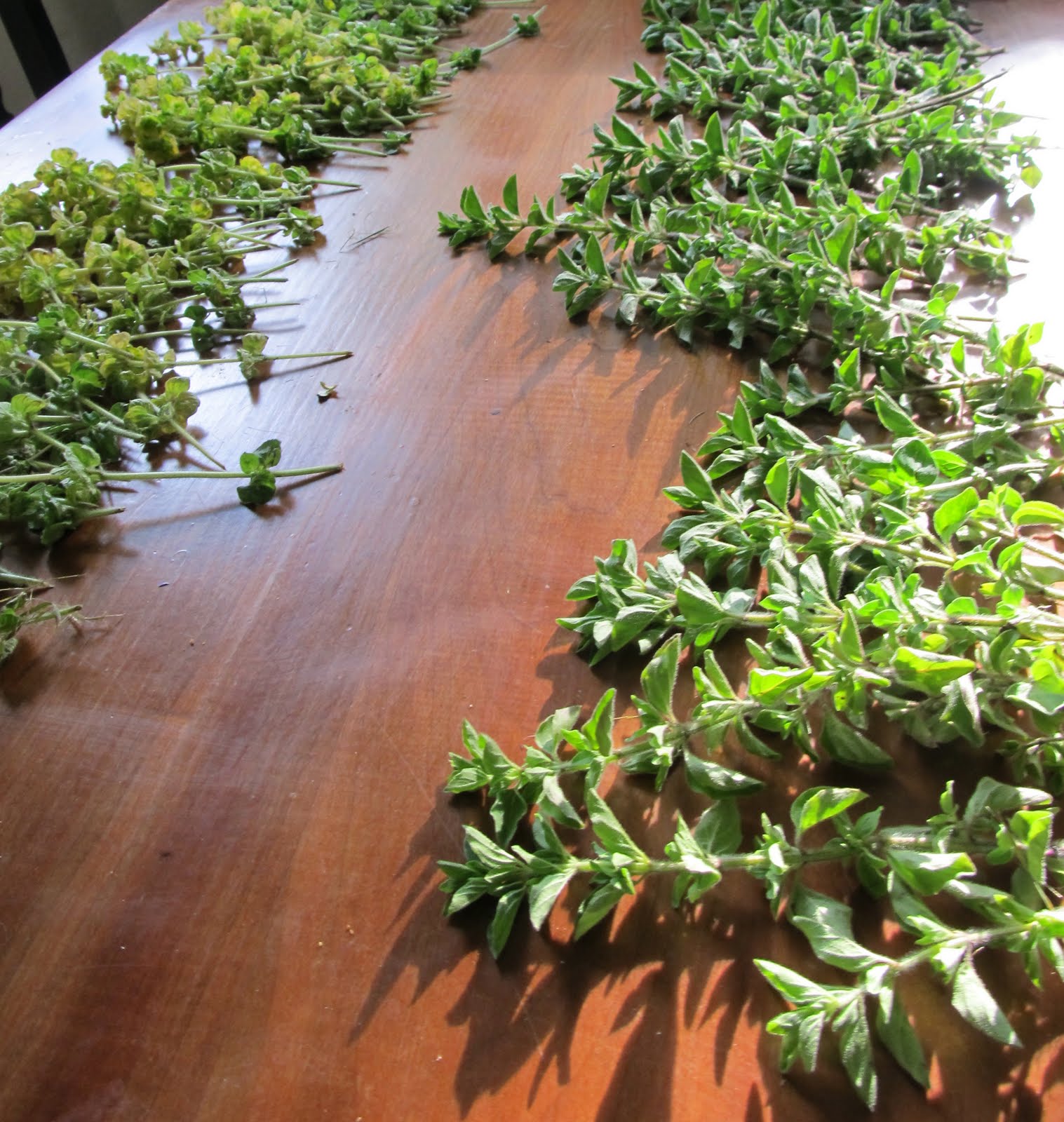
The Utilitarian Herb Dryer
The driveway may not be as pretty as the first photo, but it's a better herb dryer. Put 'em on the asphalt, and it goes even faster. This is where refinished furniture, paintings, screens wet from being cleaned (yeah, like I do that) and whatever else needs drying goes on a sunny day. 

And when it's not a sunny day, having a hard surface is still nice. To walk on without being in the mud. To let the rain wash the dirt off something. To send some sediment and water to that soil patch downslope. Level hardscapes rarely ever exist. You may think it is, but water will prove you wrong. Anyway, completely level slabs are for chumps. You want gravity and water to help you clean it off, and not just willy nilly. 

There's also something about a barren patch in the midst of a garden that provides balance. The hardness feeds soil's softness not just with organics and sediment, maybe, but metaphysically, or maybe that's just the sleep deprivation talking. The hard speeds the spin of the soil-weed-soil cycle, at any rate. Weeds thrown upon the altar sate the more ravenous of the soil gods.

So yeah. Gardens should have hard surfaces. For those and other reasons. I have no brilliant or pithy summation. What did you expect from someone who delves into a garden series with a post about barrenness and concrete, death and dessication? Stay tuned, it gets easier...

21 June, 2011

Gardening Post 1

There have been other garden posts here before, but this is the first one lacking a decent title. And by decent, I mean smart-ass, obscure, and/or irrelevant. 


This is my fourth spring gardening in Olympia, and meteorologists say the region is a month or so behind schedule in terms of warming up. Even without the delay, the climate here allows for snow peas, strawberries, and lettuce on the summer solstice, which has blown my southern mind each and every year. Back in Old Virginny, where 90+ temps have become common even in May, the season for these has long since passed, and green is  turning brown.

 This shot is from the roof of my house, looking down into the front yard, which loses some grass every year. The road-side bed has wild strawberries, herbs, camas, a saskatoon, and the usual array of weeds, volunteers (as in, weeds I can use), things I cannot remember, and sprouts trying to fight their way through the strawberry blanket. This was the first bed I carved from the lawn.

At the far lower left is a glimpse of the driveway, along which I planted a row of blueberries in year two. The bright green patch has some strawberries that came to me from a neighbor wilted and unhappy late last summer. They're producing well right now, so much that there are some left for me after the kids have their fill. This be also has burgundy shamrocks that I may or may not have planted, spreading into a nice blanket and providing my youngest with an inexhaustible supply of tangy treats. There's also some mint edging, artichokes, bitterroot, oregon grape,...and of course stuff I cannot recall right now. 

The stone walkway comes from road cuts all over the state. It has taken years to accumulate. Stonecrop from an island up north is filling in the spaces, and is starting to bloom now. I had creeping thyme, but it gets as ugly and invasive as a neo-conservative after a while, and I ripped it out. 

The triangle beyond is mostly new, having been excavated last fall and winter to make room for a meadow full of stuff from east of the Cascades. Violets, lomatiums, sage, blue fescue and other grasses, hawkweed, camas,...and various things that either arrived as seed or stowed away in the roots of something else. Also here: a dwarf Fuji apple, lavendar, more herbs, a dahlia or two, calendula,... I'm not adamant about having a purely native garden. This plot is basically an experiment to see whether the hottest, dryest part of an Olympia yard can sustain things that would be more at home in the sundrenched Columbia plateau. 


The far corner has a sickly cherry tree, a garlic patch, and a circle of snowpeas that form a little fort where my young daughter can sit and snack, hiding from traffic driving by. There's also another saskatoon (like the strawberries, transplanted during that brief window of bad transplanting weather last summer, but in this case refusing to fruit as a result) and a mystery blue or huckly berry. Winters squash and cukes are poised in these beds, ready to take over after the garlic is done. There are also onions and some scarlet runner beans just taking hold. 


Out in the back 40 the mix of haphazard planting and geometric removals of grass continues. Along the fences are berries. A few fancy black and raspberries that I actually paid for, but also some wild himalayan blackberries that I prune into something like temporary submission, thimbleberries uprooted from logging roads, and mystery berries that were set out for free by the road this spring (but which had so little roots that less than half seem to be surviving). 

It's hard to see, what with the grass that I let grow tall and free, but there are three rectangular beds that are the closest thing I have to a traditional vegetable garden. They are more or less 4 by 12-foot beds, the size I can irrigate with a 25-foot soaker hose. Snap peas are producing heavily in one as onions are finally feeling warm enough to grow. There are radishes just beginning to be ready, beets still a ways away, and carrots only now sprouting their first true leaves. Summer and winter squash are planted, ready to fill in as the earlier crops finish. One bed has a variety of tomatoes. At the north end of each bed, where they won't shade everything else out, are hops. Willamette and/or Cascade planted a couple of years ago, and Fuggles a couple of weeks ago. 


The tall stump (footholds cut in it for the girls to reach its perch) is slowly being swallowed by native blackberries that I am experimenting with (a subject you will see here, and probably in future posts). The perimeter of that bed has Quinault strawberries just about to ripen, a native bay, a rosemary bosai'd by the last winter, and mint. Oh, and a lilac, fireweed, iris, and a cool green frog.


Maybe you can spot what's left of the rhubarb in the background, regenerating after harvest. The copse of alder that fills most of the yard has lots more native blackberry, hazelnut (I get withes and bean poles from it, while squirrels and jays hog the nuts), and various woodland plants I've snagged and tranbsplanted. Among these, oceanspray is doing really well, and in a few years should yield some digging sticks (it's other common name is ironwood). 


Not shown is a tiny hoop house with tomatoes and lettuce south of the house, and a more ornamental bed along the fence at the north end of the house, with ferns, red and evergreen huckleberries, and the neighbor's rhodies arching above it all. There's another similar one across an isthmus of grass that has shrubs on a tapestry of groundcovers, most all of which is native.


So there you have it, the basic, dull introduction. More like there I have it. I used to keep a garden journal in Virginia (but the dust with a broken computer, I think), and am a little ashamed that it took me this long to get going again. Are you still reading this? Congratulations. All I meant to do was start keeping track of what's growing, where, and when. You are incredibly dedicated.


29 May, 2011

I was gonna write about tending to the wild berries

but it turns out I already did. That time, didn't post any photos, however, so here are a few. I just trimmed back the new Spring runners, who in their enthusiasm would drown the carpet of older growth that has been flowering heavily this month. Where a shoot can cover new ground (like the pile of alder and cherry branches I want to hide), I let 'em go, but otherwise I want every precious photon that makes it to the South Sound ground to kiss the berries. 


Can you hear the bees?
Last year, I found that doing this makes the ordinarily tiny native blackberry swell up and sweeten. The wild imperative is to cover ground, send out runners to new bare spots, clamber and climb through other plants: colonize, colonize, colonize before the canopy closes so tight nothing will grow below. The berries seem to be secondary, the way to get birds and mice to transport a few seeds should the vegetative expansion stall.


So in I step to cut off the natural process for my own benefit, or my kids' benefit, anyway. This year I am more organized, and have caught the runners at a really good stage: tender tips, well-formed leaves, not enough time for alder debris and other dirt to add what I don't want, or for bugs to chew what I do. I've heard of the tips being candied and preserved, and tasted a few as I was cutting: there is a hint of berry flavor wrapped in mild astringency. Books say to peel them, but I found that pinching a shoot and running my fingers down it strips off what passes for thorns on new growth. Not sure whether I'll candy and preserve them, but they'll probably work in the wok or steamer, maybe snuck into a salad. 

Liko
The liko, the emerging leaves on the extreme tip, has more thorns and both the texture and flavor are stronger than the stem, so I'll pinch those off for tea. I'm hoping that it will be analogous to some fine Chinese tea I had one time, formed entirely of the baby leaves picked at their tender best.


Further down, the runner is too tough to eat, but the leaves are good. Again, it's a matter of pinch and pull, but this time I keep the part I removed, and toss the stalk.  (As soon as I write that, I find myself wondering what uses the stripped runners could have. Hmmm...) And again on another matter, I cannot overstate how nice the leaves are right now. No bug holes or eggs or exudations, no blemishes, none of the hardness of texture and appearance of old leaves. I have read many times about gathering blackberry leaves for tea, but nobody mentions that it should be done at young runner stage. I've already mentioned the tender freshness of the produce at that point, as well as the future benefit in terms of berries, but there is also this: the thorns are smaller and not so stiff, so it's easier and less painful.

It's rumored that there will be sun today, and the leaves can dry. That, I could not plan, but the rest of the timing I will take credit for later today as I sip some tea, and later this summer as I feast on fat juicy berries.

15 May, 2011

Cooookin in the Rain, I'm Cooking in the Rain

Warning, Objects in the grill-dome reflection appear fatter than they are.

Yeah, the title is stolen from a musical, even though I despise musicals in general. I do make an exception for Clockwork Orange, though.

Cooking out holds an almost completely opposite place in my esteem, as long as I am the cooker-man, and the few times I haven't enjoyed it can be blamed on inexplicably bad meat or unavailability of good wood. 


But not rain.


Which is good, living in Olympia, where fair weather grilling is not possible often enough to sate my hunger for smoky goodness. If I held off every time clouds threatened rain, or drizzle dropped, or outright downpours dampened the day, I'd be a sad shell of a man. If the Oxygen to H2O ratio is high enough to let flames get a hold of the wood, then I'm good to go.


Yeah, wood. I am not a modern American griller, weekend warrior with a thousand dollar gas grill or a humbler briquet bucket. I do not have a "Kiss the Cook" apron or feel the need to dress up in silly summery outfits. I have no fancy gear, and my grill was foraged on Large Trash Pick-up Day (prior to which, I had a little hobo set-up consisting of a few cinderblocks). But I am pretty particular about what I'll cook on.


Gas is an idiotic expense: somewhere far away somebody fracks the earth, refines the stuff, compresses and ships it, and charges me enough to make it grate on my homesteader soul, but not enough to really pay for the environmental damage. Besides: no flavor. 

And briquettes? Long ago when I used them, the lighter-fluid infusion bothered me to begin with, and the occasional appearance of nails and other foreign objects reminded me that yes, I was cooking something I would eat on a lozenge of ground up who-knows-what. I imagined the maker, a "legitimate businessman" (sarcasm implied, whether you want to take that as the mafia euphemism or just an indictment of capitalist worship of cheap raw materials) dumping old lumber covered in lead paint, bits of railroad ties, and all manner of toxic crap into the hopper.


A couple of times, I bought actual charcoal, the slow-burned nuggets of wood, crow-shiny chunks with fire enough left in them to cook. But again, my cheapskate DIY self just cannot abide the expense, even if I had the cash to spare. 


So I scavenge wood. In Hawai`i, I had a secret spot on Puowaina where kiawe (mesquite, more or less, to you gringos and chicanos) was there for the taking, and supplemented it sometimes with mango from the tree I'd trimmed. In Virginia, it was hickory from the back yard thinning. Here, it's alder, again from the back yard. I am on year three of the wood from a single big alder I took down, and now I know why the Indians would use the half-rotten, age-softened wood to smoke fish. The smoke is abundant and flavorful without being too acrid or overpowering. Saying so may mean that I cannot return to the south, but: it's better than hickory.


So out I go to find some windfall twigs and maybe some cedar splints to get the fireball rolling, adding on progressively larger pieces until the real chunks are going. All the while: running out front to pull some garlic and get it clean and diced, back to check the fire, in to flavor the fish and burgers, back out to check the fire and fiddle with it's air supply, in again to grab another beer, back out to spread the coals how I want them. Then bring on the food, and set to grilling. Often as not, I'll be talking with my sister, already fed and 3000 miles away, as the process unfolds. Nice long conversation, and the coals are ready. This is how I measure time; watches are for chumps.


The black dome not only lets me pull this off in the rain, but is an important tool in any weather. Opening and closing the vents below the fire bowl and atop the lid to regulate the air stream, sliding it askew or removing it entirely to let the oxygen river rage. The dome lets me be miserly with the heat, especially important when cooking something big, toward the end of the cycle as the coals are ashing out to nothing, and the food coasts in to done-ness. Beneath the grate, holding it off bottom-dom, are a half-dozen carefully chosen volcanic rocks that have soaked up heat during the conflagration, and radiate it back now. Thanks dad for teaching me the physics, and mahalo Hawaiians for teaching me how to choose rocks that won't explode.


Over the past couple weeks, we've had sunny days that demanded cooking out. Both times, rain has appeared, but was kind enough to let me get the blaze going before cutting loose. Dome on, I watched as the drops hit the black and vaporized instantly with a sizzle I could feel (if not really hear anymore), the lid never appearing wet, as in the photo above (see the little steamer?). As the fire stopped sticking out its tongues, as coals glowed softer, rain made shrinking circles of wet; I suppose I could calibrate evaporation time with temperature, but an intuitive sense is enough. By the time the dome has cooled enough that droplets have time to collect and rivulet down the sides, the food is done. Imprecise and variable according to conditions, but again, that's how I regard time: I want it to speed up and slow down, stripped the standardization that puts it in charge.


Because years from now I may forget, here is the menu as of late:
Burgers from local, organic, pastured beef (first ground beef in years, and it's retty good)
Steaks of local grass fed beef tenderloin (some people claim the leaner meat is harder to cook, and corn-fed fatty stuff is better, but people are lazy and stupid)
Burgers of mushroom, beans, garlic, and probably something else (wich I'd written it down, because the taste, texture, color and mouthfeel are better than any veggie burger I've ever eaten)
Sturgeon on a foil boat laden with olive oil, garlic scallions, and sea salt
New potatoes from the farmers market, same prep as the sturgeon


08 April, 2011

Lord Marmalade

The title here is a twisting of Lady Marmalade, whose gichy gichy yaya is one of the few riffs guaranteed to get me dancing, but which has nothing to do with this entry. That weren't no lady, and marmalade seems so un-funky, more old-fashioned and British. Ergo the "Lord." 


Paddington Bear and old women take their tea with marmalade at the ready, it's medicinal power soothing the harm done to one's palate by the clinkery toast favoured on that side of the pond. My grandparents liked it, and I do too, but few devotees are young. Not sweet enough, too full of the peel that Americans have cast off for generations.

This concoction's etymology trails back to classical times, alluding to the Greek "honey apple," an apple grafted to the quince. For a long time, it has meant a jam or preserve including citrus, the acidity probably important before sanitary canning, preservatives, and pasteurization. 

Now it's a nostalgic taste to some, to me. I made some batches this year, both to practice the science of canning which was nearly lost by my generation, as well as to savor something grandma made. The first time I used blood oranges, which I'm guessing would have been unimaginably exotic in central Ohio during the Depression, when as a young mother she began canning in earnest. I followed her lead, and made a portion into "hot jam" by inserting a cinnamon stick into each jar as it was filled. I also experimented with some, adding some local cranberries to the mix to redden it further and add a bit of bite.

Equally exotic may have been the preternaturally orange navels of the modern supermarket, bred for looks, tasting like water. The blood oranges had the allure of aroma, more flavor packed into a tennis ball sized fruit than in the softballs lobbed out of Florida by the trainload. Even better, they were on sale.


Same goes for the variety in the next batch. The local grocery had a sale on "Cara Cara" oranges, which were dead ripe and redolent of heaven as I walked in. I immediately filled a couple of bags with the fruit, same size as the bloods, similarly ugly on the outside with patches of green, some blemishes, and even a soft spot or two (all of which told me the "organic" label was not fake, and that they'd been picked ripe). This time, I went for straight marmalade, no experimental or family-inspired additives.

I don't have grandma's recipe, and had to go looking on the internet, my approach to which is to triangulate, to look at plenty and attempt to discern a logic. The first task is always to weed out the bullshit: the people repeating some untested recipe because they like to post stuff, the "easy" versions maximizing prepared stuffs and minimizing cooking, and the just plain mistaken. Eventually, I zero in on the essentials, and get an idea of the leeway in ingredients and proportions that won't result in failure. The rest is reconciling units (cups versus pounds of sugar, pounds versus numbers of oranges), and trying to figure out what my palate wants compared to typicality, which in this case was less sugar.

In the end, it was this:
10 pounds of oranges (32 or so of the size  favor) - Peel the zest off of about 1/4 of them, quarter and thinly slice everything else.
6 cups of water - Add this and the oranges to a large steel or enamel pot, and gradually bring to a boil. Keep cooking til the only identifiable pieces are the rinds, which should be quite soft.
Now turn it off and do something else til tomorrow.
Start again by gradually turning your orange slurry to a boil. 
10 cups of sugar (You have pretty wide latitude here, I think. Add less to begin, and keep adding til it seems right to you.) - Add the zest and stir. And stir! If you don't it'll start to stick and burn on the bottom of the pot. 
The mixture is sneaky and vindictive at this point--it will look calm, lulling you into not stirring. Then when you start again you release a sudden violent boiling, a volcanic eruption of orange lava hotter than boiling that will stick to your skin and burn like hell. Sweet hell, but painful nonetheless.
A lot of recipes carry on about how you need to bring the stuff to 220 or 222 degrees, or the jam won't set. I've never managed to get it past about 215, and it has set fine. The key things seem to be: it gets darker, you begin to have trouble keeping it from sticking and burning, and it gets thick enough that after a while you cannot stand to stir any more. It's done, so you can it.

This last batch went into some old squat jars I got at a yard sale. Some proudly proclaimed their modernity with embossed patent dates from over a century ago (the same wide-mouth lids of today work just fine, and it's good to know that some things don't change). 

I dipped into one of these pots of marmalade--talking in a Paddington accent of course--and was rewarded with the colour and flavour of liquid sunshine. Nostalgic in name and appearance, perhaps, but as bright and fresh a taste as I could imagine. 

Yum.