Does the word that just popped into your head show up here? Find out:

Showing posts with label consciousness. Show all posts

20 December, 2016

Streaming Fascism

Police State appliances for your home.

Being a liberal, lately I've been inundated with warnings and calls to action, boycotts and protests, petitions and pleas to click and agree,...all of them in response to the election of Trump, who shows the most overt signs yet of being our first flull-blown fascist president. (Yes, Cheney fit the bill, but technically he was only VP.)

Being an American, lately I've been inundated with adds for Amazon's Alexa and some Googly thingy that can sit in my house awaiting orders. They will do amazing things like change the thermostat so that I can have indoor snowmen, or order tape so that I won't have to seal Christmas gifts with band-aids. These are the whimsical examples that tech giants are using to sneak into our homes.

And Americans could care less.

Not that we shouldn't be wary of Drumpf's scapegoating tendencies, his lashing out at the press, his promises to sue any critics and jail the opposition. We should fight that crap tooth and nail.

But we should also resist the urge to invite mega-corporations into our homes, relinquishing increasing power month after month under the guise of convenience. Sure, in aspirational, duped-by-the-dream America, it's common to wish that you are one of the wealthy, that you have a butler, and  these devices play right into that. Never mind that to actually get the right kind of tape, you'll need to answer a bunch of questions that not only take up time but inevitably lead you to Amazon check-out.

Checking out on such mundane household chores as setting the thermostat or thinking ahead and buying groceries is not without cost, and ultimately without loss of your autonomy and freedom. Amazon and Google aren't altruistically taking over your chores--they're insinuating themselves into your life, harvesting data, tayloring their marketing until you're captured. We put up with these intrusions because they're "consumer oriented." You can play with settings still to maintain the illusion of control, but once our homes are linked into a system roamed by artificial intelligences whose goal is to sell us stuff, we've just a flipped the switch to a level of of spying that the Stasi only dreamed of, of monitoring and coercion more thorough than Orwell nightmared of.

Some of you may suspect where I'm headed with this: that such a tool in the hands of a dictator would be ominous. But actually, I think it's bad enough as is. Entities whose only goal is profit are invited to spy on us. Not only do they not pay to collect data, they get us to pay for the data-collection device, they get us to sign up for the services that will deliver our data back to us, processed into gleamingly ads rendered irresistable by virtue that they were borne of our own behavior.

Don't buy this crap. Don't buy the device, and don't buy the message. Be sovereign, un-plug, and read a book.

11 November, 2014

The Hipster Effect and other Models

Image by Getty, Fair Use by This Guy's Nephew

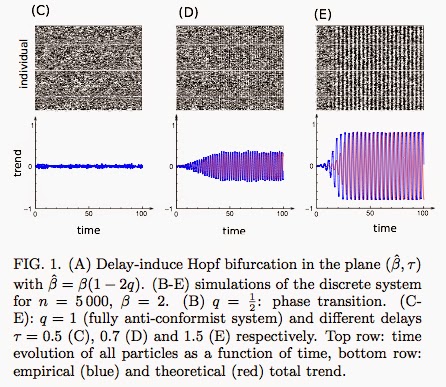
A mathematician recently posted an article (available at arXiv as a pre-print, to be published in a refereed journal soon) called "The Hipster Effect: When anticonformists all look the same." I'm too slack to learn the math, which apparently helps explain why so many people who reject the mainstream still end up conforming, just to something else. It has to do with the delay between a mainstream trend existing and the non-conformists realizing it and rejecting it, and looks like this:


As an anthropologist, I have some non-mathematical ideas about how and why hipsters end up sharing so many traits. As a human, I tend reject simplifications of our behavior to mathematical functions. But Touboul is clear that his model is just a model, and not an explanation of culture or even something that can encompass all hipsters, so it's fine for what it is. Also, the fact that some image sprange to your mind when I said "hipster" proves that he does have a point. Facial hair, clunky black glasses,...

This guy read the Hipster Effect article before I did, and was already appearing in blogposts about it days ago.
As if to prove Touboul's point, there has been a delay, and then a bunch of hipsters blogged about it (huh, blogging, it's so old-school, so they must be posting ironically) along with all the other non-conformists. I'm too late to be a hipster, having learned of the article in the Washington Post (online, at least, and not on some dead tree).

And yet, I exhibit signs of being a hipster. I'm in phase with them as far as clunky black glasses, facial hair, brewing ale with hops I grew, and so on. As I write, I am listening to the local, listener-supported, volunteer-powered community radio station called KAOS. I am in phase with a fair number of hipsters.

Partial View of an apparent Hipster, Courtesy of some Model

But is it because I react with similar intent and mathematics to the others? In some ways, no. Hipsters' oscillations are much more rapid than mine, and I was wearing this kind of glasses and growing a beard decades ago (and not in a "I did it before you did" hipster kind of way). I just hate to shave, and always wanted glasses that came from that era when all men wore the same kind of glasses. Like my uncle in the first photo. He was not a hipster, but he was an enigma, a guy who wore "normal" clothes, but to a degree (khaki pants and white oxford shirts for decades on end) that was decidedly atypical. He served in the military for a little while, got a job, and raised a family, a model citizen. But also one who was deeply subversive in some ways, whose thoughts boggled minds and defied models.

Were I in the data set being compared to Touboul's model today, I might well become empirical support for mathematical supposition. But I represent a much longer oscillation if I represent one at all, and the "why" of my seeming hipsterism may be a lot different than that of people who know enough about contemporary mainstream culture react against it.

06 October, 2014

Unwritten Rules of Archaeology. Version M.0

This summer, the blog Archaeology In Tennessee posted an invitation for archaeologists to submit the "Unwritten Rules" of the profession. I not only procrastinated posting anything, I also failed to follow up and see what Rules were published until linking them just now. Instead, I pecked out a list of my own, and didn't even post anything myself until now. This post is going to be long as hell, and there are no images to delight and distract, but it's about Rules, so what did you expect?

Unwritten Rules of Archaeology
 
Who They Think You Are...
Most people think you dig for dinosaurs or gold. You can educate them, maybe. You will chuckle or sneer about them with other archaeologists, later. But try not to be mean to them, for they know not what they do.

In the real world, there are usually people with far less education than you who know a lot more about a particular place, or how people used to live there. Learn from them before you go telling them about their past.

Who You Think You Are...
We belong to what the social anthros call affinal kinship groups (or used to, before several jargon changes), and can trace our lineages back through crew chiefs and academic descent; we recognize families accreted around certain projects of yore.
  • Corollary 1: Be careful when dissing the founder of a school of thought, for the person you're speaking to may belong to that lineage.
  • Corollary 2: Be careful when exalting an archaeological ancestor above all others, for it makes you come off like a zealot.
Unless you are in a field school or surrounded by people with little experience, limit yourself to a single field school story within any given work group. Mostly, these stories show how little you've experienced, and they become tiresome. If you participated in multiple field schools, best keep mum, lest you be branded Dolt or a Dilettante.

As in all anthropological endeavors, listen first and talk later, especially when there are experienced elders involved.

Archaeologists can be real backbiting bastards, but as far as I know that strategy proves maladaptive outside of the shrinking niche of tenured academia, and maybe won't even work there. Criticize all you want, with the understanding that you must either pledge fealty to a strong camp or risk not getting work in your area.

Join your state or regional archaeological society, attend its conferences, and give papers. Archaeology is not the same everywhere, and you'll learn more that is of practical value by meeting and listening to your local/regional peers than you will in several years of national conferences; it's also beneficial to your job prospects, from shovel bum on up to principal investigator. Once you've given a few papers, people think you're an expert, or at least aware enough to be more desirable than the person with a fancy degree but no local reputation.

Gear...
If you are a young archaeologist enamored with the latest technology, try not to dismiss archaic fieldcraft. When the satellites don't cooperate or the batteries go dead, tech savvy gets you nowhere. Besides, sometimes the old tech works best, which is why the best maps in Hawai`i are still made with plane tables and alidades.

The digital camera may be the greatest technological innovation in modern fieldwork. Take lots of photos to remind yourself of what you did all day. Shoot overviews, mid-range, and details. Take a shot of your GPS screen (see Redundancy). Get photos of flora and fauna for reference, and of anything that will look cool on your archaeology blog.

"Write in Rain" fieldbooks have their limits. Among these: too much rain, rainless but very high humidity weather, the inks of certain pens, and of course those ink-impervious clay smears on the paper. For pencil devotees, remember that after an erasure or two, you may not have full functionality.

The tool you buy needs to be modified. Unsharpened shovels and trowels are are the mark of an oaf. Grab a sharpie and draw a scale on your fieldbook, McGyver up a tool from things you can afford on perdiem (bamboo skewers have no equal in some situations, and stand in just fine for a handful of others). Watch and listen to the vets, but don't assume that they figured out all the best hacks.

Fieldwork...
Redundancy is your friend, and its value increases in proportion to the distance of the project area from your office. I know that the GPS unit stores coordinates, but writing them down in your field notebook will one day save you the pain and humiliation induced by lost or malfunctioning GPS units, not to mention software glitches, sunspots, EM-pulse warfare, whatever.

You will find things where you least expect them sometimes, but you never know which times. So stop whining and finish the transect.

After a long day of survey, or at the end of a project, be prepared to find something while walking back to the truck.  If at all possible, plan on a half day on the last day, to allow time to record this find. The worst case scenario is that you find nothing and have enough time for a few beers or maybe even a shower.


Write-up...
Don't pretend to be more precise than your data merits. I cut my teeth (shins, really) on dry masonry field stone features, and measuring these to the nearest centimeter is not only more effort than it's worth, but is fakery. 10 cm increments are fine. Most of the time, think millimeters for artifacts, centimeters for depths, meters for site areas, …
  • Corollary: Larger increments (rounding off to 5s or 10s, for example) can alert readers to uncertainty or imprecision they should be aware of in an honest report.

Unless you are a historic archaeologist working in a Commonwealth, use the metric system. (In the US, this trick mystifies the general public and our stature as scientists is enhanced.)  Be ready to be conversant in feet and tenths thereof when the engineers and project manages show up, though. Also, be aware that when they talk about "1:100," it's inches:feet, which is 1:1200 in like units (this is a trick engineers use to confuse and cow the populace).

The observation so obvious you didn't need to write it down will be the one you forget. (I phrase this truth thusly because the brilliant wording of my initial realization was not written down.)

When writing reports, stick to the facts for the most part, and relegate interpretation to a short section near the end.
  • Corollary 1: However, you should speculate frequently and in depth while in the field, drinking beers when the day is done, and drinking more beers at the local archaeological conference. This can help you discard the ridiculous and discover the creative, although it can end up the other way around if the drinking goes on too long.
  • Corollary 2: Be extremely careful when speculating with non-archaeologists. Off-hand and joking interpretations may be later repeated as facts by people who put a bit too much stock in archaeologist's words.

And Finally,

The Written Rule of Archaeology

It's spelled with two A's. Archaeology, not archeology. Don't be an idiot.

23 September, 2014

The Rain is Back, and So am I


All of a sudden, I see it's been months since I posted here (if that makes any sense). Today, we've finally returned to prototypical Northwest weather: rain, the horizon blurred by a liquid sky, drizzle-drop-drench. I was just talking to my kids, and they agree, it's a relief.

So we must be fully acclimatized to this place. Last week, even though it was a full 20 degrees cooler than "sweltering" in the land of my birth, I was sweating, unable to keep count of how many sunny days we'd had in a row. The girls agree: too many days of bright blue skies in a row becomes oppressive. We welcome the wet blanket now.

Summer rarely reaches the white-sky, humid hellishness of a mid-Atlantic summer here, and it's true that we all soak it up, enjoy it, and retreat from the indoors. It's no accident that Northwesterners spend so much time hiking and camping and such. (OK, not me, but other people, whose jobs keep them inside most days.) This summer more than most, I took a hiatus from blogging and other trivialindoor pursuits. Instead: gardening, fieldwork, and gazing into the yard that became my own, and moving.

So, a new season, a new (old) house. Through great willpower, I've managed to put off doing yardwork at the new place, but that's about to change. For one thing, the communal/community garden is starting to wind down. For another, who the hell wants to dig up the yard when it is hot(ish) and the ground is hard? For yet another, there were side gigs and wildfire-chasing to do while the sun was out.

Now, as the drizzle softens the glacial outwash that is my yard, it's time to dig in. Now, as the Equinoctal threshhold has been crossed, there will be time to write. (As opposed to just clicking in photos at Anthrowback, my minor-effort summertime diversion.) Now, as Winter wrings the glare of Summer sun into a pool of mild Autumnal reflection, it's time to seek shelter under roofs and with kin.

09 July, 2014

Freedom Inc.

Phoneto by Zonk'em

Outside of Buck's Spice Shop and Darby's, two businesses I gladly choose to support, there is an interstice of green in the sidewalk. Grey, gray,...grass! There's a little (but still larger than the li'l lawn) brass plaque identifying this space as a park. Now and then, there's the sign you see here, miniscule but effective.

"Keep off the grass*" resinates this week, what with the opening of the first legal pot stores outside of Colorado. As my family waited on Sunday morning for a table at Darby's, we saw the sign and the roach** thoughtfully tucked into the park to stack on another entendre***.

We laughed, and took a few photos, inspiring other people to do the same. My kids didn't start doing drugs, I managed to hold onto my job, and breakfast--although served to Led Zeppelin live--was delicious, and in no way a freakshow. Legal pot in 2014 Washington is,...so what?

It was interesting to hear reports on NPR that actually spoke of today's opening of pot stores here in terms of "civil rights," maybe not on par with gay marriage (local reaction: we're totally used to it,...so what?), but a great day for freedom, in the words of a guy who'd been in line since 4AM (sorry, guy who showed up at 4:20) to be the first to buy legal weed,**** only to say he'd light up to "Dark Side of the Moon,"***** sorta like he has for 33% of the 1,287 bags of reefer****** he's bougth before, illegally.

Equality for people who don't fit in the archaic man-woman identities and roles is a civil rights issue, but what happened today is a consumer issue. In Americo, though, consumer freedom has increasingly stood in for and even pushed aside the more basic freedoms in the Constitution.

Today gets reported by those who worry as the Beginning of the End, gateway drug to utter debauchery and decay. Meanwhile, others spout some crap about Freedom when what they're being offered is a chance to pay premium prices plus 25% tax (that's right, Washington State imposes a 25% tax on this freedom) for something that's actually pretty easy to get outside of the official stores. The saying "Freedom isn't Free" needs to be amended, "And it's Heavily Taxed".

So, light up and celebrate if you must, but don't let the ability to go to a store and light up legally make you think you're more free, don't let THC be the opiate of the masses, and don't develop memory loss about more fundamental freedoms at stake in this changing AmeriCo. For real freedom, don't feed the stores that will compete and merge and take-over and consolidate into the same corporate creature that stalks every revenue flow; go chip a park out of the concrete.


* an archaic term for psychoactive cannabis
** an archaic term for the remains of a partially smocked grass cigarette, or "joint"
*** a French term. I only explain archaic terms, so you're on your own for this one
**** archaic term for grass*
***** archaic stoner music
****** archaic term for a joint** or maybe weed****

11 June, 2014

"Won't get Fooled Again" (Oh yeah they will)

Having drunk the kool-aid, and realizing that it doesn't work, Rep. Cantor looks ill.

Oh, there were so many choices for titles to a post about House majority leader Cantor getting offed by the even nuttier right. I was pretty close to going with "Meet the New Brat, Same as the Old Brat," but I don't yet know that will prove true.

What is true is that I'm happy as ever to have fled Virginia's 7th Congressional District. Not quite a month ago, I wrote about those of us who have joined the Virginia Diaspora, citing among other factors that Eric Cantor, former Reagan Youth stalwart and petulant obstructionist extraordinaire, was being challenged from the right. Apparently, pundits wrote off the challenge, even though the tea party and Brat brigade had recently ousted Cantor's henchmen in the state GOP convention, under-cutting the now Establishment incumbent. He managed to keep that one fairly quiet, but losing by 11 points in a primary getting national attention is not something that can be ducked. 24 hours after the election, he's already conceded the power he once had.

Which would be cause for rejoicing, if there weren't a pretty solid chance that David Brat, blindered economist, weren't now a very good bet to win the 7th District's seat in Congress. I'd like to think that the Henrico suburbs that voted for Obama might shy away form a Tea Party wing-nut, but odds are they will once again vote against their own self-interest and elect the guy. I'd love to believe that Brat won by virture of Democrats voting in the GOP primary, sabotaging the Republicans by nominating a guy too far right to win in the general election, but I know enough old-minded Virginians (the ones who show up during working hours on a mid-week primary, the ones who feel threatened by the Socialist Negro) to believe that they were the ones that made the difference. They got rid of the sharp dressing guy who compromised once, and installed a more conservative, more dogmatic, more Christian man.

None of the breathless coverage today veered into the fact that Cantor is a Jew in the GOP South. And to be honest, Richmond is the rare southern city that has been fairly accepting of its Hebraic residents (one of the oldest Jewish cemeteries in the US is there, and Jeff Davis even appointed Judah Benjamin to cabinet posts), but the modern voters seem happy to go Old testament on this one, turning him out into the desert as a scapegoat. It's no longer sufficient to be for corporations and big money, the modern Republican candidate must establish his bona fides as an utterly dogmatic right-winger, never giving an inch. The emphasis on Jesus and God from the new Brat, comforting to so many Virginia Christians who imagine themselves oppressed, could have much darker echoes as the radical right gropes its way toward control of the Reichstag.

Hopefully, that dark a future is mere speculation. The bare facts, however, are bad enough. Faced with an economy in which the 0.1% reap all the benefits, and have bought Republican obstruction to anything the Democrats propose--in short, an economy guaranteed to further impoverish nearly everyone--well over 50% voted the punish the guy who they vaguely sense may have compromised somewhere along the way, replacing him with an even more strident anti-government zealot.

Will the Virginians who voted Brat in at the primary hand him a seat in Congress? Probably.

Will they one day realize that votes like that amounted to handing over their hard-earned money to oligarchs, the only ones who can afford clean water and filtered air? Probably not. They'll blame a Black man, or a Jew, or a Socialist (or a Woman, should Hillary or Elizabeth get the Democratic nod). Even if they realize that they were in fact fooled again, it will be too late.

22 April, 2014

I Heart Microbes


Spring continues to burgeon. The flowers and en-leafening branches are only the most obvious evidence. Underfoot, though, the soil swells as microbes kick into high gear. Without their action, the plants would sit and starve.

Meanwhile, in a cabinet under the counter, acetobacters transform liquid leached from the neighbor's leftover juice pulp into some tangy amber vinegar. The photo above is a slightly color-enhanced shot of the flocculant mat that covers the surface, which as an added gift formed a heart shape. Heart Shaped Floccs--you gotta take your Nirvana where you can get it. 

20 April, 2014

Half-blind Faith and Half-baked Science


Well, it all started with a miraculously convenient find, what appeared to be a finial from a cross at a site probably associated with the Christian Mission. Those of us working on the project had been softened up, conditioned to accepting the extraordinary through the previous miracle of finding identical Native-style tools wrought in stone and glass, evidence of the Contact we'd been speculating about. For the finials, as with so many alleged relics of the True Cross over the years, there was no proof, although in this case it was a plausible and interesting enough story that it tempted faith.

Upon further examination, stemming from the dogged (of not Godded) persistence of a scientist not quite comfortable with the all-too-easy retreat to calling an unknown artifact a "ritual object," the site kicked up a bunch more of these last week. Too many to be a cross, and in a place where they might be from a century after the Mission packed up and headed north.

Oh well. The story, and my confession at the altar of science, is over at ArchaeOlygy. It is not all a tale of faith undermined, but a strange cycle that may loop back to the Tenino Stone.

So on a day when many of you celebrate a miracle of resurrection, I wish you well. I cannot share ultimate faith in the un-provable, but I share my physicist Dad's awe at the universe wrought by forces we may not yet fully comprehend, but which we can investigate and (with stumbles now and then) come to know for sure.

08 April, 2014

I Guess You Can Call it "Work"

Call it Shooting Star, Dodecatheon, or Curlew's Beak, it's blooming this week

Monday, 5:15 AM.  The alarm on my phone buzzes, ending the fantasy that my wake-state could be followed by more shut-eye. There's but a single working clock in the house--definitely not in my room--but it seems like on the rare occasions when I set the alarm, my body gets a jump on the electronics. Maybe because it's usually prelude to fieldwork, and I love fieldwork.

6:26 finds me on the road, half a pot of coffee in my belly, and the other half in various travel vessels. I used to hate driving, but back then a trip of any length involved Interstate 95, too many lanes, and essentially no variation in the scenery: shrinking forest, burgeoning burbs, and Cracker Barrels. Today, I face a couple hundred miles of I-90, but it will rise into grand stands of conifers, pass through snowy crags, descend into elks among pines, wind through smaller hills, blow past windmills and orchards, shoot along fields, and finally let me exit into a forgotten town just in time for lunch. Then, from arterial to lateral to a gravelly capillary, not another vehicle in sight.

12:12 PM, and I am standing by the women who planned the project and will operate the machinery. My job is to watch and see if any archaeology turns up. Monitoring, as this work is called, is an exercise in bi-polarity, similar to descriptions I've read about being a soldier at war. Mostly nothing (or worse yet, senseless fulfilling of duties with no plausible reward), and then MAYHEM! No incoming artillery for the archaeological monitor, just the skull rolling off the excavator bucket, and the prospect of being universally reviled while trying to navigate a path that will satisfy interests deeply at odds.

2:02 PM rolls around, and it's clear that this project will only have the monotony pole. They're digging through what turns out to be silt dug out of roadside ditches and dumped here, and will never get down to the original soil. I decide to go walkabout and check out what I can of the 1 square mile of property.

4:24 in the afternoon, and by all rights I could knock off and head for the hotel, having turned in more than the 8 hours I'm supposed to. But I keep walking. I've already recorded one site--just a collection of 100-year-old trash, but something beats nothing--and feel like walking further. So I meander out toward where a 19th Century map said there was a wagon road. Plenty of daylight left, and this far from Olympia, I am loathe to stop. Who knows when I'll be here again?

6:36, in what even in the post-Equinox period must be considered evening. Besides flushing out a coyote (every outcrop in this place has the gnawed bones of some creature eaten by a coyote, along with a celebratory poop), I found a site that seems to have been a rest stop on the wagon road. Bottles of booze and medicine (i.e., booze with an excuse), cans capped with solder, tobacco tins, and so on. The older the glass in the Northwest, the prettier: aqua with bubbles of 19th Century breath and air, once-clear glass tinted purple by the marriage of sunbeams and manganese.

7:27 PM, and I'm nearly back to the truck, having noted an oddly elaborate fence post and a culvert passing beneath an old rail grade along the way. Normally, there is nothing less fascinating than a culvert, but in this case, it was made with a beautifully glazed terra cotta pipe, frags of which I'd seen before dumped at the depot. Wondering what the hell that fine pipe was doing out here had been bugging me for the past couple of weeks, and now I know. The Chicago, Milwaukee, and St. Paul railway did not skimp, even out here near the end of a decidedly minor capillary. Plus, this culvert seems like a nice den for some critter, and I am a big fan of the reversion of civilization to wildness. [Oh, and I did have time to check out the monitoring site, confirming that it would have been a waste of time to stay put.]

8:38, and it's pretty much dark. I've driven to the hotel (40 more miles of driving this day), and am in search of food. The options in Moses Lake for late dining are limited, and I end up at Safeway. Besides dinner, I now have tomorrow's lunch and some beer, in case I am awake enough to drink it when I get back to the hotel.

9:36 PM. I should be asleep, but instead I stay conscious for a while longer. I call the kids and learn about their day, enumerate the animals I have seen. No writing, but I check out my sister's blog. I even watch some TV, an exotic experience, and luck out with an episode of South Park about Haoles and "Native" Hawaiians. Yes, it is late and I am loopy, but it's hilarious, even though I forgot to drink the beer.

11:11 PM (plus or minus). I close my eyes and drift off, meadowlark song echoes in my ears, visions of purple glass and lines of shorn wheat on my lids.
So, that's one day, much abridged. Lots of driving with sub-par radio choices. Lots of walking while being whipped by winds carrying grit. Easily more than 12 hours of "work," but nothing I would change. I saw a lot, got to know some new ground as you only can at walking pace, and didn't have to deal with any monitoring emerencies. From my employer's perspective, I managed risk and kept them legal. For me, though, it was mostly fun.

I'm still amazed that I ended up this way, doing what I do. It's tempting to take credit and claim it was all the plan, but there are any number of junctures at which random chance changed my career path. The most I did was recognize the right times to pounce on opportunities. And now, whatever time of day, I find myself pretty happy with what I do for a living.

02 April, 2014

Twilight. All Beauty, No Vampires

Step out of the Darkness

This past February, while everyone from embattled Alaskan codgers to entitled Southern heiresses was bemoaning our only four-week month, I worked on the Pacific Coast of Washington, the notoriously winter-drenched Olympic Coast.It was warm and sunny.

Spectrum in the Spectre-less Forks

I stayed in Forks, most famous during my kids' lifetimes as the setting of the Twilight series of movies and their prequel books, a protracted tale of teenage angst and love, featuring vampires and werewolves in the Northwest, written by a Mormon from elsewhere. The town clings to the notoriety, fading movie images all around, not-quite-copyright-infringing attempts to cash in ready for the tourists unable to see the beautiful, actual, twilight.


Clear skies and stunning sunsets are not the order of February's precious few days in the Hoh Valley. I'll admit that, and I may never have as beautiful a few days on the coast as happened inexplicably this Winter. But instead of dismissing that beautiful twilight as an aberration, writing off Winter as gloom, my memory is lit by that golden softness.

24 March, 2014

Goodbye, Dave Brockie

Dave Brockie, during his stint with Virginia Beach Police Department

Suddenly today, there were a bunch of hits here, which is unusual. When I tracked them back to the source, it was an article about the death of David Brockie, founder of Death Piggy, and later, GWAR. Sadness.

I'd pretty much left Richmond by the time GWAR came about, but always enjoyed Death Piggy more. So much so, that 30 years after dancing to their manic music, it seemed important to post about their place in the history of punk, the post which is getting all the hits now, apparently because of the Death Piggy image I posted then and there, and here:


David Brockie and I were not friends, and he wouldn't remember me, but he influenced who I became. The random hilarity of Death Piggy, the utter freedom expressed by a band who could get up and play a song consisting entirely of the words "No prob dude," the refusal to plummet into the pitfalls of many a hardcore band (brick-headed hate, intoxicated inability to perform, and maybe worst of all, sanctimonious preachiness), and the commitment to just having fun stuck with me.

The internet, especially those cul-de-nut-sacs where know-it-all critics lurk, is full of references to the ridiculousness of Death Piggy, but without much appreciation of what a gift it was. They use terms like "Silly Core," and treat Death Piggy as a joke precursor to GWAR, which of course is the opposite of what really happened; GWAR was the Death Piggy sideshow that took over. That Death Piggy did not depend on spike-studded leather or huge mohawks to express their hardcore punkness did not mean that they could not thrash out noise with the best of 'em.

Dave Brockie was a leader in the Richmond punk scene because he did not act like a leader. He didn't give a shit how you danced when they played. He did not write lyrics preaching a Message (a Mess, maybe, but that's another thing entirely). He rode the GWAR waves, but as far as I can tell, did not become an insufferable asshole. He was a self-mocking artist. His "time waster" posts (on some site I cannot re-find now) would show up every so often as I surfed the net--one of my favorites was a screed about art in Richmond, especially the Lady Diana Mural and the Bojangles statue, which he correctly recognized as a racist city's backhanded insult, tucked away off the main (white people) drag and appearing to have been literally slapped together out of shit.

It's sad to lose a creative force. It's a loss to have a rebel die. Personal friend or not, I'm pretty sad. Maybe these lyrics, from the first Death Piggy release, will help:

BATHTUB IN SPACE (by Death Piggy)

I tried to get out, I tried to dry off
But when I got out it called my bluff
Bathtub in space, bathtub in space
Once you get in what a difference you make

I went up in space, I've given up hope
When I got out I slipped on the soap
Bathtub in space, bathtub in space
Bathtub in space what a difference it'll make

We're all in bathtubs, given up hope
What's that mean but soap on a rope

Bathtub in space, high above earth
You know I'm covered in cosmic dirt
Bathtub in space, bathtub in space
Once you get in what a difference it'll make


Time for a nice long soak.

04 March, 2014

An Other Sign Post

Signs may be the Alpha and the Omega


For some reason, one post I wrote about signs keeps getting hits, and currently (again) tops the list of hits over the past month. Signs have been an obsession of mine for a long time; I compulsively take photos of them, and write about them from time to time. Often, it's because signs are so often inadvertently self-mocking. Official signs, so often so lacking in humor, can be hilarious.

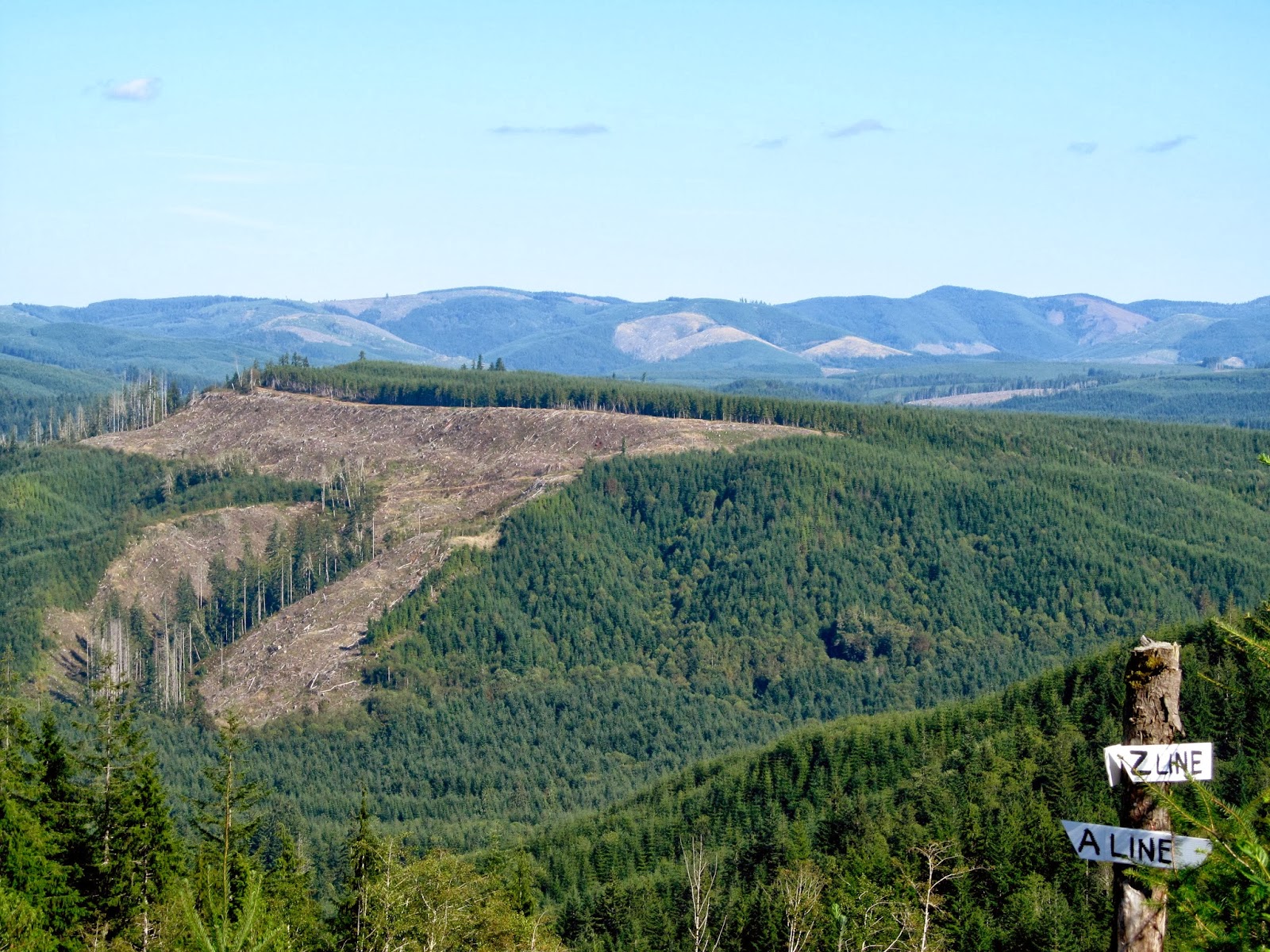
But then there are the signs posted by people who have no "right" to do so, no funding, no license to signify the wilds. The "A Line" and "Z Line" signs shown above, for instance, are on logging roads that belong to one of the largest resource extraction corporations on the continent, but somehow I doubt that corporate HQ called for or even approved those signs.  But the elk and shroom hunters wanna get their bearings, and so they put up signs.


Another species of signs in the NW woods are the mile markers. Not sure what "WILLY" has to do with it, or if this is even truly the 20th mile of the road I was on, but on many a logging road, you will see spray-painted upon trees numbers corresponding to the miles and half-miles of haul routes. Entering the forest, you'll see a little paper sign announcing the CB channel you're to tune into, upon which you are to announce your presence in-going or out-going so as not to be run down by a truckload of logs. Some guy drives the route with a can of spraypaint, stopping and hopping out, a scribe saving your life. Unofficial, but important.


Despite those efforts, people still die on roads, be they glacial gravel miles from pavement, or 8 lanes of asphalt. The bereaved often place signs in memoriam. Rex, I'm thinking, went down on his hog. This was on the same logging roads southwest of some place you've never heard of where the other photos in this post came from, but you'll see memorial signs closer to and even in towns, on highways and freeways.

People, humans with no authority or even any tendency to respect authority, have a need to put up signs. Wayfinding, marking miles, or memorializing, we put up signs.

01 February, 2014

February

The Mountain in February, as seen through a donut o' snow.

People love to hate February. Once the Superbowl is over, so is the American patience with Winter, no more holidays, just dreary months ahead before things warm up. I had a friend who whined through the whole month last year, and the sentiment is widespread. A Winter's worth of griping gets packed into 28 days.

Oh well.

I like February. Around here, it's one of our many Springs. Bulbs are popping up, alliums putting on growth in the lengthening days. Even on the colder Plateau, this month is when the first of the First Foods emerge. The days have been getting longer since December, but the light of January is still just a slanting sliver. In February, we're halfway to Equinox, and they days are finally brighter enough to notice, especially is we're graced with the Week of Gleaming Sun that pries open most Salish Winters.

Snow donuts, pretty even on a cloudy day.
Not that the only things February has to offer are meteorological. There's 42 Day, when you can celebrate anything or nothing, or maybe throw a Burt Reynolds themed party in honor of the mustache legend's birthday. The usual February also lays claim to being the only month that presents a nice neat four-week package. No other month is so in synch with the lunar cycle.

Then there's February 29th, a day so precious it comes but once a quadrenniad. An extra day, and a reminder of February's trickster nature. Not pinned down to a particular duration, an extra "r" whose pronunciation confuses many (it's mastery requires subtle refinement, and is an aural secret handshake to the non-deaf cogniscenti). February can lull you with a beautiful day or grind you down with a rough one.

What? Am I admitting that February days can be cold, that the weight of prior months of Winter does not press down on this diminutive month? Yeah, I guess I am.

But then I'm a stoic, to a degree. If all you can do in the face of sub-ideal conditions is whine about them, then by all means, enjoy your misery. If the only way you can deal with the tail end of Winter is by looking ahead toward some imaginary Utopian Spring, then fine, but you're missing Now. I get some grim satisfaction from staring down the cold rain and knowing I'll outlast it. There is joy in crouching down on creaky joints and reaching fingers into the earth again, dead frigid as it may feel now, clearing the first weeds and planting the first seeds (without some toil, that Spring won't be so idyllic).

I know the temptation is there to scapegoat February for all your long-Winter, post-Holiday blues, but try to enjoy it. Small beauties emerge this month, the Trickster is planting surprises. You'll get through it just fine.

01 November, 2013

Magic, Or Just Happy Happenstance?


The other day, as a ferry was bringing a bunch of artifacts to the Suquamish Tribe's museum, close to where they were excavated decades ago, a large number of orca bagan playing around the ferry. Sure, the whales have been active all week in the area, but to see so many around a ferry is unusual, and to have it happen when artifacts from ancient times are on their way home...it's just way too cool to dismiss as coincidence.

I was raised by a physicist, and I even make efforts to do archaeology in a scientific way, but I've also got enough experience and intelligence to know there are things I do not know and cannot explain. If people who descend from the ones who made the artifacts, from hundreds of generations of people who fished alongside the orca and recognized them as relations, if they see this as a welcome home gesture from the whales, who am I to argue?

09 October, 2013

Yellow Matter Textures


If for no other reason than the last post being a bummer, here's something completely different: a couple of yellowish photos. Since the advent of digital cameras has made it incredibly cheap and easy to take lots of shots, I supplement the "archaeological object with scale" genre with pictures of pretty much anything else of interest: landscapes, mylar balloons in unexpected places, pretty rocks, funny signs,...and textures.


Shooting an image that lacks a specific point of interest, a textured wash of color, can be a nice departure from my usual focus, complexion instead of complexity. Also, they can make nice backgrounds for slide shows that I occasionally give at a conference or presentation (because something in me rebels against the powerpoint pre-fab options).

These two shots, miles and months apart, are just a couple of examples. The bottom one is the "mother," a mat of microbes on the surface of apple cider I was letting ferment itself into vinegar. The top one is what some people call beach dodder, Hawaiians call kauna`oa, and biologists would call a species of Cuscuta. Parasite, lei material (it's Lana`i's official flower), colonizer of seashores all over the earth, background for a slide,...the shot with no focal point is open to whatever story you lay on it.

31 August, 2013

What Smell?


I have a friend who was looking for a place to live in the Portland-Vancouver sphere of influence, and found himself in the town of Camas, Washington. A massive pulp mill there pumps out stinky steam in vast volumes, at least on some days, and he wondered if this was the case all the time. So he asked a local, "Does it smell like this all the time?"

And the local said, "What smell?"

We get used to the local stinks and our auto-aromatic effluvia. Some people cannot stand it and move, or slather themselves in some masking odor, but often as not, the nose and mind conspire to erase the stench we cannot escape. It moves so far into the background that we cannot tell it smells; it dissipates so we can get on with life.

Recognizing the stank of someone else's town is easy, sensing the pee smell in an apartment where cats dwell challenges noone but the cat lady, and this adds to our perception that the townspeople may be brain-damaged by the smoke-stack blightning and that the cat lady is deranged. But she feels normal, and the people of Camas go about lives like most of us; they don't spend their days bemoaning a sub-standard life, as far as I can tell.

Which makes me wonder, what stinks in my life? What is it that people smell, or see, or hear about me that is odious or off-putting, but that I have no clue about? I can guess at a few: I sweat a lot and am no stranger to the aromatic aftermath, I speak caustic and radical ideas,...but there must be things about me that I am smell-blind or sight-deaf to, things that feel normal to me, but to others are offensive.

We all have our Camas smokestacks. Some people may pity us for them, while others hold their nose, and still others flee in disgust. Sometimes, we can and should shut down the mill, make changes to eliminate offal odors and improve ourselves. But our ability to say "What smell?" can be a positive adaptation, an ability to live in the moment and get done what needs doing, rather than engaging in what will end up being an endless and ultimately futile campaign of eliminating all odors, or banishing every quirk and imperfection. Places and people differ, and it would be boring if everyone and all places were universally acceptable.

06 August, 2013

Carto Art


I rarely link outside of this blog, but I ran across a post about an artist creating a map of NY City from scrap-paper sketches drawn by strangers when he asks for directions. See more here.

There are so many aspects of this that appeal to me. People whip out smartphones, and the artist asks for a hand-drawn version. People reveal how they make sense of space, what the landmarks are, and how they navigate. A mosaic of discrete pieces makes a weird whole (in which there are probably weird holes). It's another form of cartography. And so on. Map geeks rejoice.

21 July, 2013

What the President Said About Race

There has been a lot of punditry and partial reporting, but I finally got around to reading President Obama's remarks about the Zimmerman-Martin case. As a whole, I think it's the best speech he's ever made, and I hope more people read it fully and closely. He spoke as an African-American man, but not just to African-Americans. He was honest about some painful history and present, and made some useful suggestions for the future. He spoke as a true leader, and not just a politician.

But don't take my word for it. Read the original words:

Remarks by the President on Trayvon Martin

James S. Brady Press Briefing Room
1:33 P.M. EDT

THE PRESIDENT:  I wanted to come out here, first of all, to tell you that Jay is prepared for all your questions and is very much looking forward to the session.  The second thing is I want to let you know that over the next couple of weeks, there’s going to obviously be a whole range of issues -- immigration, economics, et cetera -- we'll try to arrange a fuller press conference to address your questions.

The reason I actually wanted to come out today is not to take questions, but to speak to an issue that obviously has gotten a lot of attention over the course of the last week -- the issue of the Trayvon Martin ruling.  I gave a preliminary statement right after the ruling on Sunday.  But watching the debate over the course of the last week, I thought it might be useful for me to expand on my thoughts a little bit.

First of all, I want to make sure that, once again, I send my thoughts and prayers, as well as Michelle’s, to the family of Trayvon Martin, and to remark on the incredible grace and dignity with which they’ve dealt with the entire situation.  I can only imagine what they’re going through, and it’s remarkable how they’ve handled it.

The second thing I want to say is to reiterate what I said on Sunday, which is there’s going to be a lot of arguments about the legal issues in the case -- I'll let all the legal analysts and talking heads address those issues.  The judge conducted the trial in a professional manner.  The prosecution and the defense made their arguments.  The juries were properly instructed that in a case such as this reasonable doubt was relevant, and they rendered a verdict.  And once the jury has spoken, that's how our system works.  But I did want to just talk a little bit about context and how people have responded to it and how people are feeling. 

You know, when Trayvon Martin was first shot I said that this could have been my son.  Another way of saying that is Trayvon Martin could have been me 35 years ago.  And when you think about why, in the African American community at least, there’s a lot of pain around what happened here, I think it’s important to recognize that the African American community is looking at this issue through a set of experiences and a history that doesn’t go away.

There are very few African American men in this country who haven't had the experience of being followed when they were shopping in a department store.  That includes me.  There are very few African American men who haven't had the experience of walking across the street and hearing the locks click on the doors of cars.  That happens to me -- at least before I was a senator.  There are very few African Americans who haven't had the experience of getting on an elevator and a woman clutching her purse nervously and holding her breath until she had a chance to get off.  That happens often.

And I don't want to exaggerate this, but those sets of experiences inform how the African American community interprets what happened one night in Florida.  And it’s inescapable for people to bring those experiences to bear.  The African American community is also knowledgeable that there is a history of racial disparities in the application of our criminal laws -- everything from the death penalty to enforcement of our drug laws.  And that ends up having an impact in terms of how people interpret the case.

Now, this isn't to say that the African American community is naïve about the fact that African American young men are disproportionately involved in the criminal justice system; that they’re disproportionately both victims and perpetrators of violence.  It’s not to make excuses for that fact -- although black folks do interpret the reasons for that in a historical context.  They understand that some of the violence that takes place in poor black neighborhoods around the country is born out of a very violent past in this country, and that the poverty and dysfunction that we see in those communities can be traced to a very difficult history.

And so the fact that sometimes that’s unacknowledged adds to the frustration.  And the fact that a lot of African American boys are painted with a broad brush and the excuse is given, well, there are these statistics out there that show that African American boys are more violent -- using that as an excuse to then see sons treated differently causes pain.

I think the African American community is also not naïve in understanding that, statistically, somebody like Trayvon Martin was statistically more likely to be shot by a peer than he was by somebody else.  So folks understand the challenges that exist for African American boys.  But they get frustrated, I think, if they feel that there’s no context for it and that context is being denied. And that all contributes I think to a sense that if a white male teen was involved in the same kind of scenario, that, from top to bottom, both the outcome and the aftermath might have been different.

Now, the question for me at least, and I think for a lot of folks, is where do we take this?  How do we learn some lessons from this and move in a positive direction?  I think it’s understandable that there have been demonstrations and vigils and protests, and some of that stuff is just going to have to work its way through, as long as it remains nonviolent.  If I see any violence, then I will remind folks that that dishonors what happened to Trayvon Martin and his family.  But beyond protests or vigils, the question is, are there some concrete things that we might be able to do. 

I know that Eric Holder is reviewing what happened down there, but I think it’s important for people to have some clear expectations here.  Traditionally, these are issues of state and local government, the criminal code.  And law enforcement is traditionally done at the state and local levels, not at the federal levels.

That doesn’t mean, though, that as a nation we can’t do some things that I think would be productive.  So let me just give a couple of specifics that I’m still bouncing around with my staff, so we’re not rolling out some five-point plan, but some areas where I think all of us could potentially focus.

Number one, precisely because law enforcement is often determined at the state and local level, I think it would be productive for the Justice Department, governors, mayors to work with law enforcement about training at the state and local levels in order to reduce the kind of mistrust in the system that sometimes currently exists. 

When I was in Illinois, I passed racial profiling legislation, and it actually did just two simple things.  One, it collected data on traffic stops and the race of the person who was stopped.  But the other thing was it resourced us training police departments across the state on how to think about potential racial bias and ways to further professionalize what they were doing. 

And initially, the police departments across the state were resistant, but actually they came to recognize that if it was done in a fair, straightforward way that it would allow them to do their jobs better and communities would have more confidence in them and, in turn, be more helpful in applying the law.  And obviously, law enforcement has got a very tough job.
So that’s one area where I think there are a lot of resources and best practices that could be brought to bear if state and local governments are receptive.  And I think a lot of them would be.  And let's figure out are there ways for us to push out that kind of training.

Along the same lines, I think it would be useful for us to examine some state and local laws to see if it -- if they are designed in such a way that they may encourage the kinds of altercations and confrontations and tragedies that we saw in the Florida case, rather than diffuse potential altercations. 

I know that there's been commentary about the fact that the "stand your ground" laws in Florida were not used as a defense in the case.  On the other hand, if we're sending a message as a society in our communities that someone who is armed potentially has the right to use those firearms even if there's a way for them to exit from a situation, is that really going to be contributing to the kind of peace and security and order that we'd like to see? 

And for those who resist that idea that we should think about something like these "stand your ground" laws, I'd just ask people to consider, if Trayvon Martin was of age and armed, could he have stood his ground on that sidewalk?  And do we actually think that he would have been justified in shooting Mr. Zimmerman who had followed him in a car because he felt threatened?  And if the answer to that question is at least ambiguous, then it seems to me that we might want to examine those kinds of laws.

Number three -- and this is a long-term project -- we need to spend some time in thinking about how do we bolster and reinforce our African American boys.  And this is something that Michelle and I talk a lot about.  There are a lot of kids out there who need help who are getting a lot of negative reinforcement.  And is there more that we can do to give them the sense that their country cares about them and values them and is willing to invest in them?

I'm not naïve about the prospects of some grand, new federal program.  I'm not sure that that’s what we're talking about here. But I do recognize that as President, I've got some convening power, and there are a lot of good programs that are being done across the country on this front.  And for us to be able to gather together business leaders and local elected officials and clergy and celebrities and athletes, and figure out how are we doing a better job helping young African American men feel that they're a full part of this society and that they've got pathways and avenues to succeed -- I think that would be a pretty good outcome from what was obviously a tragic situation.  And we're going to spend some time working on that and thinking about that. 

And then, finally, I think it's going to be important for all of us to do some soul-searching.   There has been talk about should we convene a conversation on race.  I haven't seen that be particularly productive when politicians try to organize conversations.  They end up being stilted and politicized, and folks are locked into the positions they already have.  On the other hand, in families and churches and workplaces, there's the possibility that people are a little bit more honest, and at least you ask yourself your own questions about, am I wringing as much bias out of myself as I can?  Am I judging people as much as I can, based on not the color of their skin, but the content of their character?  That would, I think, be an appropriate exercise in the wake of this tragedy.

And let me just leave you with a final thought that, as difficult and challenging as this whole episode has been for a lot of people, I don’t want us to lose sight that things are getting better.  Each successive generation seems to be making progress in changing attitudes when it comes to race.  It doesn’t mean we’re in a post-racial society.  It doesn’t mean that racism is eliminated.  But when I talk to Malia and Sasha, and I listen to their friends and I seem them interact, they’re better than we are -- they’re better than we were -- on these issues.  And that’s true in every community that I’ve visited all across the country.

And so we have to be vigilant and we have to work on these issues.  And those of us in authority should be doing everything we can to encourage the better angels of our nature, as opposed to using these episodes to heighten divisions.  But we should also have confidence that kids these days, I think, have more sense than we did back then, and certainly more than our parents did or our grandparents did; and that along this long, difficult journey, we’re becoming a more perfect union -- not a perfect union, but a more perfect union.

23 June, 2013

Tilted

Tilted and saturated, but on track and no mirage.

FOX "NEWS" being just the most blatant example, "fair and balanced" means little these days. But they're not to blame for the media's enshrinement of "getting both sides of the story," which both reduces complicated stories with many angles to two views and misses the point that true objectivity is a delusion. We never have all the facts (and tend to prioritize them differently), and humans are subjective even when they try not to be; the belief in objectivity is a subjective choice. 

People like to trot out the hard sciences to counter this argument, but my dad was a physicist, something I mention to give myself the aura of osmotic knowledge before explaining that Quantum Theory means that every observation changes the act being observed. On the surface of it, this would appear even more true for human culture, which is built on communication among subjects, each reacting to the other not only for the words said, but a variety of other cues, constantly adapting. By Anthro 201, I'd been taught that an ethnographer going in and taking notes and collecting data and walking out with a sense that he has an objective knowledge of the culture is insane. 

One way anthropologists deal with this problem (if it is a problem) is through something called "participant observation," meaning you do not stand by and take notes, you take part. Spend time with the community, learn their language, do the things they do. Which of course will be different for a 25-year-old male student than a 55-year-old female professor, neither of whom will get the whole story on a culture. Even if they want to, even if they succeed in transcending boundaries in the culture (maybe especially then), their presence  shapes the behaviors; when the anthro arranges the data and writes it up, other factors in her history, campus politics, mundanities to be dispensed and crises to be dealt with will all lead to a certain flavor. 

Trying to be objective is not a bad idea, though, and anthropologists or journalists or judges who go in with preconceived notions, hardened biases, or dull axes can be dangerous. Being open to facts and contexts for them, presenting different points of view, and not making data serve message instead of the other way around are all laudable. 

But sometimes it is laughable that both sides of the story get equal time, particularly because in America all it takes is money to elevate looney views to legitimate policy alternatives. Sometimes, one side is just flat out wrong, or interested in the 1% at the expense of the 99%. If in the name of Objectivity, the journalist gives traction to, oh, let's say the Iraq War, he has just aided and abetted a great harm. If the anthropologist is too detached and writes the academic articles but sits out the political action, she's taking sides.

Hmm. Here I am writing about anthropologists, pointing out where they can go wrong, without so much as a PhD. No specialization, making a living doing archaeology yet presuming to write about living culture, working not on a campus but in a state office. This blog reveals me as opinionated, and probably extreme as far as the bloated center of a bell curve is concerned. I'm pretty open about my bias that native cultures have had it very hard in this country, and that we ought to do what we can to perpetuate them, even if that means putting aside the notebook and taking action. 

So to some, I'm a shame to the profession. Even here at the blog, my own spew zone, I've had the occasional comment that I'm not even-handed enough, or missed something, that I was too extreme. Among my family and friends, I'll cop to being on the prickly end of the scale; I've been described as "fierce" by one. Which is true in some cases, and of course I've written things that I regret, but that's the price of feeling free to speak up. 

I am not objective, and cannot detach from something I care about easily, so I take sides. Being fair is fine, but presenting both sides of the story as if they were always of equal merit? Nah, I can't do that. Maybe three sides, or five. Maybe a dodecahedron of perspectives. At work, I need to collect data and write about them, sometimes making recommendations based on particular circustances--there is a place for something approaching objectivity. But here, opinions and iconoclasty can run loose, and my political tilt is right up front.

18 June, 2013

Two Heads Are Better Than One


OK, maybe those don't look like heads to you, but to an archaeologist, they look like profiles of hominid skulls (I just cannot haul myself into this century and say "hominin"), even if neither was intended as such. One looks left, one looks right. One was the result of something being added, one was what remained after something was removed. One is ephemeral, one lasted for decades if not centuries.

The bottom one is not too far from the US Atlantic coast. It is the remaining bit of stucco on a partially-restored column of one of the Founding Fathers' famed plantations. Maybe it looks like Africa, home of humans who were kidnapped and sold into slavery to build and then serve in the mansion.

The top one is in the tidal zone of the US Pacific Coast, very close to Canada. It is either gull poop or herring sperm, deposited on sand deep in the intertidal zone. Maybe it will last a long time on the internet, but the actual thing is long gone by now, a stain washed away by the tide, dissolved in the ocean.

The symmetry of these two heads, the balance they achieve without having ever met, is an artifact of my own odd head working solo, recognizing a mirror image in photos taken 3,000 miles a a few months apart. Heads are like that, craving company so they can take turns using their jaws and their ears, coming up with ideas that are better than either one could invent by itself (like the idea of posting about Australopithicene-ish skull images formed from marine creature excreta and plaster palimpsests, holding a mute conversation).