Does the word that just popped into your head show up here? Find out:

Showing posts with label history. Show all posts

07 January, 2017

"Rebel Bureaucrat" (Death of an Oxymoron)

-->


It only took a few weeks for Congress to start elaborating on Trump’s ascendancy to dictatorship. The guy is not even in office yet, and the GOP is in a headlong over heels rush to suppress opposition and bring the government under overt, complete control of Capitalism Gone Wild.

For reasons no one can rationally explain, the 1% of the 1% are offended by the presence of a middle class. The class war we’re living through is not rich against poor—being poor means you already lost—but oligarchs against a middle class. Maybe because the middle class enjoys a blend of financial comfort and education, the super rich feel a threat, resent the money in somebody else’s pocket, or fear that cities full of college grads may not sign on to the program of extreme social conservatism and endless upward redistribution of wealth.

Whatever the cause, a major battlefield in this war is “the government,” by which people mostly mean the people who work for federal agencies and the places they control. Conservatives are not so upset by the money government grants or the things government buys—pork barrel money feeds their districts’ businesses, they like all the stuff from irrigation systems to tactical police gear that pours in, subsidies are a major part of most farming, not state funds its own disaster recovery—but they hate the strings that are attached. Being told not to over-graze, to protect a stupid little fish, and that you cannot poison the water and air insults the independence-minded sensibilities of the rank and file, and more importantly cuts into the oligarch’s profit margin.

The strategy of riling up the base, buying the politicians, and pursuing de-regulation and down-sizing of government has proceeded unhindered from Reagan right on through Bush II. Although Obama’s compromise-oriented approach and inability to overrun the barricades thrown up by Congressional Republicans fell well short of the Right’s nightmares—remember how he was going to take all the guns and socialize the economy?—they apparently feel abused and angry and ready to retaliate.

The once desultory battle over “the government,” a Cold War of cuts made vs regulations implemented, is now blowing up; the carnage is about to begin for real. The GOP controls the elected government and stole the judiciary, and already they’re acting as if they had 100% backing of the populace.

This week, the new Congress, as it does at the beginning of each session, passed its own rules. By way of inoculating itself against the accusations of corruption sure to come as they pass a slew of heavily lobbied, pro-corporate legislation, the GOP included provisions to partisanize and weaken the non-partisan Office of Congressional Ethics. Progressives garnered immediate grass-roots and politician outrage and the House Republicans backed down, comforted only by their belief that government offices are incompetent anyway.

Before the Left could claim victory, Trump tweeted and ended up getting a large share of the credit. His base seems satisfied that he is hard at work draining the swamp, when all he did was see the writing on the wall and throw some colleagues under the bus, as per his own personal ethics (which he maintains nobody is worthy of scrutinizing).

Meanwhile, the Rules package also included a much scarier provision, provided by yet another scary Virginia Congressman. This one revived a 19th-Century rule intended to target corrupt political appointees by allowing Representatives to offer amendments reducing a person or program’s budget to $1/year. So now when a Representative disagrees with a program or needs a scapegoat for a news cycle or two, a party-line vote puts people in the poorhouse. That li’l nugget slipped right on through with no protest.

Communities nationwide have federal workers, and defunding their jobs will hurt local economies everywhere. Of course it won’t actually have that broad an effect, because no politician would pull this move in their own district. As a way to eliminate inconvenient truths, hamstring regulation, and punish a liberal district, however, it’s a win-win-win (where they get all the wins and you get nothing). That little rule is starting to look like an effective weapon, isn’t it?

Meanwhile back on the ranch—which happens to be mostly federal ground leased by settlers sons at a fraction of market rate—government employees face other threats on the battlefield. Self-proclaimed militias can show up, take over, demand snacks, trash the place, literally dig shitters through Indian sites, and incite a shootout all while broadcasting calls to arms and threatening government employees. They can do all this and they face trial but get off with no conviction.*

Which you better believe has galvanized the conviction of the Bundys and their vehemently anti-government and pro-gun ilk. These white men fee entitled above immigrants and minorities (including the tribes whose lands they occupy), but also abused and angry. Emboldened now by their victory in court, fervent in their belief that the government is an agent of evil, these yahoos put federal workers in literal danger in some of the very places where land management costs are paid by the feds and the financial benefits accrue locally.

Which brings us back to those federal employees who could suddenly find themselves making $1 a year. Few of them have the personal wealth to keep working for free, and most of them would ordinarily be plowing their moderate paychecks back into their local communities, spending their off time participating in those communities. Being middle class.

If there are people still working for the government who think they can continue to be relatively comfortable, they’d better wise up. Congress has only just begun, and Trump hasn’t even unleashed actual and imagined executive powers. The Kochs and other wealthy advocates of concentrating all wealth at the top have plenty more money and a congress begging to be, ahem, lobbied. They’ll get around to privatizing public lands—taking care of that part of “the government”—but even quicker they’ll move against unions, programs that run counter to their ideology, branches of government that impinge on unfettered capitalism, and so on, using this Rule and all the other tools at their disposal. The plutocracy is at war, and the Civil Service has been declared an enemy combatant.

And so it’s time to resist. It’s time to stand your ground, re-unite with your union, and prepare for battle. The Right feels aggrieved by the fact that you might earn a pension, outraged at how much you waste on social programs for the unworthy, tyrannized by your rules and regulations, fed up with your elitist “rationality,” and just all-round pissed about other government sins imagined and real. They are coming for you, starting with the easy targets but not stopping until the bureaucratic machinery that helps maintain free and open society is broken or repurposed to something useful, like prospecting for oil or running detention centers.

As recently as a couple of months ago, I could have imagined this was not going to happen. I could have continued being comfortable in my government job, disappointed that my salary doesn’t keep up with the cost of living, but not worried that I’d be out on the street. I could act as if being a state employee rather than a federal one, as a union member rather than “exempt,” my head is not on the chopping block at the moment.

Now, I cannot afford to sit back. Now, I can no longer think that “rebel bureaucrat” is an oxymoron.


* If they’re white. Indians protecting land at Standing Rock have been brutally attacked with tear gas, rubber bullets, percussion grenades, water cannons (in sub-freezing weather), sonic warfare, and whatever a police force with para-military toys bestowed by the feds can muster.

08 February, 2015

Guns at the Capitol

Some guy from Alabama running his mouth on the Washington State Capitol steps.

This past Saturday, our local paper reports, about 50 people showed up to protest what they see as infringement on their right to carry arms. A couple of legislators showed up to support them, and nobody was arrested. Washington state, characterized in the media as a liberal haven of pot-smokers and same-sex-marriers, turns out to also be one of the few states that does not outlaw carrying guns into its capitol building.

Still, the good voters of this state did vote last November to require background checks on all gun sales. You can still buy guns, a bunch of 'em, all kinds,...the voting public here is pretty tolerant of gun owners, but We the People decided it's reasonable to try and limit gun ownership by violent criminals and the mentally ill.

And it really pisses off a few people. Maybe the dude in the colonial outfit worries he'll be deemed as crazy as he looks. Maybe the guys covered head to foot in "tactical" paramilitary costumes genuinely believe that a background check is tantamount to tyranny.

But of course, it wasn't the legislators that passed the background check referendum. It was the neighbors of the protestors. Initiative 594 was not the work of some liberal cabal, but the result of a popular vote. Think about it for even a second, and you have to realize that many of the people who voted for the measure actually own guns themselves. No, this was not a top-down clampdown.

Some guys from Seattle standing in ordered dignity.

Not that there's not some precedent for the legislature curtailing the right to bear arms. In 1969, another protest occurred in Olympia, also making its way to the Capitol steps. That time, though, it was the Black Panthers. And that time, they were protesting a bill in the Legislature that aimed to outlaw the public display of firearms, echoing the California Legislature's act, one that was squarely aimed at the Black Panther Party. The Seattle Black Panthers stood silently on the capitol steps, rifles and shotguns aimed at the sky. When the State Patrol asked that they unload and put down their weapons, the Panthers did so, and after about an hour, they left. [Here's the firsthand account, so you don't have to take my word for it.]

To reiterate, faced with legislative action directly aimed at a political party to whom 2nd Amendment rights were a core principle, that party protested peacefully. They did not attempt to enter the Capitol building (as recent gun rights protestors have), and even allowed their weapons to be unloaded by State Troopers (as contemporary gun rights protestors swear they would never allow).

In 1969 (as in 2015, sadly) young black men were shot by policemen for minor alleged offenses. The Black Panther Party included people who had directly experienced repression by The State. Not minorly incovenienced by a referendum-passed background check, but subjected to full-on harrassment and injury at the hands of law enforcement. Break-ins, frame-ups and shootings perpetrated by local, state and federal governments, not to mention the lack of enforcement when amateurs stepped in with murders and lynchings. Thus the Panthers' belief that they needed to police the police and to arm themselves for self-protection. Thus the February 1969 protest here in Olympia.

The crowd this past Saturday did not include any black people that I could see in the available photos. They were prevented from entering the actual legislative chambers with their arsenals of handguns and assault weapons, but no legislation was passed that targeted them, or even gun owners in general. Yet their statements and signs show that these modern protesters feel that they have been grievously wronged, and are being oppressed.

If the Black Panthers had showed up with military assault weapons, would they have been treated as civilly? The 1969 photos show a bunch of guys in berets and jackets holding rifles and shotguns, hands visible and not on triggers, not handgun in sight, no paramilitary "tactical" gear at all. Had the Seattle protesters insisted that the State Patrol could unload Panther rifles once they had--in the words of Heston and any number of white NRA advocates--"pried it from my cold dead fingers," the Panthers may well have been obliged. I mean this not as a statement about the Washington State Patrol, who in fact seem to have been equally adept at diffusing tense situations then and now, but about the relative value of black and white lives then and now.

The local paper also reports that protesters this past Saturday expected to be arrested (read, "martyred") and were selling hats to cover bail that said "Fight Tyranny--Shoot Back." I'm not sure they had Michael Brown or Eric Garner in mind, but what if black men did just that? We don't have to speculate about the answer, because history provides it: those black men would be jailed, beaten, shot. In my own lifetime, I remember rowhouses in Philadephia being fire-bombed--with men, women, and children inside--because they were black nationalists. Now that's oppression. That's being Tread Upon by the iron heel of The State.

But background checks? Get real, your rights are in no danger.


02 January, 2015

Re-emerged

First there is a building, then there is no building, then there is* -Donovan (If he'd been an archaeologist)

The ebb and flow of humans on the land fascinates me. Most people see the forest and figure it's always been there, big trees out beyond civilization's paved domain, wild lands untouched, or at least not covered with buildings. Even for those who recognize second or third growth and know that there's not really any "pristine" anymore, stumbling onto the wrack of some past society's highest tide comes as a surprise.

But I should let that tidal metaphor alone, because a lot of the stuff left behind by retreating humans in this part of the world comes not from moderate daily motion, regular as the moon and achieving balance over time. True, people have walked all over this landscape since time immemorial, but until the past century or two they just didn't create that much trash for archaeologists to find. Twentieth Century Homo sapiens, though, they created a splash, a flood that reached just about everywhere in the blink of an archaeologist's eye. For enough generations that we don't even think of it anymore, this has been because of cars and the places we need to go in them (including trailheads and campgrounds tucked in the wilds), but the underlying source of this inundation of landscapes by metal and concrete lies in the resource extraction economy that the Territories and then the States relied on so heavily.

I don't have to get metaphorical or writerly about it, because the language is right there. Men seeking minerals and timber experience boom and bust; only to someone with a drawn out sense of time does it look like an ebb and flow. Discover gold, and there's a Rush.

Hidden in the forest was a lumber mill.
By the same token, when the trees are cut or the ore peters out--or larger economic forces make the investment unwise or untenable--people tend to walk away without delay. Often quite suddenly, but usually not before removing whatever's useful, to the point of prying up the rails and ties and loading them onto the last train out. Scavengers continue to pick at it for a while, but the forest eventually cloaks even big mill buildings and then takes it's sweet time devouring what's left. A place where hundreds of people lived and worked populated by animals, train whistles replaced by bird calls.

That is, until the trees get big enough to harvest. Then it may turn out that that mill is a historic site, or at least an archaeological ruin, and someone like me gets called in to be the ironic bureaucrat. A plan to cut down trees may be complicated by the presence of an archaeological site composed of the remains of: a timber mill. The place where thousands of acres of clear-cut were sawed into boards and shingles may have, in the years since falling silent, have developed a patina of historic significance that merits its protection from: a timber harvest. Yep.

Or maybe not. Not all old stuff is meaningful. Archaeologically speaking, the place I've pictured above does not have much potential, especially considering that you can go back into archival sources and get orders of magnitude more information about what happened there than you can from the few artifacts left behind. People only lived there for a decade or so, their household trash was hauled somewhere other than the place where the trees were cut, and much of the area was tidied up with heavy machinery after abandonment. Other than agreeing not to knock the building down unless it becomes clear that there's imminent risk of it falling down (maybe on a litigious history buff), the landowner didn't have to alter his plans much.

As long as the mill walls stand with no trees around, the mill lends scale to the few other remains of this former town: a few houses along the road, the concrete bank vault sitting alone in someone's yard, and the building down the road that used to be the school. Trees are more likely to grow back than this particular town, but for the time being you can drive by and marvel at the vine-covered walls. Just don't go crawling around too close, because it might fall on you, or you might drop into one of the deep concrete caverns.

* I wrote about this place previously in a post called "Swallowed." You're welcome for me not calling this one "Regurgitated."


11 November, 2014

The Hipster Effect and other Models

Image by Getty, Fair Use by This Guy's Nephew

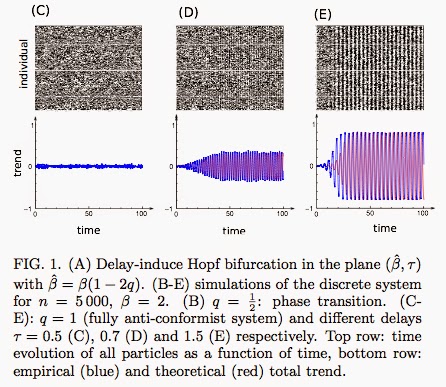
A mathematician recently posted an article (available at arXiv as a pre-print, to be published in a refereed journal soon) called "The Hipster Effect: When anticonformists all look the same." I'm too slack to learn the math, which apparently helps explain why so many people who reject the mainstream still end up conforming, just to something else. It has to do with the delay between a mainstream trend existing and the non-conformists realizing it and rejecting it, and looks like this:


As an anthropologist, I have some non-mathematical ideas about how and why hipsters end up sharing so many traits. As a human, I tend reject simplifications of our behavior to mathematical functions. But Touboul is clear that his model is just a model, and not an explanation of culture or even something that can encompass all hipsters, so it's fine for what it is. Also, the fact that some image sprange to your mind when I said "hipster" proves that he does have a point. Facial hair, clunky black glasses,...

This guy read the Hipster Effect article before I did, and was already appearing in blogposts about it days ago.
As if to prove Touboul's point, there has been a delay, and then a bunch of hipsters blogged about it (huh, blogging, it's so old-school, so they must be posting ironically) along with all the other non-conformists. I'm too late to be a hipster, having learned of the article in the Washington Post (online, at least, and not on some dead tree).

And yet, I exhibit signs of being a hipster. I'm in phase with them as far as clunky black glasses, facial hair, brewing ale with hops I grew, and so on. As I write, I am listening to the local, listener-supported, volunteer-powered community radio station called KAOS. I am in phase with a fair number of hipsters.

Partial View of an apparent Hipster, Courtesy of some Model

But is it because I react with similar intent and mathematics to the others? In some ways, no. Hipsters' oscillations are much more rapid than mine, and I was wearing this kind of glasses and growing a beard decades ago (and not in a "I did it before you did" hipster kind of way). I just hate to shave, and always wanted glasses that came from that era when all men wore the same kind of glasses. Like my uncle in the first photo. He was not a hipster, but he was an enigma, a guy who wore "normal" clothes, but to a degree (khaki pants and white oxford shirts for decades on end) that was decidedly atypical. He served in the military for a little while, got a job, and raised a family, a model citizen. But also one who was deeply subversive in some ways, whose thoughts boggled minds and defied models.

Were I in the data set being compared to Touboul's model today, I might well become empirical support for mathematical supposition. But I represent a much longer oscillation if I represent one at all, and the "why" of my seeming hipsterism may be a lot different than that of people who know enough about contemporary mainstream culture react against it.

20 June, 2014

Swallowed

On the Road to Now-nowhere
The archaeologist hacking his way through the jungle, parting the bushes and glimpsing a Mayan pyramid in the grasp of lianas rising toward the canopy, is as easy for most people to imagine as the other archaeologist (this time wearing a pith helmet) kneeling at the base of an Egyptian pyramid in the desert.

In this part of the world, tribes built no pyramids, and the rains made ruins of their mightiest longhouses before archaeologists got to them. There are no ancient lost cities in the Northwest rainforest, at least not anything as obvious as you would see in Honduras or Peru.

What does exist are more recent cities, no less festooned in ferns or draped in vines. Entire towns that thrived into the 1940s have been swallowed by our temperate jungle. You might realize you are approaching one when you find yourself on a causeway, smaller trees in your path and a slit of sky above, as in the first photo. This path used to be a road, or if flat and not so curvey, a railroad. Rails and ties are gone, because like the towns, timber railroads flowed and ebbed; when the trees were cut, the rails were lifted and sent elsewhere to haul out another forest.


Once upon a time, this perspective would be under a railroad.
Huge swaths of western Washington were stripped of their trees. It started with the California Gold Rush, when Puget settlers found a ready market for logs and lumber, but the pace and scale really took off a generation or two later, when steam power jumped ashore in the form of donkeys (a machine used to haul logs) and iron horses. Instead of a few lumberjacks and teams of oxen (I don't see much evidence that actual donkeys played a major role in NW logging, ever), logging became an industrial affair. Men who had cut their fill in Minnesota in the 1870s moved west and by 1900 were engaged in technologically and logistically more advanced logging.


As Europe crept toward WWI, its New World sons built mills to saw the great Northwestern forests into boards and shingles. As the war erupted, they kept on cutting and eve picked up the pace. Huge mills sprang up by rivers and streams, no longer because a water wheel provided the power, but because dammed waterways made ponds capable of holding vast quantities of logs dumped from trains, sorted, and fed to the machines before being hauled back out as lumber destined for markets nationwide.


The scale of some of these operations boggles the mind, given their seemingly remote locations to modern residents of Pugetopolis. Substantial amounts of capital were sunk into towns stretched out along rail lines in places where less-traveled road pass today. Hundreds of people answered the work whistle every day in places that now boast a few trailer homes and little more, or that have been completely swallowed by resurgent (of degraded) woods.

Because of Wobbly Slavs, Commie Finns, and their other organized comrades, the mill owners built housing and infrastructure to attract and retains the hundreds of people needed to cut the trees and run the mills. They sometimes got electricity and sewage before their neigboring communities. Though the work could be brutally demanding and dangerous, workers came, and the Company was ready with houses for the family men and hotels and pool halls for the lone lumberjacks, ready to circulate the paycheck back into company coffers. There would be an office in town, but nearly always, the money ultimately flowed to Seattle or back east.

Didn't I see this in Myst?
Workers' fortunes flooded and ebbed with strikes and strike-backs. Owners went boom and bust as markets rose and fell. But ultimately, few of the early 20th Century timber towns escaped the inevitable: when forests became stumps, there was no money to be made. Companies that owned the land they'd harvested might eke out a few more bucks enticing hapless outsiders (among them, Dustbowl refugees) to buy clearcut land for farming, but the towns went down. As soon as the timber ran out, so did the companies, salvaging what they could of the machinery and rails before they pulled out.

Workers went elsewhere, voluntarily or otherwise, and the businesses that served them went under. Salmonberry settled and alders arrived, vanguards of a long distant old growth forest that may see the whole cycle repeat. Wooden buildings were burnt or demolished or just left to collapse. Mill roofs fell in, leaving only concrete shells of the buildings. Log ponds were colonized by beavers or eutrophied on their own.

And now, less than a lifetime after many of these towns heard the whine of saws and hoot of the whistle at the end of each shift, only the birds and wind make noise. Trees, vines, ferns, mosses, and untold numbers of microbes and arthropods colonize these old towns in the name of nature. Even in my limited awareness, there are dozens of these abandoned towns, sprouting timber (some of it now being harvested). The high water mark of civilization's tide is way back in the woods these days, and towns that were are swallowed.

11 June, 2014

"Won't get Fooled Again" (Oh yeah they will)

Having drunk the kool-aid, and realizing that it doesn't work, Rep. Cantor looks ill.

Oh, there were so many choices for titles to a post about House majority leader Cantor getting offed by the even nuttier right. I was pretty close to going with "Meet the New Brat, Same as the Old Brat," but I don't yet know that will prove true.

What is true is that I'm happy as ever to have fled Virginia's 7th Congressional District. Not quite a month ago, I wrote about those of us who have joined the Virginia Diaspora, citing among other factors that Eric Cantor, former Reagan Youth stalwart and petulant obstructionist extraordinaire, was being challenged from the right. Apparently, pundits wrote off the challenge, even though the tea party and Brat brigade had recently ousted Cantor's henchmen in the state GOP convention, under-cutting the now Establishment incumbent. He managed to keep that one fairly quiet, but losing by 11 points in a primary getting national attention is not something that can be ducked. 24 hours after the election, he's already conceded the power he once had.

Which would be cause for rejoicing, if there weren't a pretty solid chance that David Brat, blindered economist, weren't now a very good bet to win the 7th District's seat in Congress. I'd like to think that the Henrico suburbs that voted for Obama might shy away form a Tea Party wing-nut, but odds are they will once again vote against their own self-interest and elect the guy. I'd love to believe that Brat won by virture of Democrats voting in the GOP primary, sabotaging the Republicans by nominating a guy too far right to win in the general election, but I know enough old-minded Virginians (the ones who show up during working hours on a mid-week primary, the ones who feel threatened by the Socialist Negro) to believe that they were the ones that made the difference. They got rid of the sharp dressing guy who compromised once, and installed a more conservative, more dogmatic, more Christian man.

None of the breathless coverage today veered into the fact that Cantor is a Jew in the GOP South. And to be honest, Richmond is the rare southern city that has been fairly accepting of its Hebraic residents (one of the oldest Jewish cemeteries in the US is there, and Jeff Davis even appointed Judah Benjamin to cabinet posts), but the modern voters seem happy to go Old testament on this one, turning him out into the desert as a scapegoat. It's no longer sufficient to be for corporations and big money, the modern Republican candidate must establish his bona fides as an utterly dogmatic right-winger, never giving an inch. The emphasis on Jesus and God from the new Brat, comforting to so many Virginia Christians who imagine themselves oppressed, could have much darker echoes as the radical right gropes its way toward control of the Reichstag.

Hopefully, that dark a future is mere speculation. The bare facts, however, are bad enough. Faced with an economy in which the 0.1% reap all the benefits, and have bought Republican obstruction to anything the Democrats propose--in short, an economy guaranteed to further impoverish nearly everyone--well over 50% voted the punish the guy who they vaguely sense may have compromised somewhere along the way, replacing him with an even more strident anti-government zealot.

Will the Virginians who voted Brat in at the primary hand him a seat in Congress? Probably.

Will they one day realize that votes like that amounted to handing over their hard-earned money to oligarchs, the only ones who can afford clean water and filtered air? Probably not. They'll blame a Black man, or a Jew, or a Socialist (or a Woman, should Hillary or Elizabeth get the Democratic nod). Even if they realize that they were in fact fooled again, it will be too late.

13 May, 2014

Walk Away


A few years ago, when I delved into the morass of narcissism and even more unsavory isms that comprise facebook, I half-jokingly started a group called the Virginia Diaspora, for people like me who had been born in the Old Dominion, but had subsequently fled in search of asylum, or peace, or just a change of pace and place. Few people joined, but I did re-connect with a few dozen people I'd known from the neighborhood and school. Many still lived within a half-hour SUV ride of where we'd grown up, some had migrated elsewhere in the Commonwealth or the Mid-Atlantic, and a few had flung themselves farther.

While it was interesting (sometimes) to learn what had become of people, this virtual homecoming reminded me of why I'd left, and set me to wondering how it could have gotten worse than Reagan Era Virginia, which was what had sent me running in the first place. On display: a rainbow of bigotries, a robust sense that rich white heterosexuals were sorely victimized, worship of mammon and guns (and among some, an old white man known as "God"), and intolerance. By no means all of them acted this way, but it was enough to shake my faith in progress, and eventually to turn my back on the virtual place the same way I had on the red clay of my birth-land.

Like I say, not all of the fb "friends" (never has a word been more drained of its soul than when it became synonymous with a single reflexive click) were right-wing ogres. Some had led interesting lives, had opened themselves to more than we'd been raised to accept. A small few became people I kept up with even after the fb environs grew too creepy for me to inhabit. One, I even visited a year ago, when I made my first foray back to Virginia in half a decade.


Which is when I realized (duh) that the virtual world ain't real. The avid gardener hadn't raised more than weeds in years, and was ditching country life for sprawlburbs. Having recently inherited millions, the inheritance tax had become injustice, and people were now threatening to take advantage, including me, when I let her pay for a breakfast biscuit (or, 0.00001% of said inheritance). Roughly an hour from the malaised middle class suburb where we grew up, she was in pretty much the same place, only with more liberal-ish shopping preferences, unable to see the difference between Whole Food Inc. and sustainable foodways.

Oh well.

It would have been easier to take had I not been in shock at what had happened to my old haunts during years of absence. All the farmland and forests were gone, paved over for shopping places that will fade and fall into ruin, and for road after road after road. People doing exactly as the President said in a rare moment of candor, clinging to their god and their guns. Real profits (for a few) and false prophets (for the many) twisting the message of their nominal saviour to justify greed and hatred. Again, not everybody was this way, but enough to make a lefty evolutionist like me damned nervous.

Recently, the news has been no better. A burning trainload of oil falls into the river I once canoed and from which my relatives still get their drinking water, and still the shrill calls for end to government regulation. On Easter morning, people awoke to find eggs in their yards proclaiming racist slogans, and the response was, "Kids are too young to see this," as if it would be comprehensible in a few years. My former US Congressman, Eric Cantor, not ideologically pure enough, is being challenged from the right wing, as people laugh off the concept that there could ever be a Democrat in his position.

I could rant, and I guess I just have (and probably will again), but it would not change anything. Ever since its founding as a commercial colony to benefit the few, Virginia has been driven by wealth and "conservatism." Hell, even the leaders of the revolution against the king started out and ended up being filthy rich, retaining ownership of human beings, and controlling politics in what turned out to be a very English patrician way. Generations later, having jettisoned even the pretense of Enlightenment thinking, Virginians practiced a religion that justified slavery, and backed it up with a war that was, for even the whitest of the common folk, disastrous. From Jim Crow to Massive Resistance to demonized Welfare Queens to the Tea Party, the wealthy string-pullers have mobilized the faithful pawns to protect the interests of the few at the cost of the many.

Maybe it's chickenshit of me to do so, but I choose to be in the Virginia Diaspora rather than stick around and pay taxes to a state so bent on backwardness. I walked away, again.

09 May, 2014

Perpetuating Frank


On Monday, a hero to many of us died. Billy Frank Jr. was a veteran of the fish wars, and although his contributions were many, his efforts a big part of achievements in tribal fishing rights, protection of salmon, and environmental stewardship, he was fighting an uphill battle all the way.

Up until the day he died, it turns out, when his last installment of Being Frank (his column as head of the NW Indian Fisheries Council) was posted. In his 80's, he was getting up every day and working to improve the fisheries and the environment, benefitting not just the treaty tribes, but all of us. At an age when most of us would hope to be relaxing, he kept pushing.

His will be big shoes to fill. Maybe even too much for one person, but fortunately, Uncle Billy touched the lives of multitudes. Obituaries mentioned his associations with state and federal leaders, with presidents even, and included statements from leaders and luminaries, but he also talked with everyone else. Little school-kids, fishermen, members of many tribes, even the very bureaucrats who could make his life painful. He spoke out for what he knew to be right, for his people and for the rest of us, too.

So all of us should carry on for him. That last article of his I mentioned above was about the dangers of an oil terminal where trainloads of crude could load their cargo onto tankers at Grays Harbor. In addition to his, as always, well-reasoned arguments against permitting such nonsense, let me add my little voice: the dredging and construction required for the project would likely obliterate the ancient remains of fish weirs and other sites left by ancient people who managed fisheries successfuly.

You can add your voice by visiting his post, and heeding his call to comment against this oil terminal and other projects that put our environment at risk. His voice will reverberate for generations, but it is time for us to step up and add our own. 

24 February, 2014

Straight Outta Compton, MG!

"Bang, broken like glass and plastic"  -Kurupt 2006
(or for old schoolers, "Broken glass everywhere" -Grandmaster Flash 1982)

No, the title is not a MF-in' typo, OK?!

Just a reference to the Maywood Glass Company, of Compton, California, whose mark is the MG at the left. I heard that Dr. Dre's uncle worked there, maybe. Made a bottle that got drunk sometime during or after 1951 (so sayeth the "51" in the right-hand square), and ended up broken on a beach in Olympia. The stipply texture was known as Duraglas when it came out about a decade earlier.

Nothing but a coastal thing brought this gLAss up north, so I guess I cannot resort to my usual "globalization is older than you thought it was, you punk-ass kid" rant (as if punk-ass kids even gave a shit). Nor do I have any clue whether any of NWA's aggregate ancestry worked at Maywood Glass, so I cannot in all honesty conjure some Afro-Scandanavian tale of unity or anything else.

Um, yeah. That's it. I guess this post really should be filed under ArchaeOlygy.


22 December, 2013

Backroads: Egg and I Road

At the intersection of a memory lane and a road not taken.

One day this Fall, as the leaves were changing color under clear blue skies, I drove out through the Chiumacum Valley, past he town of Center (location one of my favorite  government facility names, the Center Work Center), and up the west side the valley to look for archaeology. For my effort, I founf one abandoned house, rumored to be haunted, but that's another story.

Getting there requires a short jaunt on Egg and I Road. The Egg and I was a book by Betty MacDonald, who followed her new (and before long, former) husband on his cockamamie dream of leaving the city and starting a chicken farm. Hilarity ensued, as it often does in the memories of people who go through ordeals. According to an article at Historylink, Betty's sister had told a publisher that she was writing a humorous book, and so The Egg and I came to be to save sister Mary the embarrassment, along with the dedication "To my sister Mary, who has always believed I could do anything whe puts her mind to."

The book came out at the end of WWII, ideal timing for a funny book about anything but the war, and long enough after the Depression for its sorrowful depredations to fade under a patina of humor. By then, Betty had left the chicken farm and re-married (what became of her chicken-raising husband Robert Haskett at that point, I do not know; he was stabbed to death in 1951 by another woman's jilted husband). Millions of copies of the book sold, and it became a movie. The Ma and Pa Kettle characters from Betty's book spawned a whole series of movies.


In 1981, a road first built about a century earlier was officially named "Egg and I Road," memorializing the way to the chicken farm. It runs western slope of the western fork of Chimacum valley to Route 19 (aka Beaver Valley Road) on the east slope of the east valley. There are pastures and wooded slopes, but no chickens that I could see, and nary a porch-sittin' hillbilly to be seen.

The chicken farm that turned out to be so funny and lucrative is part of a larger story that didn't turn out so well (check out Richard White's "Land Use, Environment, and Social Change" for a more thorough telling). By the late 1920's the combination of railroad logging technology and a roaring economy had led to the clear-cutting of unprecedented swaths of land, which then seemed worthless. Attempts were made to present acres of stumps and now exposed and depleted forest soild as great opportunities for farming. Generally, people tried, failed, and left, because farming in glacial gravel full of stumps does not work so well. According to White, one of the few chances to make a go of it was to raise chickens, so at least Haskett was on the right track, even if it did not work out.

Not the barn, but a barn on Egg and I Road.

These days, the pastures around Egg and I Road feel idyllic. The  urban crow can be there in a 20-mile flight from the filthiest part of Seattle, but the Sound and the land's folds make it more remote. The presence of a quarter horse farm airport indicates that the neighborhood is not entirely safe from gentrification, but it looks like there are still regular people who live there. Between the Bremerton-Poulsbo sprawl and the long-urban Port Townsend entry to the Sound, the Egg and I's neighborhood is remote enough to retain its rural charm. It never was as isolated as the book made it sound, but it remains a back road.

29 October, 2013

Velvet 6 Feet Underground

Last Shot. October 2013, lifted from loureed.com
Flags at US Government facilities were ordered flown at half-staff today. Officially, this commemorates the recent death of Tom Foley, former Speaker of the US House of Representatives.

Un-officially, let it mark the death of Lou Reed, representative of the avidly un-official.

12 October, 2013

Agriculture and Bias

Orchards count as agriculture

In the past day or three, I've been reminded of how weird our understanding of agriculture is in modern America. Another blog that I regularly read, written by an educated, smart woman, linked to an article about the novel theory that the introduction of agriculture actually led to instability and population collapse in Europe. Then today, working with some other archaeologists and archaeologists-in-training, we talked about how generations of our forebears (and their cultural anthropology kin) have sworn that in the Northwest there was no indigenous agriculture or horticulture, just hunting and gathering.

Like most children of Western civilization, I was taught that the rise and refinement of agriculture allowed production of surplus, which was what allowed humanity (some of it, at least) to step off the dreary treadmill of subsistence, so that some people could become businessmen, priests, bureaucrats, artists, and all of the other divisions of labor that make up a civilization. Even among the cynical who viewed some of these jobs as blights upon humanity, there were few that argued the basic tenet that by making the transition from gathering and hunting wild foods (yes, in that order, if you are to be honest about where the calories came from) to farming domesticated crops represented an advance, creating some respite from the struggle for survival.

Only, if you look at it from an evolutionary point of view (so long, Bible Belt readers), agriculture does not provide stability. It is inherently unstable. From a diverse spectrum of wild plants, adapted to local conditions over millenia and more, people came to depend on a select and quite small group of species, using temporaryu success to grow larger human populations. Over time, this became more pronounced. Hundreds of wild starches gave way to dozens of grains and roots, and ultimately to a handful of cereals and russet potatoes, often grown outside their optimal range through generous application of non-renewable chemicals. Nomads moved to villages, which became cities and morphed into megalopolises. We stand now as the coyote did in the old road runner cartoons, over a canyon on a board nailed to a board nailed to a board, cantilevered so far out on a gamble that we are doomed to fall, unable to skitter back to solid ground. Evolution punishes monocroppers and urbanites who forgot how to find or grow their own food.

In our hubris, we have assumed that human selection can successfully replace natural selection, when in fact all domestication amounts to co-evolution. From corn's point of view, it has caused humans to adapt their behavior toward its own ends. We winnow down the gene pool to emphasize the parts that maximize kernel production, eliminating competition from weeds and even regional maize variants, maximizing acreage, extracting fossil fuel to fertilize and distribute the crop. Zea mays has domesticated and trained Homo sapiens to its benefit, not ours.

What amounts to genocide of other grains and the once diverse array of locally adapted cultivars of corn has resulted in such a narrow, patented gene pool that we are now at greatly increased risk of collapse in a major element of our food supply (and the same goes for soybeans, rice, wheat, and any other major food crop) should evolution create super-bugs, fungi, weeds, or diseases that could rip through the millions of acres planted in the same damned genome. Or maybe  the dirty work will be done by climate change, or the growing scarcity and cost of the chemical additives and artificial genetic alterations that are already deeply entrenched responses to the biological and climactic threats we already face.

Our smug modern bias that by replacing a "primitive" society (in which nearly every family produced its own diverse and locally adapted bread, vegetables, and protein) with a few corporately owned farms churning out the national output of food and food-like subtances is misplaced. Even before evolution engineers collapses in production, the elmination of diversity and removal of people from the healthful effects of working the land has created epidemics of heart disease, diabetes, and the other diseases of civilization that decrease individual fitness and create increasing drains on social resources. More angioplasty, less art.

Camas fields do not count as agriculture

But let's step back from that brink, back to the early days of agriculture. The domesticated crops all began as wild plants. As a young anthro, I was taught that this happened in a few select places: Mesopotamian cereals, Mesoamerican grains, Andean tubers, and a few others. While this select club would be expanded from time to time, membership rested on transformation of primitive forms to highly productive domesticates. People who ate "wild" foods were not agriculturalists, or even horticulturalists. They were foragers.

A prime example of that class were the indigenous tribes of the Northwest, who stood out among hunter-gatherers in having a higher level of social stratification and cultural elaboration than anthtropologists expected of tribal, non-agricultural peoples. Being an exception only proved the rule, however, since it was pointed out that a peculiar natural abundance of food, from salmon runs to camas meadows, was what allowed them to advance beyond, for example, their Great Basin counterparts.

But the more we look, and the more we listen to the Native cultures, the more we see that the Northwest tribes (and although I am ignorant of the details, I would have to suspect the tribes in other parts of the country) were not passive collectors of a random bounty. People burned meadows to return nutrients to the soil to such a degree that once-poor glacial outwash became black loam, while at the same time arresting succesional processes that would have liked to establish forest where berries and root foods grew. Harvesting techniques aerated the soil, gave next year's crop room to grow, rotated the burden of harvest, and propagated new generations of food. There was weeding and transplanting. Just because Tribal knowledge acknowledges first and foremost the role of Coyote for the origin of many foods does not mean that the actions of mortals played no role in the perpetuation of those foods. My suspicion is that the "wild" characterization of foods like camas and cous has as much to do with our lack of investigation as with absolute reality--the same people who weeded out the death camas, who harvested roots and berries over millennia, am I to believe that they never rooted out smaller, sicklier plants in favor of tastier or more productive ones? Are we supposed to think that because a food plant is found within it's "natural" range, it was not the result of transplanting or establishment of patches convenient to trails and settlements? I find that hard to swallow.

But our bias is that if a plant is native to its range (typically defined thousands of years after people began eating it, hmm...), it is wild. If it is not ridiculously oversized, the food part dwarfing the other elements, it must not be domesticated. If it is merely tended, rather than planted in rows or milpas, it is not agriculture. Our bias is that hard farming work, rather than knowledge of how best to feed off of natural systems with minor inputs, is superior.

We see what we want to see (I'll admit that I want to see humans who adapted to a place over millennia as pretty wise to its ways), and so Euro-Americans who conquered continents generally want to see that as progress. Casting agriculture as a noble effort, even as a single God's will that Man exercise dominion over the earth and its lesser creatures (Indians included), serves that goal. Defining what everyone else did as inferior helps make the stealing and subsequent transformation of the land more justifiable to most Americans, eases the guilt of wiping out thousands of little societies attuned to nature to make way for a large one attuned to itself. Bad as that particular bias may be, the one that may come back to haunt us more deeply is that other bias, the one in which we presume that civilization is always getting better, that we are exceptional, and our agriculture is smart and sustaining, rather than unstable, a dangerous taunt toward evolution.

20 May, 2013

Silence of the Lions

  
All archaeologists must endure the ignorance of a populace that thinks we dig up dinosaurs (that would be paleontologists) or look for gold (leave that to geologists, prospectors, pirates, treasure hunters,...pretty much everyone except archaeologists, who chose their profession in part due a pathological aversion to wealth). But those among us whose work is basically to maintain compliance with historic preservation laws must also face a public that cannot fathom that something a mere 50 years old is considered Historic. If I had a nickel for every time I've heard, "But that's just trash" or "Well hell, I'm historic then," (think again, pal, you need to be dead and abandoned for 50 years), then I'd be rich, and might therefore have to give up archaeology.

On the other hand, we occasionally get to see some interesting, if not ancient, things. Like the moldering and abandoned maritime heritage of WWII, for example. My agency disposes of these things, obstructing our waterways or fouling the water, boats and floats that are beyond repair, of interest to nearly nobody; my job is to wring whatever information I can from them before they become actual garbage.

The boat above was launched in 1944. I don't have the full history yet, but it became a Coast Guard boat after the war, and eventually was sold off. This is the second boat of about this size and age that I've documented recently; the WWII boats that are left are not doing well for the most part, and before long all but a few beloved ones will be gone. Many are steel, but WWII still saw production of a lot of wooden boats.

Mass production, to be precise. My grand-dad was a teacher who spent summers in tidewater Virginia building Liberty Ships. These may be the epitome of mass production, but the more WWII-vintage vessels I see (tugs, dry docks, patrol boats, and so on), and the more of them I investigate, the clearer it becomes that the majority never saw any action. Many were never really mobilized, launched in the last year or two of the war only to sit idly until they were  sold as surplus for pennies on the dollar. Eisenhower, administrative officer extraorindaire, probably recognized the waste, speaking out as he did years later (as president ordinaire) against the perils of a military-industrial complex; before said beast was a threat to our economy and freedom, it was guilty of (mere) overproduction. But in 1944, neither Ike nor FDR nor any of the (finally) employed shipyard workers was about to object to padding the reserves and making a few extras if it meant the Emporer and Fuhrer (oh, and the Depression) would be defeated. 

But the fact is, many of these machines of war never did roar, or even approach the action. They sat. They collected dust and rust until they could be sold off. 


Other materiel was just cut loose, apparently. This photo is of a float that held up anti-submarine nets deployed in Puget Sound. Again, I lack a detailed knowledge of the history, whether this system would have really worked if needed, or when the sub-nets were abandoned. But the floats have lived up to their name, and bobbed around Puget Sound for decades. The heavily galvanized bolts that hold together the deeply-creosoted timbers can sometimes still be loosened, and although many are starting to fall apart, others are more or less like they appeared for years. Well, less, I guess, since one of the problems with these is that they leach toxic creosote into the water. That and their tendency to obstruct navigation and damage shorelines is why they are being removed. 

Yes, there were lions that roared during the war. Great guns on boats that laid waste to Japanese fortifications on Pacific Islands and German ones in Normandy, landing craft disgorged hordes onto beaches. But many of those were sunk or so heavily damaged that they do not survive today, or were so important that they became shrines, no longer used. The overproduction, on the other hand, escaped notice like the floats, or was repurposed like the boats. They saw no action, and lived to see another day. And another and another, until time and the elements did to them what the Imperial Fleet and Admiral Doenitz could not. So I walk around them and crawl through them, mostly in silence, taking photos and writing notes that may be their last words.

18 May, 2013

It's the Fountain? An Olympia (and Tenino) Mystery Artifact


The front of a font, maybe.

Last Fall, I came across something that other people have probably seen for years, and others have forgotten about for even longer, but it was new and mysteriouis to me. Embedded in an old road berm on the Eastbay shore was a big piece of carved sandstone. Recently, I was around as a city crew pulled it free as they prepare for an environmental restoration project. In decades of archaeologizing, this stands out as one of the biggest and most interesting artifacts I've seen. It also holds a few mysteries.

Now that I've had the chance to look at it a few times, see the dirt it came out of, and talk it over with a few other archaeologists as we examined it, a few things are not so mysterious. Like, it was pretty obviously just dumped here along with concrete, asphalt, and brick rubble, part of the berm that blocked the mouth of a creek; a neighbor thinks the Salmon Club may have been involved, but it is also in a City park, at the bottom of an old road, and may have been deposited by them. I'll get to why I think that may be the case in a bit.

The stone is sandstone, and a partially obliterated inscription on one end is enough to convince me that it came from the Hercules Quarry in Tenino. The top features a square flanked by two octagonal basins, and a tunnel runs through it. There is rust surrounding one side of the opening, indicating that there was a metal attachment there, and along with pipes running from bottom to top, it suggests that this may have been a decorative fountain. The base, beginning immediately below the tunnel through the stone, at first appeared to be sandstones as well, but turns out to be stucco over concrete. The very bottom is unadorned concrete that contains glacial pebbles and bits of shell, more what you'd expect of a locally-mixed batch than what comes from commercial suppliers. More specifically, what you'd expect from a shoreline local batch than Tenino. (Ironically, the development of commercial concrete businesses is what did in the Hercules and other quarries in Tenino.)
The top.
And that's about it for what I know. A once fancy piece of stonework, stripped of metalwork and dumped on the Olympia shoreline. Maybe a fountain, and if my interpretation of the inscription (shown below, after considerable computer enhancement) is correct, it was a presentation piece. It just so happens that the abandoned road heading uphill from this spot leads to the former location of the "Swiss Chalet" that stood in Priest Point Park from not long after it's 1905 founding until the 1950s. Before that, the Chalet had been part of Olympia Brewing Company's pavilion at the Lewis and Clark Expo in Portland. A nicely carved fountain proclaiming a presentation and naming the quarry seems like just the sort of thing that may have appeared in that sort of setting, especially since Olympia Brewing even in those days was stating, "It's the Water."

Or, maybe the Hercules folks presented it to the park. Or, something else. Some sort of Park connection makes sense, though, given the proximity (seems like an awful big stretch to say that some Tenino resident hauled it all the way up here to dump it), and the fact that you need heavy machinery just to move the thing.

"PRESENTED BY HERCULES QUARRY, TENINO WASH" (Guesswork in grey).
Odds are, this modestly monumental stonework, dumped and forgotten for years, is likely to be recycled by the City of Olympia. Maybe placed in the park, or maybe elsewhere, but people once again see it as something interesting, worth using for some better purpose than shoreline armoring. Maybe it could be fixed up and one of Olympia's artesian wells could bubble forth from it.

In the meantime, if anyone out there knows about this, or has photos of the chalet in Portland or in our park, leave a comment and let me know. If I find out anything, I'll write an update. 

24 April, 2013

Obliterative Persistence


Yon shot shows the floodzone of Scottsville, Virginia, on the River James. Once, it was called by King James' subjects the River of Powhatan, the name they used for the local leader Wahunsenacawh (father of the one they called Pocahontas), but this is upstream of his territory, where Monacan people no doubt had their own name. 

The photo is dominated by the most recent development along the north bank of the river, the massive dike clad in grass; it protects a town where people travel by pick-up and, increasingly, crossover SUVs and hybrids, none of which appreciate being flooded. Just to the right is the penultimate development, black rails on a bed of gravel where grass nor weeds nor even the most beautiful shrubbery are tolerated. Under that, and perhaps in the trees to the right, lies the canal that was obsolesced by the railroad; old timey as it may seem, the canal was no less a scheme to make money off of development and the transit of goods to markets. The red brick building handled the trade, but now it's cut off by dike and a pair of rails.

Further right, the brownwater of the James peeks between tree trunks. Once, people and their stuff moved on the river itself. Canoes, then batteaux. Way before that, there was a low spot in the terrain that water sought in it's quest to become saline. Now, cities pump out of the flow so the masses may drink, and a warming globe sucks it dryer and dryer every summer. 

Even when I canoed this part of the river in the early 1980's and had to hop out and tow it (downstream, no less) through massive algae blooms in tepid water, the James seemed like a hard place to move even a lightly loaded boat. The canal meant to bypass seasonal shallows and permanent outcrops was first damaged by federal troops before succumbing to rail-borne manifest destiny. Railroads still run, but mostly for the most massive of commodities such as Appalachian coal headed seaward, while diesel trucks carry the bulk of consumer goods. The town of Scottsville feels safe behind it's dike, but this too is momentary, as it was not planned for the climate changes facing the good townspeople and everyone else. 

The town exists because there a road crosses a river. One transportation system lays itself over the last. The stay the same even as they change. What we are used to will change, and what we build will fall, but the river still flows to the sea.

01 January, 2013

Congrats, Rich People

The House of Reps is about to vote, and it is expected that they will approve the Senate's deal on the alleged Fiscal Cliff. This deal, far from grand, pecks away at the edges of budgetary woes we face, postpones some major problems, and once again puts the welfare of the richest above that of the majority of Americans. You don't have to read too far between the lines to see a hearty "To Hell with you, working Americans!" written into the bill.

Yes, the deal does toss a few bones to the poor and middling folk: extending long-term unemployment benefits and tax credits for the working poor and college students, but as they say, it's for a limited time only. Meanwhile, benefits to the richest among us (are they even among us anymore, in their gated communities and island retreats?) become permanent. My ire is deep and my outrage broad, but I'll stick to the tax deals that emerge from this the filthy dance of a weak president with millionaire senators and zealot representatives: Payroll tax, Income tax, Capital gains tax, and Estate tax.

Payroll Tax
I begin with payroll tax because it is the one that affects the most people. Even if you do not earn enough to pay income tax, if you have a job at all, payroll taxes are deducted. I don't object to this arrangement, since this revenue goes to medical and social security programs that actually help the people who pay them, and sometimes they even get more than they put in. But lost in the discussion of this "compromise deal" is the fact that it will increase from 4.2% to 6.2%. For those of you familiar with math, that's about a 50% increase in payroll tax burden. Not for the top 1%, but for everyone who works for a living (or fraction of a living). 

Obama made loud noises lately about how expiration of income tax breaks would cost middle class people on the order of $2,000/year. According to the not-so-liberal Wall Street Journal, what the payroll tax rise means for an individual who makes $113,700/year (as low as WSJ can imagine, and actually within the range of middle class in many areas) is an increase of $2,400. For a person "supporting" a family of four who earns the Federal Poverty Guideline for 2012 of $23,050/year, the tax will increase from $968 to $1429. You try feeding and housing a family for a year on $21,621, and tell me how fair and balanced this $461 tax increase feels. That $461, by the way, would have been way more likely to to flow into the local economy than into an offshore tax haven.

Income Tax
The president has been promising since 2008 to roll back what were intended to be temporary tax cuts on people who earn over $250,000/year, which in all but a very few zip codes in the US qualifies as "Damn, I want that job." Instead, this deal raises the threshold to $400,000 for an individual and $450,000 for marrieds filing jointly. For these fortunate few, tax rates on any income above the threshold will now move from 35% to 39.6%. Unable to negotiate even the symbolic threshold of 40%, the Democrats are settling for less than half the top marginal rate of the Eisenhower era, or the 70% during Reagan's first term; hell, it's a 20% discount from the 50% top rate during Reagan's second term. So when richers complain about this tax 'hike,' they are ignorant of history or else hoping that you are.

If historical perspective is not enough to piss you off, my fellow commoner, then consider this. Having won a decisive victory this past election, with polls showing massive citizen support for 'increased' (read, 'partially restored') taxe rates on high earners, Democrats immediately fell back from $250,000/year as a threshold to $450,000. They backed 80% off the line in the sand, losing revenue in the process, and you can be damned sure that the GOP will demand cuts in non-military spending to make up for this shortfall. The $450K threshold also happens to be a 15.7 % increase from the current top tax bracket threshold of around $389,000. Why the Dems would have agreed to this is beyond me; a $389K salary sounds wealthy to us commoners, but I guess it seems middling to Senators and Republicans. 

Capital Gains Tax
But who am I kidding? Really rich people don't earn their money from jobs. They get it in the form of interest and investment income, which for some reason is taxed much more leniently than money earned through labor. The current deal will increase the capital gains rate from 15% to 20%; the Washington Post dutifully points out that there is also a 3.8% surcharge associated with Obamacare, making the rate 23.8% for those rich people dull-witted enough not to hide their money. This is less than my income tax rate, as a government worker earning less than my industry standard and with pay that has been frozen for 4 years.

The people who were born to wealth, or married into it, or otherwise find themselves living off investment income that they choose not to shelter, will end up paying tax at a ridiculously low rate. Not that I feel too bad for someone making $500,000/year in wages or salary, but why does that person pay at a rate 2/3 higher than someone who sits on their ass collecting interest and dividends for doing nothing?

Estate Tax
Speaking of doing nothing, some people get money just because some other person died. This latest dirty deal enshrines the exemption for estate taxes at $5,000,000 per person, and promises to raise it 50% to $7,500,000 by 2020 (yet somehow fails to adjust poverty thresholds that affect who gets social benefits up 50%, or even 1%). 


People are incredible emotional and ignorant about what the GOP propaganda machine has successfully labeled "the death tax." For one thing, it applies only to any amount in excess of $5,000,000, which of course is a Bush era give-away to rich people; the exemption even in recent history was 80% lower than this. For another, the alluring commonsense argument that "that money was already taxed" is usually bullshit. People with vast estates that surpass the exemption have typically had it socked away for a long time; only very rarely did the value accrue in the decade prior to inheritance. Grandpa paid some income tax maybe, then used some of his leftover cash to buy stocks or some interest-bearing instrument. But unless he cashed out, he did not pay tax on the profit, and neither will the grandkid who does nothing an inherits the estate. For example, the stock purchased for $100 in 1950 and worth $10,000 when you inherited it in 2010, which you sold for $11,000 this year will be taxed as $1,000 in gain, not $10,900 in gain.This is why it is so much easier to become richer if you were born into a rich family. 

To act as if an increase in estate tax is something that will affect the majority of Americans, or even the lower echelons of the 1%-ers, is to exhibit woeful ignorance. To quote Maryland Rep. Chris Van Hollen, this is a "sweetheart give-away to the wealthiest 7,200 estates in the country."


I have ranted long enough that now the House has passed this deal. Republicans there will wave fists at the liberals and gnash their teeth, claiming to have given up much, and demand cuts in the paltry domestic discretionary spending portion of the budget as amends. Yet, what they have actually accomplished is the enshrinement of income tax rates for the wealthy that are historically low, exemptions from extate taxes that are at all-time highs, capital gains tax rates that reward parasitism over actual work, and a punitive increase on the only tax extracted from our poorest workers. 

So, congratulations rich people. You win again.