Does the word that just popped into your head show up here? Find out:

16 April, 2012

Something in the Air (KAOS)


It's that time again. After months of soggy-slumber lumbering through the dark, the days are long, Procession of the Species is nearly here, and plants are pumping out blooms and pollen, putting Spring in the air.

Meanwhile, on the air, KAOS. Recently voted Olympia's favorite station. The place we go for a morning wake-up un-marred by commercials, or jack-assedness, or Beltway speak. The place where you can tune into news and music from all over the world and right here in Olympia, without wondering how much it has been winnowed down to nothingness by corporations and professional pundits. 

You listen. You know no other station will carry this much commercial-free broadcasting, this much world music, this much native programming. 

But do you contribute?

I won't get into the whole list of reasons why you should join. Sure, you can get one of the new T-shirts or one of the indestructible mugs. Sure, you can pay off the donation by flashing your KAOS card around town and getting discounts. But maybe the best reason you should join is that the more people who are members, the better KAOS is able to protect this little patch of the people's airwaves from becoming part of the radio blandscape. 

There is strength in numbers. The more KAOS members there are (and it is incredibly cheap to become one; you can get your name on the list without a major sacrifice), the better the station is able to get other funding, and to hold off the various forces that would be happy to turn 89.3 into another outlet for voices that do not speak for our community.

The KAOSticians on and off air volunteer their time and produce outstanding programming that requires work far beyond the hours they put in on a show. Most of them also pay the dues to be members. They do their part, and we can do ours by calling them and saying good job, maybe putting in a request, and joining KAOS.

Do it now. Here.

08 April, 2012

Procrastination of the Species


Spring in Olympia. The cherries and daffodils are a-riot with blooms, buskers have migrated back to our sidewalks, and soon the Species will emerge from hibernation that they may Process. This last event is one of my favorite things about my adopted home, as various writings attest.

Last year, Oly Samba did the octopus thing. Somebody told me what they're doing this year, but I forgot, and besides, nothing quite captivates me like a cephalopod. And so in procrastinatory fashion, I have now completed a superfluous octopus. Not for the Procession, and for that matter not for anything. I don't need a reason to make an octopus, although I am just now realizing that maybe there should have been some thought put into what to do with it now that it is done.

Because, what do you do with a 6-foot octopus? Made of butcher block, so it weighs as much as a gross of actual octopi, and will be a shore to install, and a hanging hazard once it is up. Purple, with yellow and orange and electric blue stippling, not to mention day-glo orange suckers, so of course it goes with everything. For a few years now, I've had this dream (maybe scheme or half-baked plot would be more accurate) of staging a guerilla entry into the Arts Walk or Procession, but this thing is way too heavy to carry, and I'm not yet willing to drill holes in it and put in the giant bolts that would be required to put it up. I think it would be a nice addition to the Fishbowl brewpub decor, but do they?

Any ideas?
Neurons ablaze, Moctopus ponders his future.

02 April, 2012

Laid Low by High Fives

This past Friday, I took a day off work to be at my daughter's elementary school. This was under the aegis of a nationwide program to get dads involved in their kids schools, and to increase the presence of male role models, and although I am not much for taking part in pre-fab programs or role modeling, the idea of spending a day at her school sounded worthwhile. 

I've been around schools and teachers most of my life, but this may have been the first full day I've spent in school since graduating high school. (College doesn't count. Not because it's not compulsory, but because I don't think I spent six consecutive hours immersed in academe during the half dozen years it took me to finish. And I'm supposed to be a role model?) My conceptual appreciation for the difficulty of teaching and wrangling a couple-dozen kids all day was enriched by this does of reality. 


Even as I signed on to do this, pangs of fraudulency bounced around inside my rib cage. Moms go into schools all the time--the day I went in, I recognized one in the classroom as a regular and unheralded volunteer--but a dad goes in one day and kids are encouraged to give him congratulatory high-fives? This particular program has made national news, why? Even before showing up, school officials expressed gratitude that a dad would take a day off work (in my case, a day of paid leave) to participate in the raising of his own kid? Deadwood hangs around for a few hours, more likely interfering than helping, and is exalted?


I vowed to at least try and remedy that last part. Having a head-start, I figured, by having spent some time in elementary classrooms, I could jump in and engage, instead of being in the way. So I engaged the disengaged kid during math, graded spelling tests, nudged writers, managed 8 kids at a time making clay pots, played tag, helped in the library, and read a book to the class (exercising my cartoon-voice acumen). By the final bell, I felt like I'd actually done a few worthwhile things. Like maybe I deserved some of those high fives.


Oh, the high fives. That's where this post started, right? The kids had clearly been told that giving the dads high fives is a great way to show appreciation. At one point, I had a line of kids streaming by doing it. 


And therein lies the biggest fault of the program. People who know have described schools, especially elementary schools, as petri dishes because of all the germs being cultured, but they are far worse. Petri dishes occur in labs, controlled settings in which the growth of unintended species is deemed "contamination." Better metaphors for the germscape of a typical school might be: cuspidor, public toilet, community handkerchief,...you get the point. 


Most of the kids look clean, and of course they are cute and innocent at that age, but there's no escaping the fact that the practice of encouraging them all to slap palms with one individual is a choice to maximize infectious vectors, exceeded only by the shared hanky or having everyone drink from the same cup. Dozens of hands touched mine, each depositing its biota, each picking up a film of the bacteriologic soup teeming there. 


This is not just theoretical. The volume of stomach contents rushing out both ends of me yesterday constitute solid (uh, liquid, actually) evidence. I haven't been sick like that in many years. Having not been in a school for a while, my antibodies were on vacation, and I was slammed. I guess I have some immunity now that I didn't a week ago, along with the realization that when in an elementary school, washing hands every hour is a good policy (and maybe high fives are not).
 

23 March, 2012

Glad to be of Service

Just think, without this blog, what would the people searching these topics last week have done?


29 February, 2012

The Other White Album

There will be no image for this post. Imagine an old-school album cover, a canvas of slightly over one gross of square inches where record companies could visually present their product. If this worked, or if dumb luck smiled up a string of hits, then the band could do a Concept Album, complete with specially commissioned airbrush art.


So imagine a young punk's joy at flipping through a bin at Plan 9 and eyeing an album with no damn art at all. Imagine your fingertips treading to the Beatles' "White Album"  (blessed occular nerve relief from Sgt. Pepper's Gaudy Arts Club Band).

Now imagine that you are some lame old longhair, and that in another section of the store is some punk kid looking at a real white album. No words. No fucking advertisement for the band, and sure as shit no critics coming along later and using this marring of White Album-ness pretentiously, as in "Only the original vinyl was thus embossed. Other pressings are worthless...except for the music I suppose."


Furthermore, this blank expanse of non-ink contained within it more or less the legendary album (even when the Sex Pistols were only stale, not historic) "Never Mind the Bollocks." The punk boy knew this because the counter guy said so. So it was a bootleg! Young punk boy didn't know much, but he did know that buying a legit album would just hand money to wankers. Neither he nor the record store, I think, ever figured out that selling certain albums in unmarked sleeves would incentivise insecure customers' purchases.


The vinyl did not disappoint. Banter not on Bollocks (he did know that meant balls or something) appeared on this disc, and at least one song from the album (that grand old abortion ballad "Bodies") had gone missing. The quality was probably shittier than the commercially real thing. Most of the songs sound different, and young punk boy convinced himself that he had real recordings of the band, and not the over-produced crap in the House of McCLaren album cover. 

And so said album was not hidden in shame, culled, nor abused so badly that abandonment remained the only course. This week, that punk boy (now incapable of a mohawk) rearranged some things in the garage, got the phono simultaneously spinning and plugged in and not scratching the hell out of records. It had been two out of three the last time, but that was a crazy set-up on a table saw. Now turntable rested on a heavy slab o walnut on foam strips atop a surprisingly vibration-free freezer, an elegant blend of opportunism and mechanical physics.


He listened with dulleder ears than he had when this smudged and patina'd album was new, when digital recording was unheard of, groove ruled, and once you done scratched, ain't no going back. He cleaned the vinyl, and it looked pretty good, but antiquity popped, wowed, and fluttered through each side. Which was intense, in that fuzzed up preservation of something rough to begin with adheres to the ethos more than a digitally manipulated (is that a redundant phrase?) version available at vendors these days. 

Alas, it was also untense, slack and slow by the hardcore that supplanted American punks' British fadscination by 1980. Johnny Rotten's relentless tooth-hamming remained audible, sneering clearly after all these years while the bass was hard to pick up anymore, but maybe that just what happens to punk boy's ears after standing in front of PA stacks too much as a kid. 

Even if he cannot hear it right, the Sex Pistols canon is preserved, historicized (I've never seen so many notes on a wikipedian entry: 238 as of today), and curated. The Sex Pistols refused canonization by the Rock and Roll Hall of Fame a few years ago, but they do still manage to cash in on their old man music. Meanwhile, God saved the Queen for a 50th and now 60th year of her reign, while Lydon still mugs for the camera for a few quid. 


Lost luster and ironic subsequencies didn't ruin the listen, though, and when the arm swung back to it's resting place and the turntable drifted to a stop, punk boy was a little less old man than he'd been half an hour earlier.

11 February, 2012

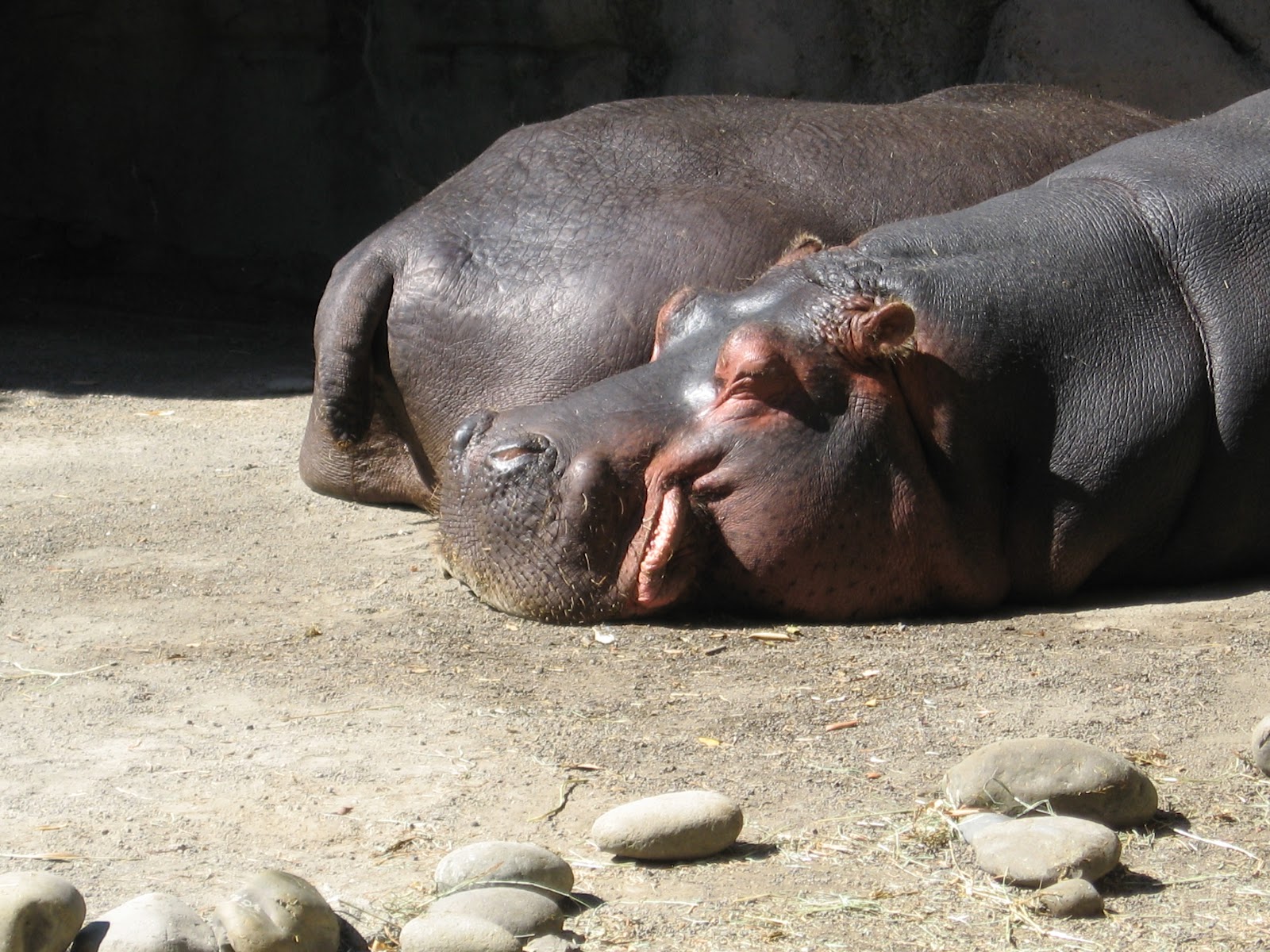
42 Day

I don't have a shot of 42 Day. Here's Hippopotamidae instead.


42 is the answer to life, the universe, and everything, according to a wildly popular series of books whose author says it was spur of the moment choice, that the number utterly lacks significance or meaning. 


Predictably, readers who are conspiracy theorists, inclined to religion or mysticism, or left-handed will act all sly and reply, "He's lying...He's a prophet (whether he knew it or not)...He's given us a game...42 really does mean something."


One of those afflictions is why I celebrate 42 Day, faithfully falling on the 11th day of February every year the earth keeps whirling round yon sun and the European calendar prevails. No Eastery shiftlessness, asserting its arbitrariness by refusing to be held to some solar or lunar anchor, 42 Day stays tucked safely in February before a Leap Day can throw it off. 42 is solid.


And yet shifting, un-pin-downable. A day for celebrating the joys of contradiction. For flouting devoutly. It commemorates all and nothing. However you may choose.

Maybe 7 people will read this post, and I wish you all a Happy 42 Day. May you enjoy it, and maybe again next year, but then forget it. To be too dedicated is against the spirit of the day, and procastination and lapsing are no prob. Although many people search "42" on the internet, this blog is snugly buried on results page 7 or 12 or 13 (or 42), and won't go viral. We need not fear that someone will take this seriously enough to get all religious about it. 


But just in case, I'd like to speak to zealous readers: I am neither devotee, disciple, nor prophet. 42 Day is just me messing around, and you should read nothing into it should you discover that Feb 11 was the very day I was born, or the Day We Fight Back Against Mass Surveillance. Don't invoke 42 Day to whip up fervor, to separate the world into the faithful and infidel, to ascribe martyrdom and sainthood. And for Darwin's sake, don't worship hippopotomi. Try not to lose this last paragraph. 

05 February, 2012

Menehune Action


A recent discussion at Olyblog got me to thinking about civic responsibility, the roles of government and the private sector, and common sense. It started when someone said that the city had told them it was fine for folks to pick up wood from trees being trimmed and felled in the aftermath of a big storm. Then they posted again, saying that no, the City had informed them that this is not the policy. I chimed in with the opinion that it probably boils down to liability, and that city government must officially say no, lest every joker who hurts themselves comes looking for a big payoff.

But what really interested me was the next comment, from a resident of Legion street, where some beautiful but doomed oaks were damaged. Under normal circumstances, she said, the city crew would cut, and the neighbors would then come through and salvage the wood. But this storm hit too many trees, and a contractor was hired that proceeded to block access to locals, while allowing someone from out Delphi Road way to come in and load up with prime firewood. The commenter said she called the City, which said that no, the contractor was not entitles to the wood.

Yet again, we see how transfer of a government function to the private sector can devolve to piracy. I don't know whether the load of firewood is destined for the market, or just heating some guy's house. But I do know that putting up barriers and preventing the neighbors from getting a share is wrong. I also see that when all is said and done, private entities will have lined their pockets with government funds, even if they are not ripping off firewood, for work that some of the neighbors would have done for free.

When I lived in Hawai'i, and worked for a chronically cash-strapped government, we sometimes relied on neighbors. Sometimes they formed a group, and signed an agreement, and became official curators of a place. But just as often, they pitched in, doing at least some of what needed doing. This kind of work came to be known as "menehune action," a reference to the menehune, ancient Hawaiians known for getting big jobs done with amazing speed and prowess.

In modern tourism-dependent Hawai'i, the menehune have been cutesified and co-opted, turned into grinning big-eyed munchkins and pressed into service selling everything from keychains to bottled water. (Disclosure: Menehune water was my favorite, but more because I knew it came from deep below Halawa Valley than for the logo.)
Long ago, Hawaiians themselves mythologized the menehune to some degree, noting their strangely short stature and ascribing to them incredible feats such as building fishponds and other massive public works in a single night.

I don't doubt the power of a determined group of hard workers unfettered by red tape, but there is at least a little of the phenomenon in which elites unaccustomed to manual labor exalt the physical ability of their laborers. The word menehune derives from Tahitian for commoners, the people who worked for the chiefs. Hawaiian lore, however, enriches this relationship with some complexities. For one, the menehune are often described as being the first people, or at least the ones who were in a place before the big Hawaiians and the bigger south sea chiefs. Also, no matter how high a chief, mistreating the menehune or ignoring their demands to work in privacy, led to them disappearing and not completing the job.

The secrecy of their work, often under cover of darkness, usually without tolerating non-menehune, survived in some of the menehune action I knew of. Where the state insisted on complicated and onerous work rules, volunteer labor sometimes evaporated like water on hot lava. Where the menehune saw something really needed to be done, and the officials were oblivious, it would sometimes mysteriously happen. Some of these officials knew exactly what was happening, their blindness was really just a long wink at their menehune partners.

Like the city guy who said take the wood. No City Official will say in print that people can come with saws and wedges and work in a right of way, but plenty of city workers know the deal, and wink or turn the other way as they drive past our own northwest menehune, cleaning the land and getting firewood.

The subject is rich, and I could go on, but it seems like now is a good time to go get some wood. The chiefs don't often work on Sundays, so I won't be bothered. I suspect that they'll be happy on Monday, judging from the number of other menehune I've seen this weekend.

building

26 January, 2012

Brittle-flex


The photo above is of ice on an apple branch. First, the branch caught snow and ice that stacked up on top, and froze there. And here, the next day, some of that ice has slipped and slung itself don below the branch. 


But ice is hard. When I whack it, or some giant branch comes crashing down, ice breaks like the glass it mimics. Crystal brittle fragility. Or, if it gets thick enough, hard and unyielding, unchanging if nobody turns up the heat.


Or speeds up the clock. Unimaginative reckoning of time traps our perception, makes us think things are solid when they are fluid, immutable when they are changing before our eyes. I've always had a weakness for the revelatory power of time-laps photography: a seed spreads her dicot to reveal a luscious tendril that becomes a plant. But with a little patience, the same can be seen without the fancy equipment. Glaciers flow, the hard little ice on an apple twig sags like a rope.


Or, the thousands of frozen shards cracked from a falling branch cascade like water, like in this shot (yeah, I know, it doesn't really show up). Hard pointillist frags conspire to produce a fuzzy flow. Then the virtual shutter of my camera freezes it into a cloud that will never move on. Of course, not even that is true: the file will degrade, pixels will disappear and move every time it is copied or re-saved. And by the way, your screen shifts everything a little to the right.

Stolidity becomes fluidity. Slow is not unchanging. Pieces become wholes and break up again. This post may be edited.


23 January, 2012

Weather Feral


Lights out, everybody home.

After months of lulling us into a false sense of security (or, for the neurotic, misplaced worry over lack of precipitation), the weather unloaded on Olympia this past week. It began with rumors of snow, and the masses watched TV or teemed to websites with little snowflake icons. Weather geeks spent more time looking at radar and satellite views, and tuned into Cliff Mass at every opportunity, because his fans like to hear him talk almost as much as he does. Me? I'm one of those outliers who just reads the Forecast Discussion from the Seattle National Weather Service office.

They called for 1-3" on Monday, and again on Tuesday, and Olympia came in at the top of that range, although it was melting from the bottom the whole time, and we didn't end up with a full 6 inches Tuesday night. As the next system came round, the NWS discussion began with a quote from Airplane, "I sure picked the wrong week to quit drinking." Various models kept predicting different amounts of snow, and differed on when it would turn to rain.

In the wee Wednesday hours, more focused on keeping the fire going than sleeping, I peeked outside and began to lose interest in the predictions and models. At first, it was a desire to replace speculation with data. The snowflakes were flat and shiny, frozen hard, and the dripping from the roofline had stopped, so clearly, it was getting colder. As day dawned, snow continued, piling up rapidly.

The last time I paid any attention, meteorologists were saying that the Olympia area might top out at 6 inches…right about the time we hit 6 inches. By mid-day, there was little sign of warming, or even of the predicted cease-snow. I'm not one of those people who scoffs at forecasters for sport (a dull, uninventive sport, indeed), but I do think that sometimes they need to ignore the model and take a walk outside.

Snowflakes got smaller, and eventually turned to pellets of ice. The warming trend never kicked in enough to give us rain, save a brief partial outbreak 24 hours late. Precipitation came in one frozen form or another for a while, and atop the snow grew a crust of ice. I decided not to shovel the driveway, reasoning that it would only result in an icy surface.

Besides, why drive? Olympia is not known for being able to handle major winter storms, and I had firewood and food. My winter fertilization had escalated beyond ignoring the weather pros to withdrawing from car culture.

And the process would continue. I got more attuned to small cues in the weather over the course of the storm. Wind direction and intensity read in the trees and chimney output, the ominous swarming of gulls seeking refuge from the bay, the sound and feel of the snow as I stalked through it.

At the same time, withdrawal from civilization became more pronounced. After an all-too-brief respite, I could hear traffic building on I-5 again, but I had no desire to join in. As consumption junkies and ailment addicts succumbed to "cabin fever" (which does actually exist, but takes weeks to incubate and only ends with a lovely spring or ugly cannibalism), people shoveled drives and ventured out to join the madding crowds buying potato chips and crappy beer as if survival depended on it.

Instead, my time went to winterizing the homestead, by which I mean playing in the snow with the kids, sculpting a giant bust of a baboon, and building a mini-luge track over the driveway. Because I'd become more attuned to the weather as it is--not how a computer say it may become--I knew exactly when to make the ape and sled run so that they'd become coated in ice.

At some point, the power went out. So I went out, and listened as firs cracked and alders popped. Ever 10 minutes or so, there was a big branch falling, the initial break followed by the glassy cascade of ice freed from twigs and falling to earth; this symphony may elude my aging ears next time around, so I gloried in its irregular crescendoes. I helped the apples shed some ice, and learned that blueberry twigs just break if you try to help them do the same.

Eventually, I headed in, shed a few wet layers, and tended fire. I barely run our electric heat if I can help it, but at this point the fire became more than a hobby. It kept the house warm, and for a couple of days it is how we cooked. I McGyvered a little grill, making some pie-like things and sausages, warmed a pot of soup and foil packet of potatoes, stewed a mess o beans, and even made espresso (NOTE: the plastic handle of those little Italian espresso makers will look OK, but then melt to your hand, the sneaky bastards.)

The house shrank into the den, four hominids by the window or the fire, depending on whether they valued light or heat more at the moment. Furniture and the TV disappeared under wet vestments, and the floor became a layer of bark fallen from firewood. Daylight ruled, stretched only a bit by candleflame. Trips beyond the dripline to get more wood, to forage for fun, but otherwise, a family sticking close to the hearth, not so different than the thousands of generations before our kind got electrified and uppity.

Feral is not all fun. Splitting and hauling wood, knocking ice off the food trees. I guess making a baboon sculpture and sled run is not exactly necessary, but it takes effort. My kids said, "Dad, you're steaming," and it is true that I did create my own tiny weather system. The day after the ice-fall, the Olympia climate replicated this on a larger scale, fog and wood-smoke enveloped everything.

Yet, the I-5 noise grew. People drove by. Eventually, a snowplow made it even to our side street. Civilization once again reared its ugly head (for those who could afford it), and there were rumors of free frozen food from the grocery store stricken with powerlessness, inciting a rush. Also, those stricken with cabin faux-fever rushing onto the roads.

Eventually, this included members of my own family, and somehow I ended up pressed to shovel the driveway (taking out the luge run, which was disintegrating but still heavy as hell), working up enough heat to reduce small thunderheads of steam over my balding pate. Then, because of the  car-driving acumen supposedly bestowed on me by my manly parts, I drove the family out into the slushy grid of asphalt that separates us from snow-baboons and other allegedly inferior apes.

And it was not pretty. Guys with overly active dangly bits driving like madmen. Everyone converging on the stores with electricity to buy…whatever. Cabin feverishness gone amok. I found myself in a grocery store (turns out that my foil stash was unequal to the task of fireplace cookery--so I guess there was some purpose), and was infuriated to learn that with a quarter million people lacking power, Safeway chose to use its precious current to play Phil Collins "music." Inforgivable.

I was glad to get back home, and play feral again. More fire. More observing the weather (quickening wind from the south with some thin spots in the cloud cover, a good sign for thawing, and mercifully short of the damaging high winds that the weather geek rumor web was predicting), which somehow stuck within a degree or three of freezing for days and nights on end, yet provided an interesting array of precipitations, fogs, and overcasts.

The adventure is over now, except for the telling. Work was abuzz this morning. While the novelty will fade, the legion is yet to be born. A few years of typically minor snowfall, and January 2012 will loom larger. That gnarly tree? 2012. The abundance of firewood? 2012. The half-assedness of future winter weather? Bow down before 2012, when the wild demigods of winter skewered the weak with mighty icicles, when the trees cracked under the unflinching ruthlessness of La Nina. Yes, in time this half-hairy ape will spin these few days into mythology, and the un-sullied minds of children and superstitious souls of the old will nod in agreement and supplication before the spirits of weather unfettered.

Happily feral

18 January, 2012

A Foot o Frozen Stuff


After a couple of days of a couple or three inches, it cut loose today. I was tending fire to keep us warm, sleeping on the couch and rousing every once in a while to mate new wood with old glowth embers. On the 2 o'clock round, I saw snow falling. At four and a third hours, the back porch light revealed big sparkling flakes mounting quickly. Dawn seemed to come late, so dense was the snow, inching up past boot height. 


By then, the school district had admitted the inevitable. My job had pre-empted the snowfall, telling us to work from home, but I'd already decided to take the day off. Write technical reports or play? No choice at all.


And play I did, but not nearly so much as a certain first grade girl who: ate her weight in snow, buttressed a snow-fort, staked claims to untrodden quarters of the yard, explored the pick-up bed full of flakes, and made snow angels (though not in the same quantity as face-prints, mind you, and not quite to the same effect as the motion-deprived snow-crucifixes she also embedded in the deepening white stuff). Among other things. At one point, she menacingly wielded a plastic lettuce knife at her sister; I'd foolishly given it to them to sculpt snow with, feebly unable to predict her using a giant green plastic knife as a, uh, giant knife. 


Baboon, or Australopithecene? I care not, so long as he guards my abode with ferocity belying his lazy grin.
Me? I'm more of a hands-on worker of snow. It took me about an hour of surprisingly aerobic work to make this. Nestled in the winter-shadow of the south hedge, it's some sort of great ape. Cracker has this song, "Guarded by Monkeys," which rocks lyrical and guitarical mad genuisness, but monkeys are only good in troupes, being fairly insubstantial, even frail, one-on-one. So I opted with a single big-ass ape (ass not pictured). For scale, the pupils of it's eyes are bottle caps. Rumors have already made it back to me that a case of Winterhook is buried in this creature's medulla oblongata, but it ain't so. This will have to do for home defense as well as a stand-in until I can realize my life-ling dream of hanging out in snowy hot springs with Japanese monkeys.

Eventually, the snow petered out, leaving a foot or son on the ground. Miserly little ice pellets finished off the day, but too few to bring down the power grid (I hope). Just in case, the fire is still burning. 

Yes, I'm gonna say it: Grillin and Chillin.

16 January, 2012

Attack of the Suit Zombies

The Northwest is not immune to the Zombie fascination sweeping the nation. Seattle, especially, had had it's share of zombie events, and the fact that hipsters there proclaim that the craze is Over can be taken as evidence that they were at the leading edge of the phenomenon to begin with.

But to my eye, it ain't over. Like most things that replicate, it has evolved. Zombi americanus, your run-of-the-mill species, is widespread to the point that supernaturalists have all checked it off on their lists and are bored with them. Fortunately, diversification has reared its many heads, and new species are emerging. 


One of these has popped up in Olympia recently. As soon as the legislative session began, swarms of Z. politicensis were observed on the capitol campus, and milling about at coffee shops and bars. They are easily distinguished from local warm-bloods and zombies by the fact that they all wear suits, which is extremely rare here. Only the Alpha males appear very comfortable in these garments--the young staffers and interns look outright comical, dressed up in big-boy clothes--and are the only ones to fear.


The rest of the pack mostly occupy themselves clumsily rushing to hearings they cannot comprehend or, as I said, milling about, trying to look important but with such vacant eyes it is impossible to take them seriously. Loitering behavior is interpreted by some ethologists as evidence of decreased brain function, and I am not going to argue that, but there is more to it. Look at them; they are almost all male. Nobody has yet explained the gender imbalance, but we've all noticed it. Some say it is because politics, like its sporting analogs mixed martial arts and golf, is interesting only to those afflicted with testosterone poisoning.  

My theory is that all this milling about is the suit zombies' way of attempting to find a mate. Hang out long enough at the drinking establishment, and maybe a female will become enamored enough with that Armani suit to let it be removed. She is likely to be disappointed, the dangly bits being among the first to drop off after zombification. The slow brain that is a hallmark of the genus takes a while to come to terms with this, and attempted mating behavior drags on for years in some cases.

Some observers suggest that Z. politicensis has already separated into two species, but I'm reserving judgment until I see a real difference, especially since most of the splitters rely on mental inclination, which is so very limited in the genus. The Equus variety is allegedly distinct based on having a highly developed social conscience compared to Elephas, but this quality remains latent, rarely expressed in a way that would lead to conflict, much less actual domination. This may be a result of the testicular absence, but I make it a habit not to check. If anything, the Elephas tendency to want to chop off pieces of the body politic ("Teachers....unnnhhhh....Unions!" they moan, waving cleavers) seems like better evidence of differentiation.


Meanwhile, the living among us tolerate this seasonal visitation. Local businesses sell them coffee and alcohol to fuel their milling about. Soon enough, they will leave, long enough before summer that the rains will wash away their residue so we can feel clean again. It is frustrating to have the rest of the state, whenever they complain about some policy, refer to it is "Olympia's," rather than pointing at the suit zombies who live elsewhere and congregate here for a brief while, but we have thick skin and all our parts. We carry on after the carrion moves on. 

04 January, 2012

More from the Abyss: Wave Them Big Hairy Arms

Kiwa puravida male holotype: (A) Dorsal view. (B) Ventral view (A and B Scale bar = 10 mm; Credit: Shane Ahyong, NIWA Wellington). (C) in situ next to Bathymodiolin mussels (D) Scanning Electron Micrograph of a detail of K. puravida's 3rd maxilliped and the comb-row setae which it uses to harvest its bacteria (scale bar = 150 µm credit; Shana Goffredi, Occidental College]. (E) Setae covered by bacteria from 3rd pereopod (see Figure 4E for scale). (F) Dense aggregation in situ. (G) Shipboard photo of K. puravida using its 3rd maxilliped to harvest its epibiotic bacteria. (H) Comb-row setae with bacteria filaments stuck among combs (indicated by arrow).
doi:10.1371/journal.pone.0026243.g001
Oh yeah, that's a Yeti Crab. My new favorite species. This one is from the waters off Costa Rica, where you least expect a Yeti, which only makes it better.

You won't run into one, lazing on the beach or even scuba diving. Unless you know where the deep-sea methane vents are, and have the right submersible, you'll never see a Yeti Crab except on screen. It is another one of those creatures who live where the sun don't shine, a denizen of the abyssal deep, a realm I've waxed un-poetic about before.

A couple of cool things about Yeti Crabs: they occupy hydrothermal vents as part of a fauna that differ from those worms we've come to expect, and they are farmers. The Yeti's genus was only discovered in 2005, and in the past year scientists found an incredibly dense population of them near Antarctica (check out this article), at vents where the usual swarms of shrimp and vestimentiferan worms were absent, but new species of barnacles and snails were discovered. 

Reading this, my initial thought was that hydrothermal vents, being rare and widely dispersed, might each be a world unto itself, populated with a unique fauna found nowhere else, isolated. But in this article reviewing the past decade of research, that turns out to be only partly true. Yes, scientists now believe that there are entirely new biogeographic regions centered on vents, but they also have begun to collect evidence for dispersal between vents, deep fracture zones and currents that allow larvae from one vent to find and colonize another. So there are species of Yeti Crabs in the Antarctic and Indian Oceans, as well as those off of Costa Rica. Between these far-flung worlds, benthonauts go where no man has gone before.

In the Antarctic, where they were so thick that scientists said they looked like piles of skulls on the ocean floor, and elsewhere, the Yeti Crabs prove to be not abominable, but peaceful. Most crabs would eat you as soon as look at you (assuming you're already dead and ripe enough to scavenge), and have no hesitation to use their chelipeds to capture and dismember prey. But not the Yeti. No, this genus grows hair on its pincers, forming a field in which bacteria  thrive. It feeds the bacteria by waving its hairy arms (the first species documented was dubbed Kiwa hirsutus) in the flow of hydrothermal vents. Then it uses a specially adapted appendage to scrape off the bacteria, its only known food. 

The earth farts, the crab waves its claws in the methane, and everyone is happy. Sounds gross, but how different is it than humans using cowshit and urea to grow food? It's certainly more efficient, dining way down on the food chain, and it has the benefit of digesting methane and hydrogen sulfide before they can contribute to our greenhouse gas problem. My main hope is that it makes the crab taste like farts, so we don't start harvesting them for our own food.


The information above came from this article:

"Dancing for Food in the Deep Sea: Bacterial Farming by a New Species of Yeti Crab"

The article was written by:
Andrew R. Thurber1*, William J. Jones2, Kareen Schnabel3

You can fund the article at: